
For nuclear power plants facing aging dams and rising seas, is a captured regulator the last finger in the dike?
At just before 3 local time on the afternoon of March 11, 2011, the operators of the Fukushima Daiichi nuclear power plant already had a problem. An earthquake measuring 9.1 on the moment magnitude scale—the largest to hit Japan since at least 1900—had damaged key systems at the facility, an emergency greatly compounded by the region-wide power outage caused by the massive temblor.
A station blackout (or SBO, as termed by an industry intensely fond of acronyms) at a nuclear power plant is, by design, cause for concern. Light-water reactors—the category that includes the units at Fukushima Daiichi and every one of the 98 still-operating reactors in the United States—function inside a kind of paradox: in order to safely generate a dependable output of electricity, they require a steady input of electricity. A plant’s meters and monitors need electricity; so, too, do many of the motors that raise and lower large, neutron-absorbing boron control rods used to regulate the atomic activity inside a reactor core. And, perhaps most critically, the systems that circulate cool water (crucial for expelling some of the intense heat generated by the fission reaction) through the nuclear reactors, as well as through pools where decades of used but still highly radioactive “spent” fuel is stored, depend on electric-powered pumps.
The SBO at Daiichi triggered a back-up: several diesel-powered emergency generators that would provide enough electricity to run the cooling systems until power could be restored (as long as there were fuel for the generators). But less than an hour later, a wave higher than a four-story building—the tsunami set off by the quake—swept over the seaside site and flooded the nuclear facility, knocking out most of the generators, which had been situated in the basement by General Electric, the plant’s designer.
Without electricity (what is called a “LOOP,” for “loss of onsite power”), the pumps stopped circulating the water, and without that circulation, the temperature inside the reactor cores quickly exceeded boiling. Within three hours, the tops of the zirconium-clad uranium fuel rods were exposed to air, starting a series of chemical reactions hot enough to free hydrogen atoms from their watery bonds. Despite the valiant efforts of hundreds of plant workers, intense heat and pressure built up inside the containment structures. Three reactor cores suffered complete meltdowns, and over the next few days, at least three powerful hydrogen explosions leveled containment buildings and shot plumes of radioactive gas and particulates high into the air, spreading contamination over land and sea. The rest is an ominous and still-evolving history Japan continues to battle nearly eight years on.
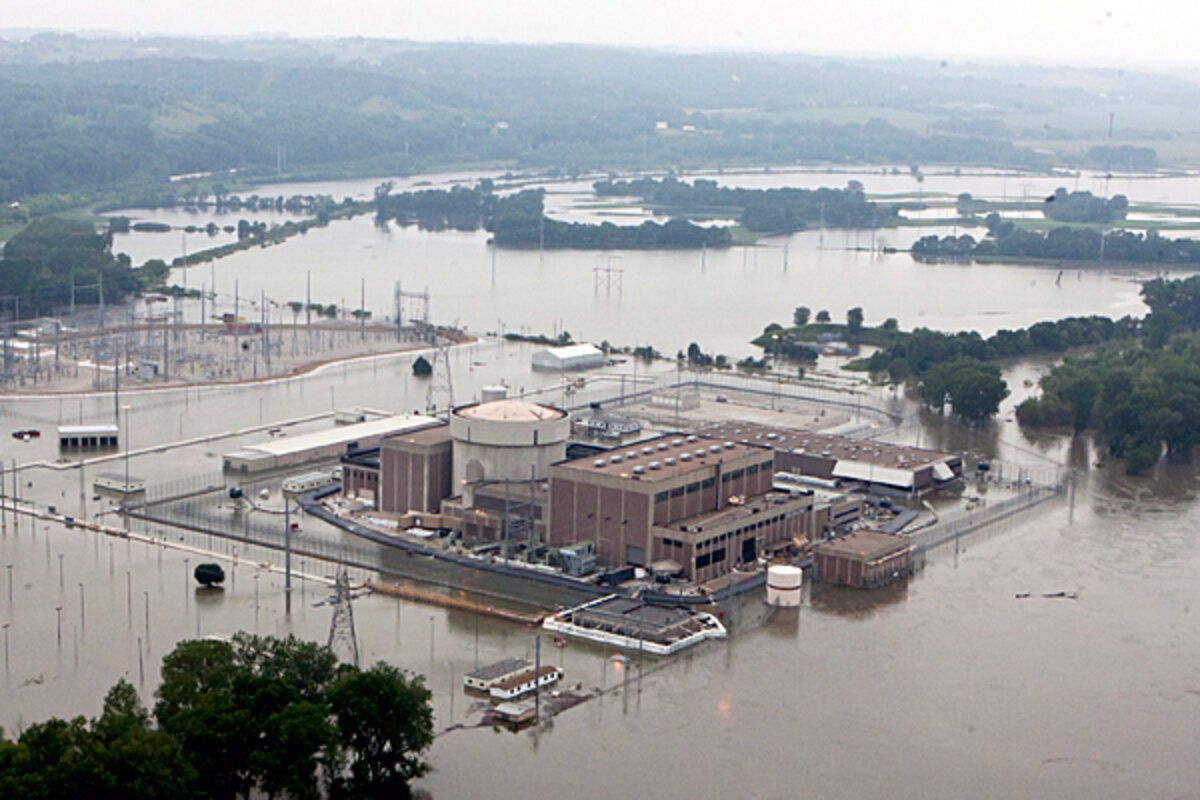
Of the currently operating civilian nuclear reactors in the US, scattered across 30 states, about two-thirds sit on the banks of rivers, lakes, or reservoirs. Add in plants on ocean shorelines, and the number of reactors adjacent to large, sometimes unruly bodies of water climbs above 80. But according to a whistleblower at the United States Nuclear Regulatory Commission (NRC)—backed up by information provided by regulators and watchdogs—more than a third of those reactors are either on sites that would no longer meet NRC flood risk guidelines for new reactor construction, or are vulnerable to flooding caused by dam breaks, swelling rivers, rising sea levels, or increasingly severe weather events.
It is that kind of foresight that was once considered the stock and trade of government regulators: examine the science, identify potential problems, and use the power and authority of the government to compel remedies and improve public safety. But in the wake of another Atlantic Hurricane season—where several nuclear plants had to reduce output or (in one case) shut down completely because of the threat of “catastrophic” flooding—it is sobering to note that, while Fukushima has been analyzed and debated by nuclear operators and regulators, the lessons of Japan’s disaster have not sufficiently been taken to heart, nor put into practice. Be it because of debates over cost-benefit assessment or blatant examples of corporate sway, what seems on one level the minutiae of regulatory process are also part and parcel of what growing numbers of Americans see as ineffectual governance by a corrupt—and corrupting—swamp.
* * *
Soon after the start of the Fukushima crisis, the NRC established a panel, known as the Near-Term Task Force (NTTF), to review the disaster in Japan and recommend regulatory changes and plant upgrades to enhance safety at US nuclear facilities. Their findings—often shorthanded as the NTTF report, or the NTTF recommendations—were comprehensive (though not, in some critics’ eyes, comprehensive enough), touching on concerns from seismic reevaluations to emergency response, with lots of technical considerations in between—including dozens of pages on flooding and the LOOP accidents it can cause.
The report came out in July, and by October, the NRC had identified a small selection of the recommendations it considered top tier and requiring implementation “without delay,” as the Commission put it at the time. Central to many of those proposals were the hazards posed by flooding.
But it’s not as if the dangers of flooding were unknown to nuclear regulators (or the industry) before the cascading disaster at Fukushima Daiichi. In fact, at Duke Energy’s Oconee Nuclear Station (ONS) in the northwesternmost corner of South Carolina, regulators and plant owners had been debating the facility’s flood risk and flood preparedness for decades.
“The concern has been around in its current iteration since 2005 or -6, but it has been raised many times in the past,” said Larry Criscione, a reliability and risk analyst at the NRC since 2009. “It was raised in the ‘80s, it was raised in the ‘90s—I think it was raised in the ‘70s as part of [Oconee’s] initial licensing.”
Construction on ONS began in 1967, and its three reactors were all online before the NRC opened its doors in 1975. But documents provided by Criscione show that by 1977, the Commission had identified flood concerns at several plants licensed before the formation of the regulatory body. Oconee is one of them, and an alphabet soup of studies and recommendations—most notably the IPEEE (the Individual Plant Examination of External Events) for Severe Accident Vulnerabilities in 1991—requested its operators assess and plan for what the industry calls “beyond design basis events” (BDBEs), incidents more extreme or powerful than accounted for in a plant’s original design (of which the earthquake and tsunami in Japan later became prime examples).
Oconee is located on the shore of Lake Keowee, an artificial reservoir created by the damming of the Keowee River, and part of a system of dams built in the 1960s and ‘70s that also includes the Jocassee Dam, just 11 miles upstream from Keowee and ONS. What would happen should the Jocassee Dam fail—and just how likely that is to happen—is central to the debate over the flood preparedness at the nuclear plant. And it is central to the life of Larry Criscione.
* * *
That a dam failure would be a BDBE of dire proportions for ONS once seemed beyond debate. “As I understand it, the NRC’s assessment of the consequences of a flooding event at Oconee would be even greater than at Fukushima,” said Tim Judson, executive director of the Nuclear Information and Resource Service, a nuclear industry watchdog. Because Fukushima Daiichi was located on the coast, and prevailing winds blew an estimated 80 percent of the fallout out to sea in the first weeks of the disaster, much of central and southern Japan was spared the high levels of radioactive contamination seen in the prefectures immediately surrounding the failed nuclear plant. Still, more than 150,000 people had to be relocated from a 12-mile radius around Daiichi.
If the Jocassee Dam were to fail, the resulting flood would inundate Oconee with 12 to 17 feet of water in about five hours, according to Duke Energy’s own assessment, filed in the 1990s in response to the IPEEE, and referenced by Criscione in his report to the NRC. A station blackout would follow, and because Oconee’s backup plan involves hydroelectric power generated by the dams on Lake Keowee, and a break of the Jocassee Dam is projected to cause Keowee Dam failure, ONS would suffer a complete LOOP. With no electricity to run the cooling systems, all three reactor cores would melt down in eight to ten hours, and (and again, this is from Duke Energy’s report) the containment buildings would fail within three days. Radioactive contamination would head down river with the flood waters, and an airborne plume would engulf the university town of Clemson, 10 miles to the southeast, and then lay a blanket of fallout 300 miles eastward to the sea.
But at the time—a pre-Fukushima time—Duke argued that this nightmare scenario was so improbable as to not merit the kind of elaborate and expensive safety upgrades required to prevent it.
As Criscione explains it, the NRC evaluates Beyond Design Basis Events by two scales: one is the relative chance that a given event will occur; the other is the resulting danger once it does. For instance, the risk analyst told me, if a meteorite were to crash into a nuclear power facility, the results could be catastrophic, but the chances of a meteor strike are calculated to be so vanishingly small that plant operators are not required to guard against it.
“The term they use in nuclear is ‘credible,’” said Criscione, “you have to protect against credible threats.”
But try to find a place in the regulations where “credible” is defined. “You’ll never be able to,” Criscione told me. Instead, there is an unspoken range: In “the day-to-day business of the NRC, when things are less than one in a million [in any given year], you can make an argument they’re not credible; when they’re more than one in 10,000, they’re certainly credible.”
“When they’re in between,” Criscione continued, “that’s where the debates start to happen.”
“In a case like Fukushima, you see where that falls apart,” cautioned NIRS’s Judson. “The NRC would have very likely determined what happened at Fukushima was outside credibility range—less than one in a million—so therefore they wouldn’t have done anything about it.”
“Despite that,” Judson observed, “it happened, and the consequences are so great it outweighs the entire alleged benefit of the Japanese nuclear power program.” (After the quake and tsunami, one NRC commissioner reevaluated the risks at Fukushima, and determined they had been one in 1,000 in any given year. Or, to put it another way, TEPCO, the operators of Fukushima Daiichi, were lucky for 40 years, until the year they weren’t.)
In the case of Oconee, with the consequences of a Jocassee Dam failure originally agreed to be grim, Duke Energy debated the probability, placing it outside the “credible” one-in-10,000 chance. But by 2010, as Criscione’s NRC-sponsored analysis showed, it was Duke’s assessment that lacked credibility. Taking into account a broader data-set (paleological as opposed to solely the far-more-limited historical record) and the reassessment of critical infrastructure conducted by various US agencies (notably FERC, the Federal Energy Regulatory Commission) in the years after the September 11, 2001 attacks, regulators placed the odds of dam break causing a BDBE at ONS at one in 3,600—about the chance of drawing a straight in poker, as Criscione put it—or if projected over the remaining time on the plant’s license, there’s better than a one-in-200 chance of such an accident before ONS permanently shuts down. That’s not a certainty in any given year, said Criscione, but it is well above the NRC’s unspoken credibility threshold of one in 10,000.
And the NRC and Duke Energy were in the process of negotiating what should be done to address this now-understood-to-be-credible threat when, as Criscione, Judson, and other nuclear watchdogs see it, Fukushima changed everything.
* * *
When the NRC moved to adopt some of the NTTF recommendations (and only a subset of a subset of the report was ever considered by the Commission as formal rules), oversight of implementation was given to the JLD—the Japan Lessons-Learned Directorate (later expanded and renamed, replacing “Directorate” with “Division”)—a group that was supposed to hive off Fukushima-related concerns to allow “the rest of the NRC keep its focus on other important issues faced by the agency,” as JLD’s own web page put it. But almost inherent in that language is a segregation that puts anything dubbed a post-Fukushima upgrade into a new class of oversight—one that, to those on the inside like Criscione, did not meet the urgency of the risks at hand, nor the fanfare of the Commission’s own pronouncements.
As Criscione told me, Duke Energy “came to the NRC” soon after the start of the Fukushima crisis and argued that if there were going to be new rules derived from that disaster, Duke didn’t want to invest in upgrades at Oconee only to find they fell short of post-Fukushima recommendations.
On its face, said Criscione, “that was a reasonable request.” However, what it did in practice was move the Oconee case from staff who had been trying to address it for five years, who had a knowledge of the issues and the history of the debate, to personnel who were, according to Criscione, not only starting from scratch, but were led by “an industry apologist.”
“You’ve got to understand how the JLD operated,” Criscione explained, “the NRC really likes to see the industry fix its own problems.” It’s the nuclear industry that builds the power plants—the Commission just licenses them. The industry designs the plants, and the NRC reviews those designs. “We don’t tell them how to fix problems,” said Criscione, “we review their fixes to their problems to see if they’re accurate.”
When it came to post-Fukushima fixes, Criscione said, “we didn’t approach it with the attitude of ‘We’re the government, we’re going to decide what changes you need to make your plants safe.’ We approached it with the attitude of ‘You’re the plant owners, you prove to us that your plants are safe.’”
The lobbying arm of the industry, the Nuclear Energy Institute (NEI), came to the NRC with standards it had written to address post-Fukushima concerns like flooding and loss of onsite power events. “And,” as Criscione described it, given the general framework of how the NRC operates, “there’s nothing wrong with that.”
“The problem is that the person who was in charge at the JLD,” the one responsible for evaluating standards, the one who had the power to overrule the rest of the staff, as Criscione told me, “was actively seeking a job as a vice president at NEI.”
Criscione was not exaggerating. The NRC executive in question, Jack R. Davis, bragged on his LinkedIn page at the time (saved for posterity at the Environmental Archive) that his work at what was supposed to be the public’s nuclear regulator had “saved the commercial energy generation industry $1.6 billion,” and “achieved 80 percent reduction in the number of customers needing to complete mandated federal safety improvements.” Those Davis saw as his “customers” were in the energy industry, not the American people who were then paying his salary.
Davis didn’t get his job at NEI, but by 2016, he had landed an executive post at Entergy, one of the nation’s largest owners of nuclear power plants, and the company with the ignominious distinction of operating what the NRC has determined are the country’s three worst-rated nuclear facilities in terms of safety.
With respect to Oconee, the transfer of flood issues to the JLD resulted in a projected 17-foot flood being reevaluated down to a five-foot threat, which is coincidentally the height of a flood barrier built outside the plant in the 1980s. It was a coincidence that did not sit well with Criscione, who was charged with evaluating flood safety. In 2012, he forwarded his concerns to the chair of the NRC and to select members of Congress—information that eventually made its way to the environmental group Greenpeace and into a story in the Huffington Post.
The coverage caught the attention of the NRC’s inspector general, who, rather than act on Criscione’s allegations of lax oversite, opened an investigation into his sharing of official documents.
Criscione said he doesn’t believe he is currently under investigation by the Office of the Inspector General (NRC OIG), but he has also not seen a final report on his case, which he’s told is still under review.
* * *
Better than one in every four nuclear plants is at risk of a flooding event, according to Criscione, an event that could lead to a Fukushima-style disaster. With more than 20 reactors along the eastern seaboard vulnerable to hurricanes, flying debris, heavy rains, and massive storm surges, and dozens of others inland near swelling rivers and aging dams—all with a half-century of spent fuel rods stored nearby—the implications for the hundreds of millions of US residents that live near these reactors is at least unsettling. With climate change increasing the frequency and severity of flood-provoking events, the status quo should be unacceptable.
The NRC will tell you it has it all in hand. “Every US reactor site has completed its flooding hazard reanalysis,” Scott Burnell, the NRC’s public affairs officer, told me in an email.
Central to the post-Fukushima seismic- and flood-hazard analysis was something called a “walkdown.” The NRC “asked” US nuclear power plants “to perform a detailed inspection” of “their currently installed seismic and flooding protection features [and] ensure the features met current requirements.” Plant operators were also told to “identify, correct, and report any degraded conditions.” According to the NRC’s website, this phase was completed across the entire US nuclear fleet by November 2012.
But in March 2013, at Arkansas Nuclear One (ANO), a two-reactor facility 80 miles northeast of Little Rock, the accidental dropping of a 550-ton generator component in the truck bay caused enough shaking to rupture a water pipe. Water flooded the plant’s electrical switchgear, interrupting all power to one reactor, and partially disabling the second. Emergency diesel generators kicked in to ward off a bigger disaster, but the accident, which killed one plant worker and injured eight others, revealed that dozens of penetration points had missing or improperly installed seals.
Dave Lochbaum, the director of the Nuclear Safety Project at the Union of Concerned Scientists, contacted the NRC to express his grave concern about the quality of their plant walkdown program. According to Lochbaum, the NRC assured him that ANO was “the only plant in the country with an ineffective flood protection walkdown.”
But in January 2014, rains hit Florida’s Atlantic coast (“Not a monsoon or a once-in-a-blue-moon rain, but a thunderstorm,” Lochbaum said). At the St. Lucie Nuclear Power Plant, 70 miles north of Palm Beach, faulty storm drains caused a 55,000-gallon flood in an auxiliary building. Water penetrated improperly sealed electrical pass-throughs, disabling pumps needed for cooling one of the facility’s two reactors. “The penetration was about five feet off the floor—at eye level during a walkdown, had anybody only been looking,” wrote Lochbaum in an email.
“So, AFTER owners conducted NRC-mandated flood protection walkdowns, and AFTER the owners formally notified the NRC that flood-protection measures were adequate, those assurances were proven false by actual flooding,” Lochbaum wrote. “Apparently,” Lochbaum’s email surmised, “the walkdowns had been more for exercise than for verification of safety.”
The NRC’s industry-friendly approach also troubles Judson. The NIRS director detailed the case of New York’s Nine Mile Point—on the banks of Lake Ontario, 40 miles north of Syracuse—a site that is home to three nuclear reactors, including the oldest still-operating commercial reactor in the US (Nine Mile Point 1, which was commissioned in December 1969). Just last year, a swelling Lake Ontario came within a foot of triggering an “unusual event” (the NRC’s first level of emergency notification). Exelon, the facility’s owner, sprung to action—and applied to the NRC to change the standards so it wouldn’t have to declare an emergency unless the site was so flooded that workers couldn’t access the site by car.
That change was quickly approved by the NRC—an alarming lack of oversite, according to Judson, given the potential for widespread environmental disaster. “Lake Ontario is the drinking-water source for 9 million people,” he said.
* * *
In addition to the examples above, there are a number of sites that worry the experts—among them: Quad Cities Nuclear Generating Station, in Northern Illinois, on the banks of the Mississippi River, Dresden Generating Station, 60 miles southwest of Chicago, at the head of the Illinois River, and Pilgrim Nuclear Power Station in Plymouth, Massachusetts, on the shores of Cape Cod Bay, less than 40 miles south of Boston. What these sites have in common, beyond their remarkable age (online 46 years, the reactors at Quad Cities are the youngest of this group), is their acute vulnerability to the perils of a warming planet.
Riverine flooding, more frequent and more severe this century and unrelated to any dam failures, leave Quad Cities and Dresden in a precarious place almost annually. (Precipitation in this region is expected to increase 37 percent by 2070, according to a NOAA—National Oceanic and Atmospheric Administration—study.) For Pilgrim, a facility that has seen numerous weather-related shutdowns in recent years, a category 5 hurricane could elevate sea level by 22.4 feet, according to plant-owner Entergy—giving the hundreds of tons of irradiated fuel stored outside in concrete and steel “dry casks” about two-and-a-half feet of clearance. But when conservative estimates project a general sea-level rise in the Bay of three feet by 2065, and possibly six feet by the end of the century, the site has less than no margin for error.
Even a partial submersion of a dry cask could block vents, interrupting its convection-dependent cooling mechanism, according to Kevin Kamps, radioactive waste specialist at clean-energy advocacy group Beyond Nuclear. Depending how long this went on, the integrity of the fuel and the steel liner could be affected.
But of course, as perilous as it is for the casks, lined up on a concrete pad less than a football field’s length from the shore, the plight of Pilgrim’s spent fuel pool, filled to over three times its design capacity, worries watchdogs more. Like with all the other reactors, a prolonged interruption of power means a “loss of cooling accident” (LOCA—yes, this has an acronym, too), with limited time before the tightly packed fuel assemblies boiled off their pool and caught fire, potentially covering northern New England with many times the amount of radioactive cesium-137 released by the Chernobyl disaster.
Pilgrim is scheduled to go offline for good this spring, but the spent fuel is expected to remain on site for decades. This was troubling enough to Senator Edward Markey that he contacted the NRC last April asking how the Commission will factor in global warming. “It is imperative,” the Massachusetts Democrat wrote, “that these plants and the NRC regulations fully consider the impacts of climate change on dangerous nuclear waste.”
* * *
As far as the NRC is concerned, it has. “Every US reactor site performs relevant analyses based on location-specific parameters,” wrote the NRC’s Burnell in response to my question about the regulator’s assessment of climate-based changes in risk. In practice that means that predictions for things like precipitation and sea level rise are factored back into the NRC’s models for assessing credible risk. Well. . . sort of.
“My sense is there’s really no uniform methodology,” said Criscione. As to NRC requirements for what needs to be in an assessment, say, for flood risk, Criscione told me, “it’s more of a style guide.”
This wasn’t always the case. “The NRC used to have more deterministic standards,” said Judson, “and there’s a debate to be had about whether that regulatory process was better at safety outcomes than the one they’ve adopted since.” Before about 20 years ago, the process, according to Judson, was more open to the public. “There was a time when the public was able to raise safety allegations with the NRC,” he said, noting instances at several reactors in New England. “The NRC was forced by public acrimony, and in some cases by Congress to step in and regulate.”
Today, under what is called “probabilistic risk assessment,” nuclear plants are expected to meet performance metrics, and that is then weighted with “risk-informed regulation”—the system that evaluates whether a threat is credible enough to merit safety upgrades.
The shift wasn’t just academic. Under deterministic assessment, reactors in Connecticut, Illinois, Maine, and Oregon were taken permanently offline or forced to make significant improvements. But that era, Judson told me, “is largely gone.”
“There were no reactor closures in the US between 1998 and 2013,” he said.
And since 2013, with the shuttering of facilities in Wisconsin, Vermont, California, and New Jersey, as well as Nebraska’s once flood-ravaged Fort Calhoun—and with more expected to close in the next couple of years—could that be evidence of Fukushima-inspired regulatory vigor? Only tangentially. The past decade has also seen a major shift in the energy market. With the fracking boom creating a surplus of natural gas, and the cost of wind and solar generation continuing to fall, nuclear power, which was never able to come anywhere close to its atomic-age promise of being “too cheap to meter,” grew increasingly uncompetitive.
What would have been an affordable safety upgrade 10 years ago is now financially untenable. “Regulations that would have been something minor in the 2008 timeframe, would certainly shut down a plant today in some markets,” Criscione told me, adding, “I think the agency has recognized that, and I think they’ve kind of caved in to some of the economic pressure that the utilities are seeing.”
“Ultimately, it almost always comes down to money,” agreed Judson. “If it passes the ‘credible’ threshold level, the NRC will determine the possible impact of the event and weigh that against what the cost of remedying it or preventing it would be—and they make a determination from that point about whether the cost is justified.”
The NRC, for its part, rejects the views of the whistleblower and the watchdog. “Plant costs were not taken into consideration” on “post-Fukushima Orders,” wrote Burnell, and “none of the plants that have recently either permanently shut down, or have announced plans to do so, asked for financial-based relief from post-Fukushima requirements.”
Except that they have. Pretty explicitly. And it was granted. Pretty explicitly.
Almost exactly a year before Burnell sent me his statement, the NRC granted a request by Entergy to waive post-Fukushima requirements for their Pilgrim nuclear plant, including improvements to vents that could potentially relieve reactor core pressure in the case of a loss-of-power/loss-of-cooling event, new seismic regulations, and, of special note here, new flooding regulations. All this for a plant identical in design to the failed reactors at Fukushima, a plant that is one of the three-worst rated in the US, and a plant that was revealed in a leaked 2016 internal inspection memo to have a staff that is “overwhelmed by just trying to run the station.”
The NRC will counter that Pilgrim’s “operational lifespan”—Entergy has announced plans to shut it down by June—is too short to complete the upgrades. But the Commission granted Pilgrim a 20-year license extension in 2012, meaning regulators and plant operators had thought plant operations could continue through 2032. The reason the plant is shuttering early is because Entergy felt it was not financially viable to maintain it.
Strangely, though, at the same time Entergy was told it would not have to invest in post-Fukushima safety improvements, Pilgrim was starting an expensive refueling cycle, which can require hundreds of extra plant workers and take the plant off line for a month. If regulators had declined to grant the waiver, if Pilgrim had been required to begin plant upgrades to stay open, would Entergy have spent on a refueling that gives their reactor an extra two years of generating power?
Mary Lampert, a longtime environmental activist and the director of Pilgrim Watch, told the Boston Globe in 2017 that the NRC was making an industry-friendly gamble. “Sadly, it’s financial safety rather than public safety,” she said.
* * *
It’s a ratio that bears all the hallmarks of what is called “regulatory capture”—a government agency so close to the commercial sector it regulates that it considers the industry’s interests over the public’s. But with the NRC, it goes a step further.
“Unlike many other federal agencies, the NRC’s continuation is dependent on the perpetuation of its industry,” said Judson. “If nuclear power goes out of business, and reactors shut down, the NRC’s mission starts to drain away.”
(Of course, if the NRC took an interest in nuclear plant decommissioning, they’d have at least another fifty years of work to do. But that is clearly not their inclination.
“The NRC staff concluded that there is no need for regulatory action at decommissioning reactors in light of lessons learned from the Fukushima accident,” wrote Burnell.
Judson put it more starkly: “There is no oversite” at a non-generating plant. “During decommissioning, there are basically no inspections by NRC.”
“Something really bad would have to happen for NRC to send inspectors to a decommission,” he said.)
Perhaps nothing demonstrates the regulator’s deference to the industry in the post-Fukushima era quite like something called FLEX (which is amazingly, despite it always being spelled with all caps, not an acronym). “FLEX,” as the NRC’s Burnell explained to me in an email, “is the industry term for its approach to complying with the NRC’s Mitigation Strategies Order of March 2012 … which the NRC has reviewed and found acceptable.”
But another way to look at FLEX is the way watchdog Judson does: “The thing that the NRC has allowed that the industry is taking credit for, but that aren’t actually real requirements.”
FLEX, as loosely explained in an illustrated web page from the NRC, allows nuclear plant operators to meet LOOP events with three phases of emergency equipment. The first involves the batteries and diesel-powered generators that are part of the backup systems at most US plants—the systems that failed so dramatically at Fukushima Daiichi (as discussed, Oconee does not use diesel generators, relying instead on hydroelectric power from nearby Keowee Dam). The second is portable equipment stored on-site at a nuclear plant that is supposed to take over when the phase one, design-basis backups fail or are exhausted. The third phase of FLEX, according to the NRC-sanctioned industry plan, is backup equipment stored off site, at two industry-maintained “response centers” in Memphis, Tennessee, and Phoenix, Arizona, which can be moved to a faltering reactor “within 24 hours.”
“It’s the sort of thing where OK, sure, it might be value added,” Judson said, “but it’s not part of the design basis of the reactor, and not part of what the NRC can easily regulate.” In fact, while Burnell told me the NRC has inspected the response centers, that is not the same thing as it having to meet an agency rule.
“It’s not a requirement,” Judson observed, “it’s something that [the industry’s] doing voluntarily outside of the regulations.”
And the moving of that equipment to a troubled site also exists outside the regulatory process. “The industry has established standing contracts to airlift phase three cargo to airports close to reactors, and additional contracts (including helicopters) to bring the phase three cargo to a site,” said the NRC’s Burnell, again relying on industry assurances. (And when asked for clarification, Burnell told me that the cargo aircraft were all private contractors, while the helicopters could be private or military, depending on the nuclear facility.)
When I questioned the 24-hour allowance (given that the Fukushima example and the industry’s own projections at Oconee show core damage starting in as few as eight hours after a loss of power), Burnell wrote, “Each plant has determined how long they have to get phase three resupply to the site.” Asked about the possibility of a large-scale, fast-moving weather event affecting multiple nuclear facilities (as was the case with 2012’s Hurricane Sandy), Burnell seemed even more certain: “Cargo aircraft flights from Memphis to East Coast sites will certainly get phase three to the sites in a timely manner, and plant response procedures account for the additional flight time from Phoenix if necessary.”
If only the weather—or a disaster-battered infrastructure, or an overstretched private contractor—could be as sanguine. “It’s very easy to imagine situations where bringing in equipment from off site is just not going to be feasible,” Judson said.
Criscione referenced his analysis of Oconee in the event of a breach of Jocassee Dam, where all four bridges used to access the plant are expected to fail. Looking at Duke Energy’s promise to bring in emergency backup equipment from off site, he said, “I don’t think it’s realistic. There’s a path to success, but I think the odds are slim.”
* * *
But Criscione’s analysis doesn’t, by his account, carry as much weight inside his agency since he blew the whistle on flood preparedness to the NRC commissioners and Congress. “I’m less effective than when I brought the issues forward,” he said. “I’m certainly not invited to the same meetings that I was in the past.”
And Criscione thinks the problem is agency-wide. “People who draw a harder line on the industry have been less involved,” he said, tracing the change to about 2012, when battles over post-Fukushima regulations precipitated a change in the NRC’s chair, and the Japan Lessons-Learned Division took over a lot of the oversite of emergency preparedness and mitigation.
Today, even the JLD has disappeared, absorbed into another spoonful of alphabet soup, the NRR (the Office of Nuclear Reactor Regulation). “Post-Fukushima activities,” Burnell told me, “have been formalized to the point where the agency’s routine reactor oversite is appropriately tracking compliance.”
But to hear critics tell it, appropriateness is in the eye of the beholder. Seven years after the earthquake and tsunami that turned “Fukushima” into disaster shorthand, “things have been done,” said Judson, “I’m not sure I’d say that they’re adequate.”
“A lot of the things that they came up with after evaluating what happened at Fukushima were things that they should have done years before anyway,” he continued. “Now we’ve got emerging threats that the NRC hasn’t dealt with, and that, in all likelihood, it won’t deal with until something bad happens.”
Lochbaum put it this way in an email: “US nuclear power plants are adequately protected against flooding—unless a flood happens.” In a “worst-case failure of the Jocassee Dam, one would not want to be close to Oconee,” he said. “All three reactors are likely to follow Fukushima’s path and reach its destination.”
For Criscione, the clarion call is coming from the inside the house. “I don’t feel good about Oconee, he told me. “From what I see, we’ve been compromised when it comes to flooding.”
(No version of this story may be reprinted without the express written permission of Gregg Levine.)


You must be logged in to post a comment.