The Flood Next Time

For nuclear power plants facing aging dams and rising seas, is a captured regulator the last finger in the dike?
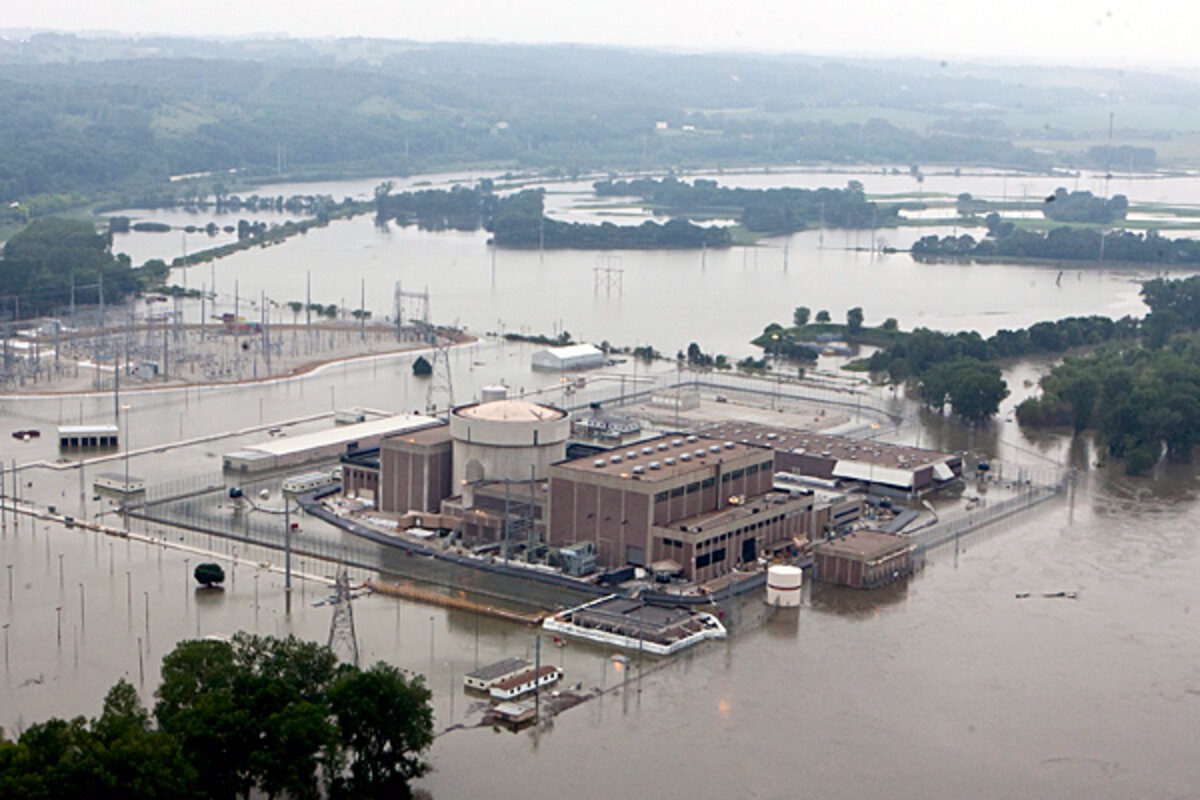
Fort Calhoun nuclear plant surrounded by flood waters
Nebraska’s Fort Calhoun nuclear power plant surrounded by flood waters from the Missouri River in June 2011.


At just before 3 local time on the afternoon of March 11, 2011, the operators of the Fukushima Daiichi nuclear power plant already had a problem. An earthquake measuring 9.1 on the moment magnitude scale—the largest to hit Japan since at least 1900—had damaged key systems at the facility, an emergency greatly compounded by the region-wide power outage caused by the massive temblor.

A station blackout (or SBO, as termed by an industry intensely fond of acronyms) at a nuclear power plant is, by design, cause for concern. Light-water reactors—the category that includes the units at Fukushima Daiichi and every one of the 98 still-operating reactors in the United States—function inside a kind of paradox: in order to safely generate a dependable output of electricity, they require a steady input of electricity. A plant’s meters and monitors need electricity; so, too, do many of the motors that raise and lower large, neutron-absorbing boron control rods used to regulate the atomic activity inside a reactor core. And, perhaps most critically, the systems that circulate cool water (crucial for expelling some of the intense heat generated by the fission reaction) through the nuclear reactors, as well as through pools where decades of used but still highly radioactive “spent” fuel is stored, depend on electric-powered pumps.

The SBO at Daiichi triggered a back-up: several diesel-powered emergency generators that would provide enough electricity to run the cooling systems until power could be restored (as long as there were fuel for the generators). But less than an hour later, a wave higher than a four-story building—the tsunami set off by the quake—swept over the seaside site and flooded the nuclear facility, knocking out most of the generators, which had been situated in the basement by General Electric, the plant’s designer.

Without electricity (what is called a “LOOP,” for “loss of onsite power”), the pumps stopped circulating the water, and without that circulation, the temperature inside the reactor cores quickly exceeded boiling. Within three hours, the tops of the zirconium-clad uranium fuel rods were exposed to air, starting a series of chemical reactions hot enough to free hydrogen atoms from their watery bonds. Despite the valiant efforts of hundreds of plant workers, intense heat and pressure built up inside the containment structures. Three reactor cores suffered complete meltdowns, and over the next few days, at least three powerful hydrogen explosions leveled containment buildings and shot plumes of radioactive gas and particulates high into the air, spreading contamination over land and sea. The rest is an ominous and still-evolving history Japan continues to battle nearly eight years on.

Of the currently operating civilian nuclear reactors in the US, scattered across 30 states, about two-thirds sit on the banks of rivers, lakes, or reservoirs. Add in plants on ocean shorelines, and the number of reactors adjacent to large, sometimes unruly bodies of water climbs above 80. But according to a whistleblower at the United States Nuclear Regulatory Commission (NRC)—backed up by information provided by regulators and watchdogs—more than a third of those reactors are either on sites that would no longer meet NRC flood risk guidelines for new reactor construction, or are vulnerable to flooding caused by dam breaks, swelling rivers, rising sea levels, or increasingly severe weather events.

It is that kind of foresight that was once considered the stock and trade of government regulators: examine the science, identify potential problems, and use the power and authority of the government to compel remedies and improve public safety. But in the wake of another Atlantic Hurricane season—where several nuclear plants had to reduce output or (in one case) shut down completely because of the threat of “catastrophic” flooding—it is sobering to note that, while Fukushima has been analyzed and debated by nuclear operators and regulators, the lessons of Japan’s disaster have not sufficiently been taken to heart, nor put into practice. Be it because of debates over cost-benefit assessment or blatant examples of corporate sway, what seems on one level the minutiae of regulatory process are also part and parcel of what growing numbers of Americans see as ineffectual governance by a corrupt—and corrupting—swamp.

* * *

Soon after the start of the Fukushima crisis, the NRC established a panel, known as the Near-Term Task Force (NTTF), to review the disaster in Japan and recommend regulatory changes and plant upgrades to enhance safety at US nuclear facilities. Their findings—often shorthanded as the NTTF report, or the NTTF recommendations—were comprehensive (though not, in some critics’ eyes, comprehensive enough), touching on concerns from seismic reevaluations to emergency response, with lots of technical considerations in between—including dozens of pages on flooding and the LOOP accidents it can cause.

The report came out in July, and by October, the NRC had identified a small selection of the recommendations it considered top tier and requiring implementation “without delay,” as the Commission put it at the time. Central to many of those proposals were the hazards posed by flooding.

But it’s not as if the dangers of flooding were unknown to nuclear regulators (or the industry) before the cascading disaster at Fukushima Daiichi. In fact, at Duke Energy’s Oconee Nuclear Station (ONS) in the northwesternmost corner of South Carolina, regulators and plant owners had been debating the facility’s flood risk and flood preparedness for decades.

“The concern has been around in its current iteration since 2005 or -6, but it has been raised many times in the past,” said Larry Criscione, a reliability and risk analyst at the NRC since 2009. “It was raised in the ‘80s, it was raised in the ‘90s—I think it was raised in the ‘70s as part of [Oconee’s] initial licensing.”

Construction on ONS began in 1967, and its three reactors were all online before the NRC opened its doors in 1975. But documents provided by Criscione show that by 1977, the Commission had identified flood concerns at several plants licensed before the formation of the regulatory body. Oconee is one of them, and an alphabet soup of studies and recommendations—most notably the IPEEE (the Individual Plant Examination of External Events) for Severe Accident Vulnerabilities in 1991—requested its operators assess and plan for what the industry calls “beyond design basis events” (BDBEs), incidents more extreme or powerful than accounted for in a plant’s original design (of which the earthquake and tsunami in Japan later became prime examples).

Oconee is located on the shore of Lake Keowee, an artificial reservoir created by the damming of the Keowee River, and part of a system of dams built in the 1960s and ‘70s that also includes the Jocassee Dam, just 11 miles upstream from Keowee and ONS. What would happen should the Jocassee Dam fail—and just how likely that is to happen—is central to the debate over the flood preparedness at the nuclear plant. And it is central to the life of Larry Criscione.

* * *

That a dam failure would be a BDBE of dire proportions for ONS once seemed beyond debate. “As I understand it, the NRC’s assessment of the consequences of a flooding event at Oconee would be even greater than at Fukushima,” said Tim Judson, executive director of the Nuclear Information and Resource Service, a nuclear industry watchdog. Because Fukushima Daiichi was located on the coast, and prevailing winds blew an estimated 80 percent of the fallout out to sea in the first weeks of the disaster, much of central and southern Japan was spared the high levels of radioactive contamination seen in the prefectures immediately surrounding the failed nuclear plant. Still, more than 150,000 people had to be relocated from a 12-mile radius around Daiichi.

If the Jocassee Dam were to fail, the resulting flood would inundate Oconee with 12 to 17 feet of water in about five hours, according to Duke Energy’s own assessment, filed in the 1990s in response to the IPEEE, and referenced by Criscione in his report to the NRC. A station blackout would follow, and because Oconee’s backup plan involves hydroelectric power generated by the dams on Lake Keowee, and a break of the Jocassee Dam is projected to cause Keowee Dam failure, ONS would suffer a complete LOOP. With no electricity to run the cooling systems, all three reactor cores would melt down in eight to ten hours, and (and again, this is from Duke Energy’s report) the containment buildings would fail within three days. Radioactive contamination would head down river with the flood waters, and an airborne plume would engulf the university town of Clemson, 10 miles to the southeast, and then lay a blanket of fallout 300 miles eastward to the sea.

But at the time—a pre-Fukushima time—Duke argued that this nightmare scenario was so improbable as to not merit the kind of elaborate and expensive safety upgrades required to prevent it.

As Criscione explains it, the NRC evaluates Beyond Design Basis Events by two scales: one is the relative chance that a given event will occur; the other is the resulting danger once it does. For instance, the risk analyst told me, if a meteorite were to crash into a nuclear power facility, the results could be catastrophic, but the chances of a meteor strike are calculated to be so vanishingly small that plant operators are not required to guard against it.

“The term they use in nuclear is ‘credible,’” said Criscione, “you have to protect against credible threats.”

But try to find a place in the regulations where “credible” is defined. “You’ll never be able to,” Criscione told me. Instead, there is an unspoken range: In “the day-to-day business of the NRC, when things are less than one in a million [in any given year], you can make an argument they’re not credible; when they’re more than one in 10,000, they’re certainly credible.”

“When they’re in between,” Criscione continued, “that’s where the debates start to happen.”

“In a case like Fukushima, you see where that falls apart,” cautioned NIRS’s Judson. “The NRC would have very likely determined what happened at Fukushima was outside credibility range—less than one in a million—so therefore they wouldn’t have done anything about it.”

“Despite that,” Judson observed, “it happened, and the consequences are so great it outweighs the entire alleged benefit of the Japanese nuclear power program.” (After the quake and tsunami, one NRC commissioner reevaluated the risks at Fukushima, and determined they had been one in 1,000 in any given year. Or, to put it another way, TEPCO, the operators of Fukushima Daiichi, were lucky for 40 years, until the year they weren’t.)

In the case of Oconee, with the consequences of a Jocassee Dam failure originally agreed to be grim, Duke Energy debated the probability, placing it outside the “credible” one-in-10,000 chance. But by 2010, as Criscione’s NRC-sponsored analysis showed, it was Duke’s assessment that lacked credibility. Taking into account a broader data-set (paleological as opposed to solely the far-more-limited historical record) and the reassessment of critical infrastructure conducted by various US agencies (notably FERC, the Federal Energy Regulatory Commission) in the years after the September 11, 2001 attacks, regulators placed the odds of dam break causing a BDBE at ONS at one in 3,600—about the chance of drawing a straight in poker, as Criscione put it—or if projected over the remaining time on the plant’s license, there’s better than a one-in-200 chance of such an accident before ONS permanently shuts down. That’s not a certainty in any given year, said Criscione, but it is well above the NRC’s unspoken credibility threshold of one in 10,000.

And the NRC and Duke Energy were in the process of negotiating what should be done to address this now-understood-to-be-credible threat when, as Criscione, Judson, and other nuclear watchdogs see it, Fukushima changed everything.

* * *

When the NRC moved to adopt some of the NTTF recommendations (and only a subset of a subset of the report was ever considered by the Commission as formal rules), oversight of implementation was given to the JLD—the Japan Lessons-Learned Directorate (later expanded and renamed, replacing “Directorate” with “Division”)—a group that was supposed to hive off Fukushima-related concerns to allow “the rest of the NRC keep its focus on other important issues faced by the agency,” as JLD’s own web page put it. But almost inherent in that language is a segregation that puts anything dubbed a post-Fukushima upgrade into a new class of oversight—one that, to those on the inside like Criscione, did not meet the urgency of the risks at hand, nor the fanfare of the Commission’s own pronouncements.

As Criscione told me, Duke Energy “came to the NRC” soon after the start of the Fukushima crisis and argued that if there were going to be new rules derived from that disaster, Duke didn’t want to invest in upgrades at Oconee only to find they fell short of post-Fukushima recommendations.

On its face, said Criscione, “that was a reasonable request.” However, what it did in practice was move the Oconee case from staff who had been trying to address it for five years, who had a knowledge of the issues and the history of the debate, to personnel who were, according to Criscione, not only starting from scratch, but were led by “an industry apologist.”

“You’ve got to understand how the JLD operated,” Criscione explained, “the NRC really likes to see the industry fix its own problems.” It’s the nuclear industry that builds the power plants—the Commission just licenses them. The industry designs the plants, and the NRC reviews those designs. “We don’t tell them how to fix problems,” said Criscione, “we review their fixes to their problems to see if they’re accurate.”

When it came to post-Fukushima fixes, Criscione said, “we didn’t approach it with the attitude of ‘We’re the government, we’re going to decide what changes you need to make your plants safe.’ We approached it with the attitude of ‘You’re the plant owners, you prove to us that your plants are safe.’”

The lobbying arm of the industry, the Nuclear Energy Institute (NEI), came to the NRC with standards it had written to address post-Fukushima concerns like flooding and loss of onsite power events. “And,” as Criscione described it, given the general framework of how the NRC operates, “there’s nothing wrong with that.”

“The problem is that the person who was in charge at the JLD,” the one responsible for evaluating standards, the one who had the power to overrule the rest of the staff, as Criscione told me, “was actively seeking a job as a vice president at NEI.”

Criscione was not exaggerating. The NRC executive in question, Jack R. Davis, bragged on his LinkedIn page at the time (saved for posterity at the Environmental Archive) that his work at what was supposed to be the public’s nuclear regulator had “saved the commercial energy generation industry $1.6 billion,” and “achieved 80 percent reduction in the number of customers needing to complete mandated federal safety improvements.” Those Davis saw as his “customers” were in the energy industry, not the American people who were then paying his salary.

Davis didn’t get his job at NEI, but by 2016, he had landed an executive post at Entergy, one of the nation’s largest owners of nuclear power plants, and the company with the ignominious distinction of operating what the NRC has determined are the country’s three worst-rated nuclear facilities in terms of safety.

With respect to Oconee, the transfer of flood issues to the JLD resulted in a projected 17-foot flood being reevaluated down to a five-foot threat, which is coincidentally the height of a flood barrier built outside the plant in the 1980s. It was a coincidence that did not sit well with Criscione, who was charged with evaluating flood safety. In 2012, he forwarded his concerns to the chair of the NRC and to select members of Congress—information that eventually made its way to the environmental group Greenpeace and into a story in the Huffington Post.

The coverage caught the attention of the NRC’s inspector general, who, rather than act on Criscione’s allegations of lax oversite, opened an investigation into his sharing of official documents.

Criscione said he doesn’t believe he is currently under investigation by the Office of the Inspector General (NRC OIG), but he has also not seen a final report on his case, which he’s told is still under review.

* * *

Better than one in every four nuclear plants is at risk of a flooding event, according to Criscione, an event that could lead to a Fukushima-style disaster. With more than 20 reactors along the eastern seaboard vulnerable to hurricanes, flying debris, heavy rains, and massive storm surges, and dozens of others inland near swelling rivers and aging dams—all with a half-century of spent fuel rods stored nearby—the implications for the hundreds of millions of US residents that live near these reactors is at least unsettling. With climate change increasing the frequency and severity of flood-provoking events, the status quo should be unacceptable.

The NRC will tell you it has it all in hand. “Every US reactor site has completed its flooding hazard reanalysis,” Scott Burnell, the NRC’s public affairs officer, told me in an email.

Central to the post-Fukushima seismic- and flood-hazard analysis was something called a “walkdown.” The NRC “asked” US nuclear power plants “to perform a detailed inspection” of “their currently installed seismic and flooding protection features [and] ensure the features met current requirements.” Plant operators were also told to “identify, correct, and report any degraded conditions.” According to the NRC’s website, this phase was completed across the entire US nuclear fleet by November 2012.

But in March 2013, at Arkansas Nuclear One (ANO), a two-reactor facility 80 miles northeast of Little Rock, the accidental dropping of a 550-ton generator component in the truck bay caused enough shaking to rupture a water pipe. Water flooded the plant’s electrical switchgear, interrupting all power to one reactor, and partially disabling the second. Emergency diesel generators kicked in to ward off a bigger disaster, but the accident, which killed one plant worker and injured eight others, revealed that dozens of penetration points had missing or improperly installed seals.

Dave Lochbaum, the director of the Nuclear Safety Project at the Union of Concerned Scientists, contacted the NRC to express his grave concern about the quality of their plant walkdown program. According to Lochbaum, the NRC assured him that ANO was “the only plant in the country with an ineffective flood protection walkdown.”

But in January 2014, rains hit Florida’s Atlantic coast (“Not a monsoon or a once-in-a-blue-moon rain, but a thunderstorm,” Lochbaum said). At the St. Lucie Nuclear Power Plant, 70 miles north of Palm Beach, faulty storm drains caused a 55,000-gallon flood in an auxiliary building. Water penetrated improperly sealed electrical pass-throughs, disabling pumps needed for cooling one of the facility’s two reactors. “The penetration was about five feet off the floor—at eye level during a walkdown, had anybody only been looking,” wrote Lochbaum in an email.

“So, AFTER owners conducted NRC-mandated flood protection walkdowns, and AFTER the owners formally notified the NRC that flood-protection measures were adequate, those assurances were proven false by actual flooding,” Lochbaum wrote. “Apparently,” Lochbaum’s email surmised, “the walkdowns had been more for exercise than for verification of safety.”

The NRC’s industry-friendly approach also troubles Judson. The NIRS director detailed the case of New York’s Nine Mile Point—on the banks of Lake Ontario, 40 miles north of Syracuse—a site that is home to three nuclear reactors, including the oldest still-operating commercial reactor in the US (Nine Mile Point 1, which was commissioned in December 1969). Just last year, a swelling Lake Ontario came within a foot of triggering an “unusual event” (the NRC’s first level of emergency notification). Exelon, the facility’s owner, sprung to action—and applied to the NRC to change the standards so it wouldn’t have to declare an emergency unless the site was so flooded that workers couldn’t access the site by car.

That change was quickly approved by the NRC—an alarming lack of oversite, according to Judson, given the potential for widespread environmental disaster. “Lake Ontario is the drinking-water source for 9 million people,” he said.

* * *

In addition to the examples above, there are a number of sites that worry the experts—among them: Quad Cities Nuclear Generating Station, in Northern Illinois, on the banks of the Mississippi River, Dresden Generating Station, 60 miles southwest of Chicago, at the head of the Illinois River, and Pilgrim Nuclear Power Station in Plymouth, Massachusetts, on the shores of Cape Cod Bay, less than 40 miles south of Boston. What these sites have in common, beyond their remarkable age (online 46 years, the reactors at Quad Cities are the youngest of this group), is their acute vulnerability to the perils of a warming planet.

Riverine flooding, more frequent and more severe this century and unrelated to any dam failures, leave Quad Cities and Dresden in a precarious place almost annually. (Precipitation in this region is expected to increase 37 percent by 2070, according to a NOAA—National Oceanic and Atmospheric Administration—study.) For Pilgrim, a facility that has seen numerous weather-related shutdowns in recent years, a category 5 hurricane could elevate sea level by 22.4 feet, according to plant-owner Entergy—giving the hundreds of tons of irradiated fuel stored outside in concrete and steel “dry casks” about two-and-a-half feet of clearance. But when conservative estimates project a general sea-level rise in the Bay of three feet by 2065, and possibly six feet by the end of the century, the site has less than no margin for error.

Even a partial submersion of a dry cask could block vents, interrupting its convection-dependent cooling mechanism, according to Kevin Kamps, radioactive waste specialist at clean-energy advocacy group Beyond Nuclear. Depending how long this went on, the integrity of the fuel and the steel liner could be affected.

But of course, as perilous as it is for the casks, lined up on a concrete pad less than a football field’s length from the shore, the plight of Pilgrim’s spent fuel pool, filled to over three times its design capacity, worries watchdogs more. Like with all the other reactors, a prolonged interruption of power means a “loss of cooling accident” (LOCA—yes, this has an acronym, too), with limited time before the tightly packed fuel assemblies boiled off their pool and caught fire, potentially covering northern New England with many times the amount of radioactive cesium-137 released by the Chernobyl disaster.

Pilgrim is scheduled to go offline for good this spring, but the spent fuel is expected to remain on site for decades. This was troubling enough to Senator Edward Markey that he contacted the NRC last April asking how the Commission will factor in global warming. “It is imperative,” the Massachusetts Democrat wrote, “that these plants and the NRC regulations fully consider the impacts of climate change on dangerous nuclear waste.”

* * *

As far as the NRC is concerned, it has. “Every US reactor site performs relevant analyses based on location-specific parameters,” wrote the NRC’s Burnell in response to my question about the regulator’s assessment of climate-based changes in risk. In practice that means that predictions for things like precipitation and sea level rise are factored back into the NRC’s models for assessing credible risk. Well. . . sort of.

“My sense is there’s really no uniform methodology,” said Criscione. As to NRC requirements for what needs to be in an assessment, say, for flood risk, Criscione told me, “it’s more of a style guide.”

This wasn’t always the case. “The NRC used to have more deterministic standards,” said Judson, “and there’s a debate to be had about whether that regulatory process was better at safety outcomes than the one they’ve adopted since.” Before about 20 years ago, the process, according to Judson, was more open to the public. “There was a time when the public was able to raise safety allegations with the NRC,” he said, noting instances at several reactors in New England. “The NRC was forced by public acrimony, and in some cases by Congress to step in and regulate.”

Today, under what is called “probabilistic risk assessment,” nuclear plants are expected to meet performance metrics, and that is then weighted with “risk-informed regulation”—the system that evaluates whether a threat is credible enough to merit safety upgrades.

The shift wasn’t just academic. Under deterministic assessment, reactors in Connecticut, Illinois, Maine, and Oregon were taken permanently offline or forced to make significant improvements. But that era, Judson told me, “is largely gone.”

“There were no reactor closures in the US between 1998 and 2013,” he said.

And since 2013, with the shuttering of facilities in Wisconsin, Vermont, California, and New Jersey, as well as Nebraska’s once flood-ravaged Fort Calhoun—and with more expected to close in the next couple of years—could that be evidence of Fukushima-inspired regulatory vigor? Only tangentially. The past decade has also seen a major shift in the energy market. With the fracking boom creating a surplus of natural gas, and the cost of wind and solar generation continuing to fall, nuclear power, which was never able to come anywhere close to its atomic-age promise of being “too cheap to meter,” grew increasingly uncompetitive.

What would have been an affordable safety upgrade 10 years ago is now financially untenable. “Regulations that would have been something minor in the 2008 timeframe, would certainly shut down a plant today in some markets,” Criscione told me, adding, “I think the agency has recognized that, and I think they’ve kind of caved in to some of the economic pressure that the utilities are seeing.”

“Ultimately, it almost always comes down to money,” agreed Judson. “If it passes the ‘credible’ threshold level, the NRC will determine the possible impact of the event and weigh that against what the cost of remedying it or preventing it would be—and they make a determination from that point about whether the cost is justified.”

The NRC, for its part, rejects the views of the whistleblower and the watchdog. “Plant costs were not taken into consideration” on “post-Fukushima Orders,” wrote Burnell, and “none of the plants that have recently either permanently shut down, or have announced plans to do so, asked for financial-based relief from post-Fukushima requirements.”

Except that they have. Pretty explicitly. And it was granted. Pretty explicitly.

Almost exactly a year before Burnell sent me his statement, the NRC granted a request by Entergy to waive post-Fukushima requirements for their Pilgrim nuclear plant, including improvements to vents that could potentially relieve reactor core pressure in the case of a loss-of-power/loss-of-cooling event, new seismic regulations, and, of special note here, new flooding regulations. All this for a plant identical in design to the failed reactors at Fukushima, a plant that is one of the three-worst rated in the US, and a plant that was revealed in a leaked 2016 internal inspection memo to have a staff that is “overwhelmed by just trying to run the station.”

The NRC will counter that Pilgrim’s “operational lifespan”—Entergy has announced plans to shut it down by June—is too short to complete the upgrades. But the Commission granted Pilgrim a 20-year license extension in 2012, meaning regulators and plant operators had thought plant operations could continue through 2032. The reason the plant is shuttering early is because Entergy felt it was not financially viable to maintain it.

Strangely, though, at the same time Entergy was told it would not have to invest in post-Fukushima safety improvements, Pilgrim was starting an expensive refueling cycle, which can require hundreds of extra plant workers and take the plant off line for a month. If regulators had declined to grant the waiver, if Pilgrim had been required to begin plant upgrades to stay open, would Entergy have spent on a refueling that gives their reactor an extra two years of generating power?

Mary Lampert, a longtime environmental activist and the director of Pilgrim Watch, told the Boston Globe in 2017 that the NRC was making an industry-friendly gamble. “Sadly, it’s financial safety rather than public safety,” she said.

* * *

It’s a ratio that bears all the hallmarks of what is called “regulatory capture”—a government agency so close to the commercial sector it regulates that it considers the industry’s interests over the public’s. But with the NRC, it goes a step further.

“Unlike many other federal agencies, the NRC’s continuation is dependent on the perpetuation of its industry,” said Judson. “If nuclear power goes out of business, and reactors shut down, the NRC’s mission starts to drain away.”

(Of course, if the NRC took an interest in nuclear plant decommissioning, they’d have at least another fifty years of work to do. But that is clearly not their inclination.

“The NRC staff concluded that there is no need for regulatory action at decommissioning reactors in light of lessons learned from the Fukushima accident,” wrote Burnell.

Judson put it more starkly: “There is no oversite” at a non-generating plant. “During decommissioning, there are basically no inspections by NRC.”

“Something really bad would have to happen for NRC to send inspectors to a decommission,” he said.)

Perhaps nothing demonstrates the regulator’s deference to the industry in the post-Fukushima era quite like something called FLEX (which is amazingly, despite it always being spelled with all caps, not an acronym). “FLEX,” as the NRC’s Burnell explained to me in an email, “is the industry term for its approach to complying with the NRC’s Mitigation Strategies Order of March 2012 … which the NRC has reviewed and found acceptable.”

But another way to look at FLEX is the way watchdog Judson does: “The thing that the NRC has allowed that the industry is taking credit for, but that aren’t actually real requirements.”

FLEX, as loosely explained in an illustrated web page from the NRC, allows nuclear plant operators to meet LOOP events with three phases of emergency equipment. The first involves the batteries and diesel-powered generators that are part of the backup systems at most US plants—the systems that failed so dramatically at Fukushima Daiichi (as discussed, Oconee does not use diesel generators, relying instead on hydroelectric power from nearby Keowee Dam). The second is portable equipment stored on-site at a nuclear plant that is supposed to take over when the phase one, design-basis backups fail or are exhausted. The third phase of FLEX, according to the NRC-sanctioned industry plan, is backup equipment stored off site, at two industry-maintained “response centers” in Memphis, Tennessee, and Phoenix, Arizona, which can be moved to a faltering reactor “within 24 hours.”

“It’s the sort of thing where OK, sure, it might be value added,” Judson said, “but it’s not part of the design basis of the reactor, and not part of what the NRC can easily regulate.” In fact, while Burnell told me the NRC has inspected the response centers, that is not the same thing as it having to meet an agency rule.

“It’s not a requirement,” Judson observed, “it’s something that [the industry’s] doing voluntarily outside of the regulations.”

And the moving of that equipment to a troubled site also exists outside the regulatory process. “The industry has established standing contracts to airlift phase three cargo to airports close to reactors, and additional contracts (including helicopters) to bring the phase three cargo to a site,” said the NRC’s Burnell, again relying on industry assurances. (And when asked for clarification, Burnell told me that the cargo aircraft were all private contractors, while the helicopters could be private or military, depending on the nuclear facility.)

When I questioned the 24-hour allowance (given that the Fukushima example and the industry’s own projections at Oconee show core damage starting in as few as eight hours after a loss of power), Burnell wrote, “Each plant has determined how long they have to get phase three resupply to the site.” Asked about the possibility of a large-scale, fast-moving weather event affecting multiple nuclear facilities (as was the case with 2012’s Hurricane Sandy), Burnell seemed even more certain: “Cargo aircraft flights from Memphis to East Coast sites will certainly get phase three to the sites in a timely manner, and plant response procedures account for the additional flight time from Phoenix if necessary.”

If only the weather—or a disaster-battered infrastructure, or an overstretched private contractor—could be as sanguine. “It’s very easy to imagine situations where bringing in equipment from off site is just not going to be feasible,” Judson said.

Criscione referenced his analysis of Oconee in the event of a breach of Jocassee Dam, where all four bridges used to access the plant are expected to fail. Looking at Duke Energy’s promise to bring in emergency backup equipment from off site, he said, “I don’t think it’s realistic. There’s a path to success, but I think the odds are slim.”

* * *

But Criscione’s analysis doesn’t, by his account, carry as much weight inside his agency since he blew the whistle on flood preparedness to the NRC commissioners and Congress. “I’m less effective than when I brought the issues forward,” he said. “I’m certainly not invited to the same meetings that I was in the past.”

And Criscione thinks the problem is agency-wide. “People who draw a harder line on the industry have been less involved,” he said, tracing the change to about 2012, when battles over post-Fukushima regulations precipitated a change in the NRC’s chair, and the Japan Lessons-Learned Division took over a lot of the oversite of emergency preparedness and mitigation.

Today, even the JLD has disappeared, absorbed into another spoonful of alphabet soup, the NRR (the Office of Nuclear Reactor Regulation). “Post-Fukushima activities,” Burnell told me, “have been formalized to the point where the agency’s routine reactor oversite is appropriately tracking compliance.”

But to hear critics tell it, appropriateness is in the eye of the beholder. Seven years after the earthquake and tsunami that turned “Fukushima” into disaster shorthand, “things have been done,” said Judson, “I’m not sure I’d say that they’re adequate.”

“A lot of the things that they came up with after evaluating what happened at Fukushima were things that they should have done years before anyway,” he continued. “Now we’ve got emerging threats that the NRC hasn’t dealt with, and that, in all likelihood, it won’t deal with until something bad happens.”

Lochbaum put it this way in an email: “US nuclear power plants are adequately protected against flooding—unless a flood happens.” In a “worst-case failure of the Jocassee Dam, one would not want to be close to Oconee,” he said. “All three reactors are likely to follow Fukushima’s path and reach its destination.”

For Criscione, the clarion call is coming from the inside the house. “I don’t feel good about Oconee, he told me. “From what I see, we’ve been compromised when it comes to flooding.”

(No version of this story may be reprinted without the express written permission of Gregg Levine.)

Two Years On, Fukushima Raises Many Questions, Provides One Clear Answer

Fukushima's threats to health and the environment continue. (graphic: Surian Soosay via flickr)

Fukushima’s threats to health and the environment continue. (graphic: Surian Soosay via flickr)

You can’t say you have all the answers if you haven’t asked all the questions. So, at a conference on the medical and ecological consequences of the Fukushima nuclear disaster, held to commemorate the second anniversary of the earthquake and tsunami that struck northern Japan, there were lots of questions. Questions about what actually happened at Fukushima Daiichi in the first days after the quake, and how that differed from the official report; questions about what radionuclides were in the fallout and runoff, at what concentrations, and how far they have spread; and questions about what near- and long-term effects this disaster will have on people and the planet, and how we will measure and recognize those effects.

A distinguished list of epidemiologists, oncologists, nuclear engineers, former government officials, Fukushima survivors, anti-nuclear activists and public health advocates gathered at the invitation of The Helen Caldicott Foundation and Physicians for Social Responsibility to, if not answer all these question, at least make sure they got asked. Over two long days, it was clear there is much still to be learned, but it was equally clear that we already know that the downsides of nuclear power are real, and what’s more, the risks are unnecessary. Relying on this dirty, dangerous and expensive technology is not mandatory–it’s a choice. And when cleaner, safer, and more affordable options are available, the one answer we already have is that nuclear is a choice we should stop making and a risk we should stop taking.

“No one died from the accident at Fukushima.” This refrain, as familiar as multiplication tables and sounding about as rote when recited by acolytes of atomic power, is a close mirror to versions used to downplay earlier nuclear disasters, like Chernobyl and Three Mile Island (as well as many less infamous events), and is somehow meant to be the discussion-ender, the very bottom-line of the bottom-line analysis that is used to grade global energy options. “No one died” equals “safe” or, at least, “safer.” Q.E.D.

But beyond the intentional blurring of the differences between an “accident” and the probable results of technical constraints and willful negligence, the argument (if this saw can be called such) cynically exploits the space between solid science and the simple sound bite.

“Do not confuse narrowly constructed research hypotheses with discussions of policy,” warned Steve Wing, Associate Professor of Epidemiology at the University of North Carolina’s Gillings School of Public Health. Good research is an exploration of good data, but, Wing contrasted, “Energy generation is a public decision made by politicians.”

Surprisingly unsurprising

A public decision, but not necessarily one made in the public interest. Energy policy could be informed by health and environmental studies, such as the ones discussed at the Fukushima symposium, but it is more likely the research is spun or ignored once policy is actually drafted by the politicians who, as Wing noted, often sport ties to the nuclear industry.

The link between politicians and the nuclear industry they are supposed to regulate came into clear focus in the wake of the March 11, 2011 Tohoku earthquake and tsunami–in Japan and the United States.

The boiling water reactors (BWRs) that failed so catastrophically at Fukushima Daiichi were designed and sold by General Electric in the 1960s; the general contractor on the project was Ebasco, a US engineering company that, back then, was still tied to GE. General Electric had bet heavily on nuclear and worked hand-in-hand with the US Atomic Energy Commission (AEC–the precursor to the NRC, the Nuclear Regulatory Commission) to promote civilian nuclear plants at home and abroad. According to nuclear engineer Arnie Gundersen, GE told US regulators in 1965 that without quick approval of multiple BWR projects, the giant energy conglomerate would go out of business.

It was under the guidance of GE and Ebasco that the rocky bluffs where Daiichi would be built were actually trimmed by 10 meters to bring the power plant closer to the sea, the water source for the reactors’ cooling systems–but it was under Japanese government supervision that serious and repeated warnings about the environmental and technological threats to Fukushima were ignored for another generation.

Failures at Daiichi were completely predictable, observed David Lochbaum, the director of the Nuclear Safety Project at the Union of Concerned Scientists, and numerous upgrades were recommended over the years by scientists and engineers. “The only surprising thing about Fukushima,” said Lochbaum, “is that no steps were taken.”

The surprise, it seems, should cross the Pacific. Twenty-two US plants mirror the design of Fukushima Daiichi, and many stand where they could be subject to earthquakes or tsunamis. Even without those seismic events, some US plants are still at risk of Fukushima-like catastrophic flooding. Prior to the start of the current Japanese crisis, the Nuclear Regulatory Commission learned that the Oconee Nuclear Plant in Seneca, South Carolina, was at risk of a major flood from a dam failure upstream. In the event of a dam breach–an event the NRC deems more likely than the odds that were given for the 2011 tsunami–the flood at Oconee would trigger failures at all four reactors. Beyond hiding its own report, the NRC has taken no action–not before Fukushima, not since.

The missing link

But it was the health consequences of nuclear power–both from high-profile disasters, as well as what is considered normal operation–that dominated the two days of presentations at the New York Academy of Medicine. Here, too, researchers and scientists attempted to pose questions that governments, the nuclear industry and its captured regulators prefer to ignore, or, perhaps more to the point, omit.

Dr. Hisako Sakiyama, a member of the Fukushima Nuclear Accident Independent Investigation Commission, has been studying the effects of low-dose radiation. Like others at the symposium, Dr. Sakiyama documented the linear, no-threshold risk model drawn from data across many nuclear incidents. In essence, there is no point at which it can be said, “Below this amount of radiation exposure, there is no risk.” And the greater the exposure, the greater the risk of health problems, be they cancers or non-cancer diseases.

Dr. Sakiyama contrasted this with the radiation exposure limits set by governments. Japan famously increased what it called acceptable exposure quite soon after the start of the Fukushima crisis, and, as global background radiation levels increase as a result of the disaster, it is feared this will ratchet up what is considered “safe” in the United States, as the US tends to discuss limits in terms of exposure beyond annual average background radiation. Both approaches lack credibility and expose an ugly truth. “Debate on low-dose radiation risk is not scientific,” explained Sakiyama, “but political.”

And the politics are posing health and security risks in Japan and the US.

Akio Matsumura, who spoke at the Fukushima conference in his role as founder of the Global Forum of Spiritual and Parliamentary Leaders for Human Survival, described a situation at the crippled Japanese nuclear plant that is much more perilous, even today, than leaders are willing to acknowledge. Beyond the precarious state of the spent fuel pool above reactor four, Matsumura also cited the continued melt-throughs of reactor cores (which could lead to a steam explosion), the high levels of radiation at reactors one and three (making any repairs impossible), and the unprotected pipes retrofitted to help cool reactors and spent fuel. “Probability of another disaster,” Matsumura warned, “is higher than you think.”

Matsumura lamented that investigations of both the technical failures and the health effects of the disaster are not well organized. “There is no longer a link between scientists and politicians,” said Matsumura, adding, “This link is essential.”

The Union of Concerned Scientists’ Lochbaum took it further. “We are losing the no-brainers with the NRC,” he said, implying that what should be accepted as basic regulatory responsibility is now subject to political debate. With government agencies staffed by industry insiders, “the deck is stacked against citizens.”

Both Lochbaum and Arnie Gundersen criticized the nuclear industry’s lack of compliance, even with pre-Fukushima safety requirements. And the industry’s resistance undermines nuclear’s claims of being competitive on price. “If you made nuclear power plants meet existing law,” said Gundersen, “they would have to shut because of cost.”

But without stronger safety rules and stricter enforcement, the cost is borne by people instead.

Determinate data, indeterminate risk

While the two-day symposium was filled with detailed discussions of chemical and epidemiologic data collected throughout the nuclear age–from Hiroshima through Fukushima–a cry for more and better information was a recurring theme. In a sort of wily corollary to “garbage in, garbage out,” experts bemoaned what seem like deliberate holes in the research.

Even the long-term tracking study of those exposed to the radiation and fallout in Japan after the atomic blasts at Hiroshima and Nagasaki–considered by many the gold-standard in radiation exposure research because of the large sample size and the long period of time over which data was collected–raises as many questions as it answers.

The Hiroshima-Nagasaki data was referenced heavily by Dr. David Brenner of the Center for Radiological Research, Columbia University College of Physicians and Surgeons. Dr. Brenner praised the study while using it to buttress his opinion that, while harm from any nuclear event is unfortunate, the Fukushima crisis will result in relatively few excess cancer deaths–something like 500 in Japan, and an extra 2,000 worldwide.

“There is an imbalance of individual risk versus overall anxiety,” said Brenner.

But Dr. Wing, the epidemiologist from the UNC School of Public Health, questioned the reliance on the atom bomb research, and the relatively rosy conclusions those like Dr. Brenner draw from it.

“The Hiroshima and Nagasaki study didn’t begin till five years after the bombs were dropped,” cautioned Wing. “Many people died before research even started.” The examination of cancer incidence in the survey, Wing continued, didn’t begin until 1958–it misses the first 13 years of data. Research on “Black Rain” survivors (those who lived through the heavy fallout after the Hiroshima and Nagasaki bombings) excludes important populations from the exposed group, despite those populations’ high excess mortality, thus driving down reported cancer rates for those counted.

The paucity of data is even more striking in the aftermath of the Three Mile Island accident, and examinations of populations around American nuclear power plants that haven’t experienced high-profile emergencies are even scarcer. “Studies like those done in Europe have never been done in the US,” said Wing with noticeable regret. Wing observed that a German study has shown increased incidences of childhood leukemia near operating nuclear plants.

There is relatively more data on populations exposed to radioactive contamination in the wake of the Chernobyl nuclear accident. Yet, even in this catastrophic case, the fact that the data has been collected and studied owes much to the persistence of Alexey Yablokov of the Russian Academy of Sciences. Yablokov has been examining Chernobyl outcomes since the early days of the crisis. His landmark collection of medical records and the scientific literature, Chernobyl: Consequences of the Catastrophe for People and the Environment, has its critics, who fault its strong warnings about the long-term dangers of radiation exposure, but it is that strident tone that Yablokov himself said was crucial to the evolution of global thinking about nuclear accidents.

Because of pressure from the scientific community and, as Yablokov stressed at the New York conference, pressure from the general public, as well, reaction to accidents since Chernobyl has evolved from “no immediate risk,” to small numbers who are endangered, to what is now called “indeterminate risk.”

Calling risk “indeterminate,” believe it or not, actually represents a victory for science, because it means more questions are asked–and asking more questions can lead to more and better answers.

Yablokov made it clear that it is difficult to estimate the real individual radiation dose–too much data is not collected early in a disaster, fallout patterns are patchy and different groups are exposed to different combinations of particles–but he drew strength from the volumes and variety of data he’s examined.

Indeed, as fellow conference participant, radiation biologist Ian Fairlie, observed, people can criticize Yablokov’s advocacy, but the data is the data, and in the Chernobyl book, there is lots of data.

Complex and consequential

Data presented at the Fukushima symposium also included much on what might have been–and continues to be–released by the failing nuclear plant in Japan, and how that contamination is already affecting populations on both sides of the Pacific.

Several of those present emphasized the need to better track releases of noble gasses, such as xenon-133, from the earliest days of a nuclear accident–both because of the dangers these elements pose to the public and because gas releases can provide clues to what is unfolding inside a damaged reactor. But more is known about the high levels of radioactive iodine and cesium contamination that have resulted from the Fukushima crisis.

In the US, since the beginning of the disaster, five west coast states have measured elevated levels of iodine-131 in air, water and kelp samples, with the highest airborne concentrations detected from mid-March through the end of April 2011. Iodine concentrates in the thyroid, and, as noted by Joseph Mangano, director of the Radiation and Public Health Project, fetal thyroids are especially sensitive. In the 15 weeks after fallout from Fukushima crossed the Pacific, the western states reported a 28-percent increase in newborn (congenital) hypothyroidism (underactive thyroid), according to the Open Journal of Pediatrics. Mangano contrasted this with a three-percent drop in the rest of the country during the same period.

The most recent data from Fukushima prefecture shows over 44 percent of children examined there have thyroid abnormalities.

Of course, I-131 has a relatively short half-life; radioactive isotopes of cesium will have to be tracked much longer.

With four reactors and densely packed spent fuel pools involved, Fukushima Daiichi’s “inventory” (as it is called) of cesium-137 dwarfed Chernobyl’s at the time of its catastrophe. Consequently, and contrary to some of the spin out there, the Cs-137 emanating from the Fukushima plant is also out-pacing what happened in Ukraine.

Estimates put the release of Cs-137 in the first months of the Fukushima crisis at between 64 and 114 petabecquerels (this number includes the first week of aerosol release and the first four months of ocean contamination). And the damaged Daiichi reactors continue to add an additional 240 million becquerels of radioactive cesium to the environment every single day. Chernobyl’s cesium-137 release is pegged at about 84 petabecquerels. (One petabecquerel equals 1,000,000,000,000,000 becquerels.) By way of comparison, the nuclear “device” dropped on Hiroshima released 89 terabecquerels (1,000 terabecquerels equal one petabecquerel) of Cs-137, or, to put it another way, Fukushima has already released more than 6,400 times as much radioactive cesium as the Hiroshima bomb.

The effects of elevated levels of radioactive cesium are documented in several studies across post-Chernobyl Europe, but while the implications for public health are significant, they are also hard to contain in a sound bite. As medical genetics expert Wladimir Wertelecki explained during the conference, a number of cancers and other serious diseases emerged over the first decade after Chernobyl, but the cycles of farming, consuming, burning and then fertilizing with contaminated organic matter will produce illness and genetic abnormalities for many decades to come. Epidemiological studies are only descriptive, Wertelecki noted, but they can serve as a “foundation for cause and effect.” The issues ahead for all of those hoping to understand the Fukushima disaster and the repercussions of the continued use of nuclear power are, as Wertelecki pointed out, “Where you study and what you ask.”

One of the places that will need some of the most intensive study is the Pacific Ocean. Because Japan is an island, most of Fukushima’s fallout plume drifted out to sea. Perhaps more critically, millions of gallons of water have been pumped into and over the damaged reactors and spent fuel pools at Daiichi, and because of still-unplugged leaks, some of that water flows into the ocean every day. (And even if those leaks are plugged and the nuclear fuel is stabilized someday, mountain runoff from the area will continue to discharge radionuclides into the water.) Fukushima’s fisheries are closed and will remain so as far into the future as anyone can anticipate. Bottom feeders and freshwater fish exhibit the worst levels of cesium, but they are only part of the picture. Ken Beusseler, a marine scientist at Woods Hole Oceanographic Institute, described a complex ecosystem of ocean currents, food chains and migratory fish, some of which carry contamination with them, some of which actually work cesium out of their flesh over time. The seabed and some beaches will see increases in radio-contamination. “You can’t keep just measuring fish,” warned Beusseler, implying that the entire Pacific Rim has involuntarily joined a multidimensional long-term radiation study.

For what it’s worth

Did anyone die as a result of the nuclear disaster that started at Fukushima Daiichi two years ago? Dr. Sakiyama, the Japanese investigator, told those assembled at the New York symposium that 60 patients died while being moved from hospitals inside the radiation evacuation zone–does that count? Joseph Mangano has reported on increases in infant deaths in the US following the arrival of Fukushima fallout–does that count? Will cancer deaths or future genetic abnormalities, be they at the low or high end of the estimates, count against this crisis?

It is hard to judge these answers when the question is so very flawed.

As discussed by many of the participants throughout the Fukushima conference, a country’s energy decisions are rooted in politics. Nuclear advocates would have you believe that their favorite fuel should be evaluated inside an extremely limited universe, that there is some level of nuclear-influenced harm that can be deemed “acceptable,” that questions stem from the necessity of atomic energy instead of from whether civilian nuclear power is necessary at all.

The nuclear industry would have you do a cost-benefit analysis, but they’d get to choose which costs and benefits you analyze.

While all this time has been and will continue to be spent on tracking the health and environmental effects of nuclear power, it isn’t a fraction of a fraction of the time that the world will be saddled with fission’s dangerous high-level radioactive trash (a problem without a real temporary storage program, forget a permanent disposal solution). And for all the money that has been and will continue to be spent compiling the health and environmental data, it is a mere pittance when compared with the government subsidies, liability waivers and loan guarantees lavished upon the owners and operators of nuclear plants.

Many individual details will continue to emerge, but a basic fact is already clear: nuclear power is not the world’s only energy option. Nor are the choices limited to just fossil and fissile fuels. Nuclear lobbyists would love to frame the debate–as would advocates for natural gas, oil or coal–as cold calculations made with old math. But that is not where the debate really resides.

If nuclear reactors were the only way to generate electricity, would 500 excess cancer deaths be acceptable? How about 5,000? How about 50,000? If nuclear’s projected mortality rate comes in under coal’s, does that make the deaths–or the high energy bills, for that matter–more palatable?

As the onetime head of the Tennessee Valley Authority, David Freeman, pointed out toward the end of the symposium, every investment in a new nuclear, gas or coal plant is a fresh 40-, 50-, or 60-year commitment to a dirty, dangerous and outdated technology. Every favor the government grants to nuclear power triggers an intense lobbying effort on behalf of coal or gas, asking for equal treatment. Money spent bailing out the past could be spent building a safer and more sustainable future.

Nuclear does not exist in a vacuum; so neither do its effects. There is much more to be learned about the medical and ecological consequences of the Fukushima nuclear disaster–but that knowledge should be used to minimize and mitigate the harm. These studies do not ask and are not meant to answer, “Is nuclear worth it?” When the world already has multiple alternatives–not just in renewable technologies, but also in conservation strategies and improvements in energy efficiency–the answer is already “No.”

A version of this story previously appeared on Truthout; no version may be reprinted without permission.

Fukushima Plus Two: Still the Beginning?

An IAEA inspector examines the remains of reactor 3 at Fukushima Daiichi (5/27/11) (photo: Greg Webb/IAEA imagebank)

An IAEA inspector examines the remains of reactor 3 at Fukushima Daiichi (5/27/11) (photo: Greg Webb/IAEA imagebank)

I was up working in what were in my part of the world the early morning hours of March 11, 2011, when I heard over the radio that a massive earthquake had struck northeastern Japan. I turned on the TV just in time to see the earliest pictures of the tsunami that followed what became known as the Tohoku quake. The devastation was instantly apparent, and reports of high numbers of casualties seemed inevitable, but it wasn’t until a few hours later, when news of the destruction and loss of power at the Fukushima Daiichi nuclear plant hit the English-language airwaves, that I was gripped by a real sense of despair.

I was far from a nuclear expert at the time, but I knew enough to know that without intact cooling systems, or the power to keep them running, and with the added threat of a containment breach, some amount of environmental contamination was certain, and the potential for something truly terrifying was high.

What started as a weekend of watching newswires and live streams, virtually around the clock, and posting basic tech and health questions on email lists, expanded as the Fukushima crisis itself grew. Two years later, I have written tens of thousands of words, and read hundreds of thousands more. I have learned much, but I think I have only scratched the surface.

We all might be a little closer to understanding what happened in those first days and weeks after the earthquake, but what has happened since is still, sadly, a story where much must be written. What the Daiichi plant workers really went through in those early days is just now coming to light, and the tales of intrigue and cover-up, of corruption and captured government, grow more complex and more sinister with each revelation. But what has happened to the environment, not just in the government-cordoned evacuation zone, but also throughout Japan, across the Pacific, and around the world, will likely prove the most chilling narrative.

Radiation levels in the quarantined parts of Japan are still far too high to permit any kind of human re-habitation, but exposure rates in areas far outside that radius are also well above what would have been considered acceptable before this disaster. And water, used to cool the molten cores and damaged spent fuel pools at Fukushima Daiichi, now dangerously radioactive itself, continues to leak into the ground and into the ocean at unprecedented rates.

Alas, the efforts of the Japanese government seem more focused on limiting the information, quieting dissent, and sharing the pain (by shipping radioactive detritus across the country for disposal and incineration), than it is on stopping the leaks, cleaning up the contamination, and eliminating future risks. Though originally pledged to quickly turn away from all nuclear power, a change of government in Japan has revived the incestuous relationship between the nuclear industry and the bureaucrats and politicians who are supposed to police it.

Across the Pacific, the United States has not exactly bathed itself in glory, either. Within days of the news of the explosions at Fukushima, President Barack Obama was the rare world leader that made a point of publicly assuring the nuclear industry that America’s commitment to this dangerous energy source was still strong. Just months after the start of the crisis, information on airborne radiation samples from across the country became less accessible to the public. And while industrialized countries like Germany work to phase out their nuclear plants, the US Nuclear Regulatory Commission actually approved construction of new reactors, and the federal government is poised to backstop the baldly risky investment to the tune of $8.3 billon.

But most disturbing of all, of course, will be the stories of the people. First, the stories we will hear from the families in Japan exposed to the toxic fallout in the immediate aftermath of the initial containment breaches and explosions–stories we are already hearing of children with severe thyroid abnormalities. But soon, and likely for decades to come, the stories of cancers and immune disorders, of birth defects and health challenges, elevated not only in northern Japan, but perhaps across the northern hemisphere.

Two years after the earthquake and tsunami, it is not the beginning of the end of this disaster, and, with apologies to Winston Churchill, it may not even be the end of the beginning. The spent fuel pool at Daiichi reactor 4 remains in precarious shape, and the state of the three molten cores is still shrouded in mystery. Radioactive dust and grime blanket large parts of Japan with no serious plan to remove it, and the waters off the northeast coast continue to absorb irradiated runoff, putting an entire aquatic food chain in peril.

On this second anniversary of the start of the Fukushima crisis, let us honor those who have suffered so far, review what we have learned to date, and endeavor to understand what is likely to come. But, most of all, let us renew our commitment to breaking with this dirty, dangerous and expensive technology.

* * *

To this end, on March 11 and 12, I will be attending a symposium at the New York Academy of Medicine, “The Medical and Ecological Consequences of the Fukushima Nuclear Accident,” sponsored by the Helen Caldicott Foundation and Physicians for Social Responsibility. If you are in the New York area, there is still space available; if you want to watch online, the organizers have promised a live stream. More information can be found on the Caldicott Foundation website.

The Long, Long Con: Seventy Years of Nuclear Fission; Thousands of Centuries of Nuclear Waste

From here to eternity: a small plaque on the campus of the University of Chicago commemorates the site of Fermi's first atomic pile--and the start of the world's nuclear waste problem. (Photo: Nathan Guy via Flickr)

From here to eternity: a small plaque on the campus of the University of Chicago commemorates the site of Fermi’s first atomic pile–and the start of the world’s nuclear waste problem. (Photo: Nathan Guy via Flickr)

On December 2, 1942, a small group of physicists under the direction of Enrico Fermi gathered on an old squash court beneath Alonzo Stagg Stadium on the Campus of the University of Chicago to make and witness history. Uranium pellets and graphite blocks had been stacked around cadmium-coated rods as part of an experiment crucial to the Manhattan Project–the program tasked with building an atom bomb for the allied forces in WWII. The experiment was successful, and for 28 minutes, the scientists and dignitaries present observed the world’s first manmade, self-sustaining nuclear fission reaction. They called it an atomic pile–Chicago Pile 1 (CP-1), to be exact–but what Fermi and his team had actually done was build the world’s first nuclear reactor.

The Manhattan Project’s goal was a bomb, but soon after the end of the war, scientists, politicians, the military and private industry looked for ways to harness the power of the atom for civilian use, or, perhaps more to the point, for commercial profit. Fifteen years to the day after CP-1 achieved criticality, President Dwight Eisenhower threw a ceremonial switch to start the reactor at Shippingport, PA, which was billed as the first full-scale nuclear power plant built expressly for civilian electrical generation.

Shippingport was, in reality, little more than a submarine engine on blocks, but the nuclear industry and its acolytes will say that it was the beginning of billions of kilowatts of power, promoted (without a hint of irony) as “clean, safe, and too cheap to meter.” It was also, however, the beginning of what is now a, shall we say, weightier legacy: 72,000 tons of nuclear waste.

Atoms for peace, problems forever

News of Fermi’s initial success was communicated by physicist Arthur Compton to the head of the National Defense Research Committee, James Conant, with artistically coded flair:

Compton: The Italian navigator has landed in the New World.
Conant: How were the natives?
Compton: Very friendly.

But soon after that initial success, CP-1 was disassembled and reassembled a short drive away, in Red Gate Woods. The optimism of the physicists notwithstanding, it was thought best to continue the experiments with better radiation shielding–and slightly removed from the center of a heavily populated campus. The move was perhaps the first necessitated by the uneasy relationship between fissile material and the health and safety of those around it, but if it was understood as a broader cautionary tale, no one let that get in the way of “progress.”

A stamp of approval: the US Postal Service commemorated Eisenhower's initiative in 1955.

A stamp of approval: the US Postal Service commemorated Eisenhower’s initiative in 1955.

By the time the Shippingport reactor went critical, North America already had a nuclear waste problem. The detritus from manufacturing atomic weapons was poisoning surrounding communities at several sites around the continent (not that most civilians knew it at the time). Meltdowns at Chalk River in Canada and the Experimental Breeder Reactor in Idaho had required fevered cleanups, the former of which included the help of a young Navy officer named Jimmy Carter. And the dangers of errant radioisotopes were increasing with the acceleration of above-ground atomic weapons testing. But as President Eisenhower extolled “Atoms for Peace,” and the US Atomic Energy Commission promoted civilian nuclear power at home and abroad, a plan to deal with the “spent fuel” (as used nuclear fuel rods are termed) and other highly radioactive leftovers was not part of the program (beyond, of course, extracting some of the plutonium produced by the fission reaction for bomb production, and the promise that the waste generated by US-built reactors overseas could at some point be marked “return to sender” and repatriated to the United States for disposal).

Attempts at what was called “reprocessing”–the re-refining of used uranium into new reactor fuel–quickly proved expensive, inefficient and dangerous, and created as much radioactive waste as it hoped to reuse. It also provided an obvious avenue for nuclear weapons proliferation because of the resulting production of plutonium. The threat of proliferation (made flesh by India’s test of an atomic bomb in 1976) led President Jimmy Carter to cancel the US reprocessing program in 1977. Attempts by the Department of Energy to push mixed-oxide (MOX) fuel fabrication (combining uranium and plutonium) over the last dozen years has not produced any results, either, despite over $5 billion in government investments.

In fact, there was no official federal policy for the management of used but still highly radioactive nuclear fuel until passage of The Nuclear Waste Policy Act of 1982. And while that law acknowledged the problem of thousands of tons of spent fuel accumulating at US nuclear plants, it didn’t exactly solve it. Instead, the NWPA started a generation of political horse trading, with goals and standards defined more by market exigencies than by science, that leaves America today with what amounts to over five-dozen nominally temporary repositories for high-level radioactive waste–and no defined plan to change that situation anytime soon.

When you assume…

When a US Court of Appeals ruled in June that the Nuclear Regulatory Commission acted improperly when it failed to consider all the risks of storing spent radioactive fuel onsite at the nation’s nuclear power facilities, it made specific reference to the lack of any real answers to the generations-old question of waste storage:

[The Nuclear Regulatory Commission] apparently has no long-term plan other than hoping for a geologic repository. . . . If the government continues to fail in its quest to establish one, then SNF (spent nuclear fuel) will seemingly be stored on site at nuclear plants on a permanent basis. The Commission can and must assess the potential environmental effects of such a failure.

The court concluded the current situation–where spent fuel is stored across the country in what were supposed to be temporary configurations–“poses a dangerous long-term health and environmental risk.”

The decision also harshly criticized regulators for evaluating plant relicensing with the assumption that spent nuclear fuel would be moved to a central long-term waste repository.

A mountain of risks

The Nuclear Waste Policy Act set in motion an elaborate process that was supposed to give the US a number of possible waste sites, but, in the end, the only option seriously explored was the Yucca Mountain site in Nevada. After years of preliminary construction and tens of millions of dollars spent, Yucca was determined to be a bad choice for the waste:

[Yucca Mountain’s] volcanic formation is more porous and less isolated than originally believed–there is evidence that water can seep in, there are seismic concerns, worries about the possibility of new volcanic activity, and a disturbing proximity to underground aquifers. In addition, Yucca mountain has deep spiritual significance for the Shoshone and Paiute peoples.

Every major Nevada politician on both sides of the aisle has opposed the Yucca repository since its inception. Senate Majority Leader Harry Reid has worked most of his political life to block the facility. And with the previous NRC head, Gregory Jaczko, (and now his replacement, Allison Macfarlane, as well) recommending against it, the Obama administration’s Department of Energy moved to end the project.

Even if it were an active option, Yucca Mountain would still be many years and maybe as much as $100 million away from completion. And yet, the nuclear industry (through recipients of its largesse in Congress) has challenged the administration to spend any remaining money in a desperate attempt to keep alive the fantasy of a solution to their waste crisis.

Such fevered dreams, however, do not qualify as an actual plan, according to the courts.

The judges also chastised the NRC for its generic assessment of spent fuel pools, currently packed well beyond their projected capacity at nuclear plants across the United States. Rather than examine each facility and the potential risks specific to its particular storage situation, the NRC had only evaluated the safety risks of onsite storage by looking at a composite of past events. The court ruled that the NRC must appraise each plant individually and account for potential future dangers. Those dangers include leaks, loss of coolant, and failures in the cooling systems, any of which might result in contamination of surrounding areas, overheating and melting of stored rods, and the potential of burning radioactive fuel–risks heightened by the large amounts of fuel now densely packed in the storage pools and underscored by the ongoing disaster at Japan’s Fukushima Daiichi plant.

Indeed, plants were not designed nor built to house nuclear waste long-term. The design life of most reactors in the US was originally 40 years. Discussions of the spent fuel pools usually gave them a 60-year lifespan. That limit seemed to double almost magically as nuclear operators fought to postpone the expense of moving cooler fuel to dry casks and of the final decommissioning of retired reactors.

Everyone out of the pool

As disasters as far afield as the 2011 Tohoku earthquake and last October’s Hurricane Sandy have demonstrated, the storage of spent nuclear fuel in pools requires steady supplies of power and cool water. Any problem that prevents the active circulation of liquid through the spent fuel pools–be it a loss of electricity, the failure of a back-up pump, the clogging of a valve or a leak in the system–means the temperature in the pools will start to rise. If the cooling circuit is out long enough, the water in the pools will start to boil. If the water level dips (due to boiling or a leak) enough to expose hot fuel rods to the air, the metal cladding on the rods will start to burn, in turn heating the fuel even more, resulting in plumes of smoke carrying radioactive isotopes into the atmosphere.

And because these spent fuel pools are so full–containing as much as five times more fuel than they were originally designed to hold, and at densities that come close to those in reactor cores–they both heat stagnant water more quickly and reach volatile temperatures faster when exposed to air.

A spent fuel pool and dry casks. (Both photos courtesy of the US Nuclear Regulatory Commission)

A spent fuel pool and dry casks. (Both photos courtesy of the US Nuclear Regulatory Commission)

After spent uranium has been in a pool for at least five years (considerably longer than most fuel is productive as an energy source inside the reactor), fuel rods are deemed cool enough to be moved to dry casks. Dry casks are sealed steel cylinders filled with spent fuel and inert gas, which are themselves encased in another layer of steel and concrete. These massive fuel “coffins” are then placed outside, spaced on concrete pads, so that air can circulate and continue to disperse heat.

While the long-term safety of dry casks is still in question, the fact that they require no active cooling system gives them an advantage, in the eyes of many experts, over pool storage. As if to highlight that difference, spent fuel pools at Fukushima Daiichi have posed some of the greatest challenges since the March 2011 earthquake and tsunami, whereas, to date, no quake or flood-related problems have been reported with any of Japan’s dry casks. The disparity was so obvious, that the NRC’s own staff review actually added a proposal to the post-Fukushima taskforce report, recommending that US plants take more fuel out of spent fuel pools and move it to dry casks. (A year-and-a-half later, however, there is still no regulation–or even a draft–requiring such a move.)

But current dry cask storage poses its own set of problems. Moving fuel rods from pools to casks is slow and costly–about $1.5 million per cask, or roughly $7 billion to move all of the nation’s spent fuel (a process, it is estimated, that would take no less than five to ten years). That is expensive enough to have many nuclear plant operators lobbying overtime to avoid doing it.

Further, though not as seemingly vulnerable as fuel pools, dry casks are not impervious to natural disaster. In 2011, a moderate earthquake centered about 20 miles from the North Anna, Virginia, nuclear plant caused most of its vertical dry casks–each weighing 115 tons–to shift, some by more than four inches. The facility’s horizontal casks didn’t move, but some showed what was termed “cosmetic damage.”

Dry casks at Michigan’s Palisades plant sit on a pad atop a sand dune just 100 yards from Lake Michigan. An earthquake there could plunge the casks into the water. And the casks at Palisades are so poorly designed and maintained, submersion could result in water contacting the fuel, contaminating the lake and possibly triggering a nuclear chain reaction.

And though each cask contains far less fissile material than one spent fuel pool, casks are still considered possible targets for terrorism. A TOW anti-tank missile would breach even the best dry cask (PDF), and with 25 percent of the nation’s spent fuel now stored in hundreds of casks across the country, all above ground, it provides a rich target environment.

Confidence game

Two months after the Appeals Court found fault with the Nuclear Regulatory Commission’s imaginary waste mitigation scenario, the NRC announced it would suspend the issuing of new reactor operating licenses, license renewals and construction licenses until the agency could craft a new plan for dealing with the nation’s growing spent nuclear fuel crisis. In drafting its new nuclear “Waste Confidence Decision” (NWCD)–the methodology used to assess the hazards of nuclear waste storage–the Commission said it would evaluate all possible options for resolving the issue.

At first, the NRC said this could include both generic and site-specific actions (remember, the court criticized the NRC’s generic appraisals of pool safety), but as the prescribed process now progresses, it appears any new rule will be designed to give the agency, and so, the industry, as much wiggle room as possible. At a public hearing in November, and later at a pair of web conferences in early December, the regulator’s Waste Confidence Directorate (yes, that’s what it is called) outlined three scenarios (PDF) for any future rulemaking:

  • Storage until a repository becomes available at the middle of the century
  • Storage until a repository becomes available at the end of the century
  • Continued storage in the event a repository is not available

And while, given the current state of affairs, the first option seems optimistic, the fact that their best scenario now projects a repository to be ready by about 2050 is a story in itself.

When the Nuclear Waste Policy Act was signed into law by President Reagan early in 1983, it was expected the process it set in motion would present at least one (and preferably another) long-term repository by the late 1990s. But by the time the “Screw Nevada Bill” (as it is affectionately known in the Silver State) locked in Yucca Mountain as the only option for permanent nuclear waste storage, the projected opening was pushed back to 2007.

But Yucca encountered problems from its earliest days, so a mid-’90s revision of the timeline postponed the official start, this time to 2010. By 2006, the Department of Energy was pegging Yucca’s opening at 2017. And, when the NWPA was again revised in 2010–after Yucca was deemed a non-option–it conveniently avoided setting a date for the opening of a national long-term waste repository altogether.

It was that 2010 revision that was thrown out by the courts in June.

“Interim storage” and “likely reactors”

So, the waste panel now has three scenarios–but what are the underlying assumptions for those scenarios? Not, obviously, any particular site for a centralized, permanent home for the nation’s nuclear garbage–no new site has been chosen, and it can’t even be said there is an active process at work that will choose one.

There are the recommendations of a Blue Ribbon Commission (BRC) convened by the president after Yucca Mountain was off the table. Most notable there, was a recommendation for interim waste storage, consolidated at a handful of locations across the country. But consolidated intermediate waste storage has its own difficulties, not the least of which is that no sites have yet been chosen for any such endeavor. (In fact, plans for the Skull Valley repository, thought to be the interim facility closest to approval, were abandoned by its sponsors just days before Christmas.)

Just-retired New Mexico Senator Jeff Bingaman (D), the last chair of the Energy and Natural Resources Committee, tried to turn the BRC recommendations into law. When he introduced his bill in August, however, he had to do so without any cosponsors. Hearings on the Nuclear Waste Administration Act of 2012 were held in September, but the gavel came down on the 112th Congress without any further action.

In spite of the underdeveloped state of intermediate storage, however, when the waste confidence panel was questioned on the possibility, interim waste repositories seemed to emerge, almost on the fly, as an integral part of any revised waste policy rule.

“Will any of your scenarios include interim centralized above-ground storage?” we asked during the last public session. Paul Michalak, who heads the Environmental Impact Statement branch of the Waste Confidence Directorate, first said temporary sites would be considered in the second and third options. Then, after a short pause, Mr. Michalak added (PDF p40), “First one, too. All right. Right. That’s right. So we’re considering an interim consolidated storage facility [in] all three scenarios.”

The lack of certainty on any site or sites is, however, not the only fuzzy part of the picture. As mentioned earlier, the amount of high-level radioactive waste currently on hand in the US and in need of a final resting place is upwards of 70,000 tons–already at the amount that was set as the initial limit for the Yucca Mountain repository. Given that there are still over 100 domestic commercial nuclear reactors more or less in operation, producing something like an additional 2,000 tons of spent fuel every year, what happens to the Waste Confidence Directorate’s scenarios as the years and waste pile up? How much waste were regulators projecting they would have to deal with–how much spent fuel would a waste confidence decision assume the system could confidently handle?

There was initial confusion on what amount of waste–and at what point in time–was informing the process. Pressed for clarification on the last day of hearings, NRC officials finally posited that it was assumed there would be 150,000 metric tons of spent fuel–all deriving from the commercial reactor fleet–by 2050. By the end of the century, the NRC expects to face a mountain of waste weighing 270,000 metric tons (PDF pp38-41) (though this figure was perplexingly termed both a “conservative number” and an “overestimate”).

How did the panel arrive at these numbers? Were they assuming all 104 (soon to be 103–Wisconsin’s Kewaunee Power Station will shut down by mid-2013 for reasons its owner, Dominion Resources, says are based “purely on economics”) commercial reactors nominally in operation would continue to function for that entire time frame–even though many are nearing the end of their design life and none are licensed to continue operation beyond the 2030s? Were they counting reactors like those at San Onofre, which have been offline for almost a year, and are not expected to restart anytime soon? Or the troubled reactors at Ft. Calhoun in Nebraska and Florida’s Crystal River? Neither facility has been functional in recent years, and both have many hurdles to overcome if they are ever to produce power again. Were they factoring in the projected AP1000 reactors in the early stages of construction in Georgia, or the ones slated for South Carolina? Did the NRC expect more or fewer reactors generating waste over the course of the next 88 years?

The response: waste estimates include all existing facilities, plus “likely reactors”–but the NRC cannot say exactly how many reactors that is (PDF p41).

Jamming it through

Answers like those from the Waste Confidence Directorate do not inspire (pardon the expression) confidence for a country looking at a mountain of eternally toxic waste. Just what would the waste confidence decision (and the environmental impact survey that should result from it) actually cover? What would it mandate, and what would change as a result?

How long is it? Does this NRC chart provide a justification for the narrow scope of the waste confidence process? (US Nuclear Regulatory PDF, p12)

How long is it? Does this NRC chart provide a justification for the narrow scope of the waste confidence process? (US Nuclear Regulatory PDF, p12)

In past relicensing hearings–where the public could comment on proposed license extensions on plants already reaching the end of their 40-year design life–objections based on the mounting waste problem and already packed spent fuel pools were waived off by the NRC, which referenced the waste confidence decision as the basis of its rationale. Yet, when discussing the parameters of the process for the latest, court-ordered revision to the NWCD, Dr. Keith McConnell, Director of the Waste Confidence Directorate, asserted that waste confidence was not connected to the site-specific licensed life of operations (PDF p42), but only to a period defined as “Post-Licensed Life Storage” (which appears, if a chart in the directorate’s presentation (PDF p12) is to be taken literally, to extend from 60 years after the initial creation of waste, to 120 years–at which point a phase labeled “Disposal” begins). Issues of spent fuel pool and dry cask safety are the concerns of a specific plant’s relicensing process, said regulators in the latest hearings.

“It’s like dealing with the Mad Hatter,” commented Kevin Kamps, a radioactive waste specialist for industry watchdog Beyond Nuclear. “Jam yesterday, jam tomorrow, but never jam today.”

The edict originated with the White Queen in Lewis Carroll’s Through the Looking Glass, but it is all too appropriate–and no less maddening–when trying to motivate meaningful change at the Nuclear Regulatory Commission. The NRC has used the nuclear waste confidence decision in licensing inquiries, but in these latest scoping hearings, we are told the NWCD does not apply to on-site waste storage. The Appeals Court criticized the lack of site-specificity in the waste storage rules, but the directorate says they are now only working on a generic guideline. The court disapproved of the NRC’s continued relicensing of nuclear facilities based on the assumption of a long-term geologic repository that in reality did not exist–and the NRC said it was suspending licensing pending a new rule–but now regulators say they don’t anticipate the denial or even the delay of any reactor license application while they await the new waste confidence decision (PDF pp49-50).

In fact, the NRC has continued the review process on pending applications, even though there is now no working NWCD–something deemed essential by the courts–against which to evaluate new licenses.

The period for public comment on the scope of the waste confidence decision ended January 2, and no more scoping hearings are planned. There will be other periods for civic involvement–during the environmental impact survey and rulemaking phases–but, with each step, the areas open to input diminish. And the current schedule has the entire process greatly accelerated over previous revisions.

On January 3, a coalition of 24 grassroots environmental groups filed documents with the Nuclear Regulatory Commission (PDF) protesting “the ‘hurry up’ two-year timeframe” for this assessment, noting the time allotted for environmental review falls far short of the 2019 estimate set by the NRC’s own technical staff. The coalition observed that two years was also not enough time to integrate post-Fukushima recommendations, and that the NRC was narrowing the scope of the decision–ignoring specific instructions from the Appeals Court–in order to accelerate the drafting of a new waste storage rule.

Speed might seem a valuable asset if the NRC were shepherding a Manhattan Project-style push for a solution to the ever-growing waste problem–the one that began with the original Manhattan Project–but that is not what is at work here. Instead, the NRC, under court order, is trying to set the rules for determining the risk of all that high-level radioactive waste if there is no new, feasible solution. The NRC is looking for a way to permit the continued operation of the US nuclear fleet–and so the continued manufacture of nuclear waste–without an answer to the bigger, pressing question.

A plan called HOSS

While there is much to debate about what a true permanent solution to the nuclear waste problem might look like, there is little question that the status quo is unacceptable. Spent fuel pools were never intended to be used as they are now used–re-racked and densely packed with over a generation of fuel assemblies. Both the short- and long-term safety and security of the pools has now been questioned by the courts and laid bare by reality. Pools at numerous US facilities have leaked radioactive waste (PDF) into rivers, groundwater and soil. Sudden “drain downs” have come perilously close to triggering major accidents in plants shockingly close to major population centers. Recent hurricanes have knocked out power to cooling systems and flooded backup generators, and last fall’s superstorm came within inches of overwhelming the coolant intake structure at Oyster Creek in New Jersey.

The crisis at Japan’s Fukushima Daiichi facility was so dangerous and remains dangerous to this day in part because of the large amounts of spent fuel stored in pools next to the reactors but outside of containment–a design identical to 35 US nuclear reactors. A number of these GE Mark 1 Boiling Water Reactors–such as Oyster Creek and Vermont Yankee–have more spent fuel packed into their individual pools than all the waste in Fukushima Daiichi Units 1, 2, 3, and 4 combined.

Dry casks, the obvious next “less-bad” option for high-level radioactive waste, were also not supposed to be a permanent panacea. The design requirements and manufacturing regulations of casks–especially the earliest generations–do not guarantee their reliability anywhere near the 100 to 300 years now being casually tossed around by NRC officials. Some of the nation’s older dry casks (which in this case means 15 to 25 years) have already shown seal failures and structural wear (PDF). Yet, the government does not require direct monitoring of casks for excessive heat or radioactive leaks–only periodic “walkthroughs.”

Add in the reluctance of plant operators to spend money on dry cask transfer and the lack of any workable plan to quickly remove radioactive fuel from failed casks, and dry cask storage also appears to fail to attain any court-ordered level of confidence.

Interim plans, such as regional consolidated above-ground storage, remain just that–plans. There are no sites selected and no designs for such a facility up for public scrutiny. What is readily apparent, though, is that the frequent transport of nuclear waste increases the risk of nuclear accidents. There does not, as of now, exist a transfer container that is wholly leak proof, accident proof, and impervious to terrorist attack. Moving high-level radioactive waste across the nation’s highways, rail lines and waterways has raised fears of “Mobile Chernobyls” and “Floating Fukushimas.”

More troubling still, if past (and present) is prologue, is the tendency of options designed as “interim” to morph into a default “permanent.” Can the nation afford to kick the can once more, spending tens (if not hundreds) of millions of dollars on a “solution” that will only add a collection of new challenges to the existing roster of problems? What will the interim facilities become beyond the next problem, the next site for costly mountains of poorly stored, dangerous waste?

Hardened: The more robust HOSS option as proposed in 2003. (From "Robust Storage of Spent Nuclear Fuel: A Neglected Issue of Homeland Security" courtesy of the Nuclear Information and Resource Service)

Hardened: The more robust HOSS option as proposed in 2003. (From “Robust Storage of Spent Nuclear Fuel: A Neglected Issue of Homeland Security” courtesy of the Nuclear Information and Resource Service)

If there is an interim option favored by many nuclear experts, engineers and environmentalists (PDF), it is something called HOSS–Hardened On-Site Storage (PDF). HOSS is a version of dry cask storage that is designed and manufactured to last longer, is better protected against leaks and better shielded from potential attacks. Proposals (PDF) involve steel, concrete and earthen barriers incorporating proper ventilation and direct monitoring for heat and radiation.

But not all reactor sites are good candidates for HOSS. Some are too close to rivers that regularly flood, some are vulnerable to the rising seas and increasingly severe storms brought on by climate change, and others are close to active geologic fault zones. For facilities where hardened on-site storage would be an option, nuclear operators will no doubt fight the requirements because of the increased costs above and beyond the price of standard dry cask storage, which most plant owners already try to avoid or delay.

The first rule of holes

Mixed messages: A simple stone marker in Red Gate Woods, just outside Chicago, tries to both warn and reassure visitors to this public park. (Photo: Kevin Kamps, Beyond Nuclear. Used by permission.)

Mixed messages: A simple stone marker in Red Gate Woods, just outside Chicago, tries to both warn and reassure visitors to this public park. (Photo: Kevin Kamps, Beyond Nuclear. Used by permission.)

In a wooded park just outside Chicago sits a dirt mound, near a bike path, that contains parts of the still-highly radioactive remains of CP-1, the world’s first atomic pile. Seven decades after that nuclear fuel was first buried, many health experts would not recommend that spot (PDF) for a long, languorous picnic, nor would they recommend drinking from nearby water fountains. To look at it in terms Arthur Compton might favor, when it comes to the products of nuclear chain reactions, the natives are restless. . . and will remain so for millennia to come.

One can perhaps forgive those working in the pressure cooker of the Manhattan Project and in the middle of a world war for ignoring the forest for the trees–for not considering waste disposal while pursuing a self-sustaining nuclear chain reaction. Perhaps. But, as the burial mound in Red Gate Woods reminds us, ignoring a problem does not make it go away.

And if that small pile, or the mountains of spent fuel precariously stored around the nation are not enough of a prompt, the roughly $960 million that the federal government has had to pay private nuclear operators should be. For every year that the Department of Energy does not provide a permanent waste repository–or at least some option that takes the burden of storing spent nuclear fuel off the hands (and off the books) of power companies–the government is obligated to reimburse the industry for the costs of onsite waste storage. By 2020, it is estimated that $11 billion in public money will have been transferred into the pockets of private nuclear companies. By law, these payments cannot be drawn from the ratepayer-fed fund that is earmarked for a permanent geologic repository, and so, these liabilities must be paid out of the federal budget. Legal fees for defending the DoE against these claims will add another 20 to 30 percent to settlement costs.

The Federal Appeals Court, too, has sent a clear message that the buck needs to stop somewhere at some point–and that such a time and place should be both explicit and realistic. The nuclear waste confidence scoping process, however, is already giving the impression that the NRC’s next move will be generic and improbable.

The late, great Texas journalist Molly Ivins once remarked, “The first rule of holes” is “when you’re in one, stop digging.” For high-level radioactive waste, that hole is now a mountain, over 70 years in the making and over 70,000 tons high. If the history of the atomic age is not evidence enough, the implications of the waste confidence decision process put the current crisis in stark relief. There is, right now, no good option for dealing with the nuclear detritus currently on hand, and there is not even a plan to develop a good option in the near future. Without a way to safely store the mountain of waste already created, under what rationale can a responsible government permit the manufacture of so much more?

The federal government spends billions to perpetuate and protect the nuclear industry–and plans to spend billions more to expand the number of commercial reactors. Dozens of facilities already are past, or are fast approaching, the end of their design lives, but the Nuclear Regulatory Commission has yet to reject any request for an operating license extension–and it is poised to approve many more, nuclear waste confidence decision not withstanding. Plant operators continue to balk at any additional regulations that would require better waste management.

The lesson of the first 70 years of fission is that we cannot endure more of the same. The government–from the DoE to the NRC–should reorient its priorities from creating more nuclear waste to safely and securely containing what is now here. Money slated for subsidizing current reactors and building new ones would be better spent on shuttering aging plants, designing better storage options for their waste, modernizing the electrical grid, and developing sustainable energy alternatives. (And reducing demand through conservation programs should always be part of the conversation.)

Enrico Fermi might not have foreseen (or cared about) the mountain of waste that began with his first atomic pile, but current scientists, regulators and elected officials have the benefit of hindsight. If the first rule of holes says stop digging, then the dictum here should be that when you’re trying to summit a mountain, you don’t keep shoveling more garbage on top.

A version of this story previously appeared on Truthout; no version may be reprinted without permission.

LIPA’s Nuclear Legacy Leaves Sandy’s Survivors in the Dark

Head of Long Island Power Authority Steps Aside as Governor Convenes Special Commission, But Problems Have Deep Roots

The decommissioned Shoreham Nuclear Power Plant still occupies a 58-acre site on Long Island Sound. (photo: Paul Searing via Wikipedia)

As the sun set on Veterans Day, 2012, tens of thousands of homes on New York’s Long Island prepared to spend another night in darkness. The lack of light was not part of any particular memorial or observance; instead, it was the noisome and needless culmination of decades of mismanagement and malfeasance by a power company still struggling to pay for a now-moldering nuclear plant that never provided a single usable kilowatt to the region’s utility customers.

The enterprise in charge of all that darkness bears little resemblance to the sorts of power companies that provide electricity to most Americans–it is not a private energy conglomerate, nor is it really a state- or municipality-owned public utility–but the pain and frustration felt by Long Island residents should be familiar to many. And the tale of how an agency mandated by law to provide “a safer, more efficient, reliable and economical supply of electric energy” failed to deliver any of that is at its very least cautionary, and can likely serve as an object lesson for the entire country.

Almost immediately, the United States will be faced with tough choices about how to create and deliver electrical power. Those choices are defined not just by demand but by a warming climate and an infrastructure already threatened by the changes that climate brings. When one choice, made by a private concern nearly 50 years ago, means weeks of power outages and billions of dollars in repair costs today, it suggests new decisions about America’s energy strategy should be handled with care.

A stormy history

Two weeks after Hurricane-cum-Superstorm Sandy battered the eastern coast of the United States, upwards of 76,000 customers of the Long Island Power Authority (LIPA) were still without power. That number is down markedly from the one million LIPA customers (91 percent of LIPA’s total customer base) that lost power as Sandy’s fierce winds, heavy rains and massive storm surge came up the Atlantic Coast on Monday, October 29, and down, too, from the over 300,000 still without service on election day, but at each step of the process, consumers and outside observers alike agreed it was too many waiting too long.

And paying too much. LIPA customers suffer some of the highest utility rates in the country, and yet, the power outages that came with last month’s storm–and a subsequent snowstorm nine days later–while disgraceful, were far from unexpected. The Long Island Power Authority and its corporate predecessor, the Long Island Lighting Company (LILCO), have a long track record of service failures and glacial disaster response times dating back to Hurricane Gloria, which hit the region in the autumn of 1985.

After Gloria, when many Long Island homes lost power for two weeks, and again after widespread outages resulted from 2011’s Hurricane Irene, the companies responsible for providing electricity to the residents of most of Nassau and Suffolk Counties, along with parts of the Borough of Queens in New York City, were told to make infrastructure improvements. In 2006, it was reported that LIPA had pledged $20 million annually in grid improvements. But the reality proved to be substantially less–around $12.5 million–while LIPA also cut back on transmission line inspections.

Amidst the current turmoil, New York Governor Andrew Cuomo has been highly critical of LIPA, calling for the “removal of management” for the “colossal misjudgments” that led to the utility’s failures. Cuomo made similar statements about LIPA and its private, for-profit subcontractor, National Grid, last year after Hurricane Irene. But as another day mercifully dawned on tens of thousands of homes still without electricity over two weeks after Sandy moved inland, the dysfunctional structure in charge of the dysfunctional infrastructure remains largely unchanged.

Which, it must be noted, is especially vexing because Governor Cuomo should not be powerless when it came to making changes to the Long Island Power Authority.

It was Andrew’s father, Governor Mario Cuomo, who oversaw the creation of LIPA in 1985 to clean up the fiscal and physical failures of the Long Island Lighting Company. LILCO’s inability to quickly restore power to hundreds of thousands of customers after Hurricane Gloria met with calls for change quite similar to contemporary outrage. But it was LILCO’s crushing debt that perhaps exacerbated problems with post-Gloria cleanup and absolutely precipitated the government takeover.

The best-laid schemes

It was April 1965 when LILCO’s president announced plans for Long Island’s first commercial nuclear power facility to be built on Long Island Sound near the town of Brookhaven, already home to a complex of research reactors. The 540-megawatt General Electric boiling water reactor (similar in design to those that failed last year in Japan) was estimated to cost $65 million and come online in 1973.

The price of the Shoreham nuclear project quickly ballooned, first, as LILCO proposed additional reactors across Long Island–none of which were ever built–and then as the utility up-rated the original design to 820 megawatts. Further design changes, some mandated by the Nuclear Regulatory Commission, and construction delays pushed the price tag to $2 billion by the late 1970s.

Because of its proximity to the Brookhaven reactors, LILCO expected little public activism against Shoreham, but local opposition steadily grew throughout the ’70s. The Sierra Club, the Audubon Society and environmentalist Barry Commoner all raised early objections. After a meltdown at Pennsylvania’s Three Mile Island nuclear plant in 1979, Shoreham saw 15,000 gather in protest outside its gates, an action that resulted in 600 arrests.

Three Mile Island led to new NRC rules requiring nuclear facilities to coordinate with civic authorities on emergency plans for accidents necessitating the evacuation of surrounding communities. LILCO was forced to confront the fact that, for Shoreham, the only routes for evacuation were already clogged highways that bottlenecked at a few bridges into Manhattan, 60 miles to the west.

In 1983, the government of Suffolk County, where Shoreham was located, determined that there was no valid plan for evacuating its population. New York Governor Mario Cuomo followed suit, ordering state regulators not to approve the LILCO-endorsed evacuation plan.

Still, as Shoreham’s reactor was finally completed in 1984, 11 years late and nearly 100-times over budget, the NRC granted LILCO permission for a low-power test.

But 1985’s Hurricane Gloria further eroded trust in LILCO, and the next year, the Chernobyl disaster further galvanized opposition to a nuclear plant. As LILCO’s debts mounted, it became apparent that a new structure was needed to deliver dependable power to Long Island residents.

The power to act

The Long Island Power Act of 1985 created LIPA to assume LILCO’s assets, and a subsidiary of this municipal authority, also known as LIPA, acquired LILCO’s electric transmission and distribution systems a year later. The radioactive but moribund Shoreham plant was purchased by the state for one dollar, and later decommissioned at a cost of $186 million. (Shoreham’s turbines were sent to Ohio’s Davis-Besse nuclear facility; its nuclear fuel was sent to the Limerick Nuclear Power Plant, with LILCO/LIPA paying Philadelphia Electric Company $50 million to take the fuel off its hands.)

The $6 billion Shoreham folly was passed on to consumers in the form of a three-percent surcharge on utility bills, to be charged for 30 years. Service on LILCO’s $7 billion in debt, half of which is a direct result of Shoreham, makes up 16 percent of every LIPA bill.

But LIPA itself is not really a utility company. Its roughly 100 employees are low on public utilities experience and, as the New York Times reports, high on political patronage. The majority of LILCO’s non-nuclear power plants were sold to a newly created company called KeySpan (itself a product of a merger of LILCO holdings with Brooklyn Union Gas), and maintenance of LIPA’s grid was subcontracted to KeySpan.

KeySpan was in turn purchased by British power company National Grid in 2006.

The situation is now further complicated, as National Grid lost out to Public Service Enterprise Group, New Jersey’s largest electricity provider, in a bid to continue its maintenance contract. PSEG takes over the upkeep of LIPA’s grid in 2014.

A commission on transmission

On Tuesday, Governor Cuomo the Younger announced formation of a Moreland Commission–a century-old New York State provision that allows for an investigative body with subpoena power–to explore ways of reforming or restructuring LIPA, including the possibility of integrating with the state’s New York Power Authority. And just hours later, LIPA’s COO and acting CEO, Michael Hervey, announced he would leave the utility at the end of the year.

But the problems look more systemic than one ouster or one commission, no matter how august, can correct. Andrew Cuomo’s inability to appoint new LIPA board members could owe as much to entrenched patronage practices as to political pre-positioning. State Republicans, overwhelmingly the beneficiaries of LIPA posts, are engaged in a behind-the-scenes standoff with the Democratic Governor over whom to name as a permanent LIPA director. Others see Cuomo as too willing to accept the political cover conveyed by not having his appointees take control of the LIPA board.

Still, no matter who runs LIPA, the elaborate public-private Russian-doll management structure makes accountability, not to mention real progress, hard to fathom. Perhaps it would be crazy to expect anything but regular disasters from a grid maintained by a foreign-owned, lame-duck, for-profit corporation under the theoretical direction of a leaderless board of political appointees, funded by some of the highest electricity rates in the country. And those rates, by the way, are not subject to the same public utilities commission oversight that would regulate a private utility, nor do they seem sensitive to any democratic checks and balances.

And all of this was created to bail out a utility destabilized by the money pit that is nuclear power.

The truth has consequences

As nighttime temperatures dip below freezing, it will be cold comfort, indeed, for those still without the power to light or heat their homes to learn that money they have personally contributed to help LIPA with its nuclear debt could have instead paid for the burying of vulnerable transmission lines and the storm-proofing of electrical transformers. But the unfortunate results of that trade-off hold a message for the entire country.

It was true (if not obvious) in 1965, it was true in 1985, and it is still true today: nuclear power, beyond being dirty and dangerous, is an absurdly expensive way to generate electricity. This is especially apropos now, in the wake of a superstorm thought to be a harbinger of things to come as the climate continues to warm.

In recent years, the nuclear industry has latched on to global warming as its latest raison d’être, claiming, quite inaccurately, that nuclear is a low-greenhouse gas answer to growing electrical needs. While the entire lifecycle of nuclear power is decidedly not climate friendly, it is perhaps equally as important to consider that nuclear plants take too long and cost too much to build. The time, as well as the federal and consumer dollars, would be better spent on efficiency, conservation, and truly renewable, truly climate-neutral energy projects.

That is not a hypothetical; that is the lesson of LIPA, and the unfortunate reality–still–for far too many New York residents.

Oyster Creek Nuclear Alert: As Floodwaters Fall, More Questions Arise

Oyster Creek Nuclear Generating Station in pre-flood mode. (photo: NRCgov)

New Jersey’s Oyster Creek Nuclear Generating Station remains under an official Alert, a day-and-a-half after the US Nuclear Regulatory Commission declared the emergency classification due to flooding triggered by Hurricane Sandy. An Alert is the second category on the NRC’s four-point emergency scale. Neil Sheehan, a spokesman for the federal regulator, said that floodwaters around the plant’s water intake structure had receded to 5.7 feet at 2:15 PM EDT Tuesday, down from a high of 7.4 feet reached just after midnight.

Water above 6.5 to 7 feet was expected to compromise Oyster Creek’s capacity to cool its reactor and spent fuel pool, according to the NRC. An “Unusual Event,” the first level of emergency classification, was declared Monday afternoon when floodwaters climbed to 4.7 feet.

Though an emergency pump was brought in when water rose above 6.5 feet late Monday, the NRC and plant owner Exelon have been vague about whether it was needed. As of this writing, it is still not clear if Oyster Creek’s heat transfer system is functioning as designed.

As flooding continued and water intake pumps were threatened, plant operators also floated the idea that water levels in the spent fuel pool could be maintained with fire hoses. Outside observers, such as nuclear consultant Arnie Gundersen, suspected Oyster Creek might have accomplished this by repurposing its fire suppression system (and Reuters later reported the same), though, again, neither Exelon nor regulators have given details.

Whether the original intake system or some sort of contingency is being used, it appears the pumps are being powered by backup diesel generators. Oyster Creek, like the vast majority of southern New Jersey, lost grid power as Sandy moved inland Monday night. In the even of a site blackout, backup generators are required to provide power to cooling systems for the reactor–there is no such mandate, however, for spent fuel pools. Power for pool cooling is expected to come either from the grid or the electricity generated by the plant’s own turbines.

As the NRC likes to remind anyone who will listen, Oyster Creek’s reactor was offline for fueling and maintenance. What regulators don’t add, however, is that the reactor still needs cooling for residual decay heat, and that the fuel pool likely contains more fuel and hotter fuel as a result of this procedure, which means it is even more at risk for overheating. And, perhaps most notably, with the reactor shutdown, it is not producing the electricity that could be used to keep water circulating through the spent fuel pool.

If that sounds confusing, it is probably not by accident. Requests for more and more specific information (most notably by the nuclear watchdog site SimplyInfo) from Exelon and the NRC remain largely unanswered.

Oyster Creek was not the only nuclear power plant dealing with Sandy-related emergencies. As reported here yesterday, Nine Mile Point Unit 1 and Indian Point Unit 3–both in New York–each had to scram because of grid interruptions triggered by Monday’s superstorm. In addition, one of New Jersey’s Salem reactors shut down when four of six condenser circulators (water pumps that aid in heat transfer) failed “due to a combination of high river level and detritus from Hurricane Sandy’s transit.” Salem vented vapor from what are considered non-nuclear systems, though as noted often, that does not mean it is completely free of radioactive components. (Salem’s other reactor was offline for refueling.)

Limerick (PA) reactors 1 and 2, Millstone (CT) 3, and Vermont Yankee all reduced power output in response to Superstorm Sandy. The storm also caused large numbers of emergency warning sirens around both Oyster Creek and the Peach Bottom (PA) nuclear plant to fail.

If you thought all of these problems would cause nuclear industry representatives to lay low for a while, well, you’d be wrong:

“Our facilities’ ability to weather the strongest Atlantic tropical storm on record is due to rigorous precautions taken in advance of the storm,” Marvin Fertel, chief executive officer of the Nuclear Energy Institute, a Washington-based industry group, said yesterday in a statement.

Fertel went on to brag that of the 34 reactors it said were in Sandy’s path, 24 survived the storm without incident.

Or, to look at it another way, during a single day, the heavily populated eastern coast of the Unite States saw multiple nuclear reactors experience problems. And that’s in the estimation of the nuclear industry’s top lobbyist.

Or, should we say, the underestimation? Of the ten reactors not in Fertel’s group of 24, seven were already offline, and the industry is not counting them. So, by Fertel’s math, Oyster Creek does not figure against what he considers success. Power reductions and failed emergency warning systems are also not factored in, it appears.

This storm–and the trouble it caused for America’s nuclear fleet–comes in the context of an 18-month battle to improve nuclear plant safety in the wake of the multiple meltdowns and continuing crisis at Japan’s Fukushima Daiichi nuclear facility. Many of the rules and safety upgrades proposed by a US post-Fukushima taskforce are directly applicable to problems resulting from Superstorm Sandy. Improvements to flood preparation, backup power regimes, spent fuel storage and emergency notification were all part of the taskforce report–all of which were theoretically accepted by the Nuclear Regulatory Commission. But nuclear industry pushback, and stonewalling, politicking and outright defiance by pro-industry commissioners has severely slowed the execution of post-Fukushima lessons learned.

The acolytes of atom-splitting will no doubt point to the unprecedented nature of this massive hybrid storm, echoing the “who could have predicted” language heard from so many after the earthquake and tsunami that started the Fukushima disaster. Indeed, such language has already been used–though, granted, in a non-nuclear context–by Con Edison officials discussing massive power outages still afflicting New York City:

At a Consolidated Edison substation in Manhattan’s East Village, a gigantic wall of water defied elaborate planning and expectations, swamped underground electrical equipment, and left about 250,000 lower Manhattan customers without power.

Last year, the surge from Hurricane Irene reached 9.5 feet at the substation. ConEd figured it had that covered.

The utility also figured the infrastructure could handle a repeat of the highest surge on record for the area — 11 feet during a hurricane in 1821, according to the National Weather Service. After all, the substation was designed to withstand a surge of 12.5 feet.

With all the planning, and all the predictions, planning big was not big enough. Sandy went bigger — a surge of 14 feet.

“Nobody predicted it would be that high,” said ConEd spokesman Allan Drury.

In a decade that has seen most of the warmest years on record and some of the era’s worst storms, there needs to be some limit on such excuses. Nearly a million New York City residents (including this reporter) are expected to be without electricity through the end of the week. Residents in the outer boroughs and millions in New Jersey could be in the dark for far longer. Having a grid that simply survives a category 1 hurricane without a Fukushima-sized nuclear disaster is nothing to crow about.

The astronomical cost of restoring power to millions of consumers is real, as is the potential danger still posed by a number of crippled nuclear power plants. The price of preventing the current storm-related emergencies from getting worse is also not a trivial matter, nor are the radioactive isotopes vented with every emergency reactor scram. All of that should be part of the nuclear industry’s report card; all of that should raise eyebrows and questions the next time nuclear is touted as a clean, safe, affordable energy source for a climate change-challenged world.

UPDATE: The AP is reporting that the NRC has now lifted the emergency alert at Oyster Creek.

Superstorm Sandy Shows Nuclear Plants Who’s Boss

Oyster Creek Nuclear Power Station as seen in drier times. (photo via wikipedia)

Once there was an ocean liner; its builders said it was unsinkable. Nature had other ideas.

On Monday evening, as Hurricane Sandy was becoming Post-Tropical Cyclone Sandy, pushing record amounts of water on to Atlantic shores from the Carolinas to Connecticut, the Nuclear Regulatory Commission issued a statement. Oyster Creek, the nation’s oldest operating nuclear reactor, was under an Alert. . . and under a good deal of water.

An Alert is the second rung on the NRC’s four-point emergency classification scale. It indicates “events are in process or have occurred which involve an actual or potential substantial degradation in the level of safety of the plant.” (By way of reference, the fourth level–a General Emergency–indicates substantial core damage and a potential loss of containment.)

As reported earlier, Oyster Creek’s coolant intake structure was surrounded by floodwaters that arrived with Sandy. Oyster Creek’s 47-year-old design requires massive amounts of external water that must be actively pumped through the plant to keep it cool. Even when the reactor is offline, as was the case on Monday, water must circulate through the spent fuel pools to keep them from overheating, risking fire and airborne radioactive contamination.

With the reactor shut down, the facility is dependant on external power to keep water circulating. But even if the grid holds up, rising waters could trigger a troubling scenario:

The water level was more than six feet above normal. At seven feet, the plant would lose the ability to cool its spent fuel pool in the normal fashion, according to Neil Sheehan, a spokesman for the Nuclear Regulatory Commission.

The plant would probably have to switch to using fire hoses to pump in extra water to make up for evaporation, Mr. Sheehan said, because it could no longer pull water out of Barnegat Bay and circulate it through a heat exchanger, to cool the water in the pool.

If hoses desperately pouring water on endangered spent fuel pools remind you of Fukushima, it should. Oyster Creek is the same model of GE boiling water reactor that failed so catastrophically in Japan.

The NRC press release (PDF) made a point–echoed in most traditional media reports–of noting that Oyster Creek’s reactor was shut down, as if to indicate that this made the situation less urgent. While not having to scram a hot reactor is usually a plus, this fact does little to lessen the potential problem here. As nuclear engineer Arnie Gundersen told Democracy Now! before the Alert was declared:

[Oyster Creek is] in a refueling outage. That means that all the nuclear fuel is not in the nuclear reactor, but it’s over in the spent fuel pool. And in that condition, there’s no backup power for the spent fuel pools. So, if Oyster Creek were to lose its offsite power—and, frankly, that’s really likely—there would be no way cool that nuclear fuel that’s in the fuel pool until they get the power reestablished. Nuclear fuel pools don’t have to be cooled by diesels per the old Nuclear Regulatory Commission regulations.

A site blackout (SBO) or a loss of coolant issue at Oyster Creek puts all of the nuclear fuel and high-level radioactive waste at risk. The plant being offline does not change that, though it does, in this case, increase the risk of an SBO.

But in the statement from the NRC, there was also another point they wanted to underscore (or one could even say “brag on”): “As of 9 p.m. EDT Monday, no plants had to shut down as a result of the storm.”

If only regulators had held on to that release just one more minute. . . .

SCRIBA, NY – On October 29 at 9 p.m., Nine Mile Point Unit 1 experienced an automatic reactor shutdown.

The shutdown was caused by an electrical grid disturbance that caused the unit’s output breakers to open. When the unit’s electrical output breakers open, there is nowhere to “push” or transmit the power and the unit is appropriately designed to shut down under these conditions.

“Our preliminary investigation identified a lighting pole in the Scriba switchyard that had fallen onto an electrical component. This is believed to have caused the grid disturbance. We continue to evaluate conditions in the switchyard,” said Jill Lyon, company spokesperson.

Nine Mile Point Nuclear Station consists of two GE boiling water reactors, one of which would be the oldest operating in the US were it not for Oyster Creek. They are located just outside Oswego, NY, on the shores of Lake Ontario. Just one week ago, Unit 1–the older reactor–declared an “unusual event” as the result of a fire in an electrical panel. Then, on Monday, the reactor scrammed because of a grid disturbance, likely caused by a lighting pole knocked over by Sandy’s high winds.

An hour and forty-five minutes later, and 250 miles southeast, another of the nation’s ancient reactors also scrammed because of an interruption in offsite power. Indian Point, the very old and very contentious nuclear facility less than an hour’s drive north of New York City, shut down because of “external grid issues.” And Superstorm Sandy has given Metropolitan New York’s grid a lot of issues.

While neither of these shutdowns is considered catastrophic, they are not as trivial as the plant operators and federal regulators would have you believe. First, emergency shutdowns–scrams–are not stress-free events, even for the most robust of reactors. As discussed here before, it is akin to slamming the breaks on a speeding locomotive. These scrams cause wear and tear aging reactors can ill afford.

Second, scrams produce pressure that usually leads to the venting of some radioactive vapor. Operators and the NRC will tell you that these releases are well within “permissible” levels–what they can’t tell you is that “permissible” is the same as “safe.”

If these plants were offline, or running at reduced power, the scrams would not have been as hard on the reactors or the environment. Hitting the breaks at 25 mph is easier on a car than slamming them while going 65. But the NRC does not have a policy of ordering shutdowns or reductions in capacity in advance of a massive storm. In fact, the NRC has no blanket protocol for these situations, period. By Monday morning, regulators agreed to dispatch extra inspectors to nuclear plants in harm’s way (and they gave them sat phones, too!), but they left it to private nuclear utility operators to decide what would be done in advance to prepare for the predicted natural disaster.

Operators and the Nuclear Regulatory Commission spokes-folks like to remind all who will listen (or, at least, all who will transcribe) that nuclear reactors are the proverbial house of bricks–a hurricane might huff and puff, but the reinforced concrete that makes up a typical containment building will not blow in. But that’s not the issue, and the NRC, at least, should know it.

Loss of power (SBOs) and loss of coolant accidents (LOCAs) are what nuclear watchdogs were warning about in advance of Sandy, and they are exactly the problems that presented themselves in New York and New Jersey when the storm hit.

The engineers of the Titanic claimed that they had built the unsinkable ship, but human error, corners cut on construction, and a big chunk of ice cast such hubris asunder. Nuclear engineers, regulators and operators love to talk of four-inch thick walls and “defense-in-depth” backup systems, but the planet is literally littered with the fallout of their folly. Nuclear power systems are too complex and too dangerous for the best of times and the best laid plans. How are they supposed to survive the worst of times and no plans at all?

Hurricane Sandy Brings Wind, Rain and Irony to US Nuclear Plants

Hurricane Sandy’s projected path as of 9 AM, Monday. (map courtesy of NOAA)

With Hurricane Sandy projected to make landfall hundreds of miles to the south and the predicted storm surge still over 24 hours away, New York City completely shuttered its mass transit system early Sunday evening. By 7 PM, all subway service was halted for only the second time in history. The fear, according to state authorities, is that heavy rainfall or the expected six-to-eleven-foot increase in tide levels would flood subway tunnels, stranding trains at various points across the 842 miles of track.

Fearing similar flooding, the Washington, DC, Metro is also expected to suspend service for all of Monday.

Twelve hours after NYC shut down its subways, at 7 AM Monday, with Hurricane Sandy lashing the Mid-Atlantic coast with heavy rain and 85 mph winds, at least a half-dozen commercial nuclear reactors lie in the storm’s projected path–and the US Nuclear Regulatory Commission has yet to issue any specific orders to the facilities it supposedly oversees. In fact, check out the NRC’s twitter feed or look at its website, and the only reference you will find to what has been dubbed “Frankenstorm” is the recently posted cancellation notice for a public hearing that was supposed to convene on Tuesday, October 30.

The subject of that meeting? The Fort Calhoun Nuclear Generating Station.

The Fort Calhoun plant sits on the Missouri River, on the eastern edge of Nebraska, near the town of Blair. Fort Calhoun’s single pressurized water reactor was shutdown for refueling in April of last year, but floods during the summer of 2011 encircled the facility and caused a series of dangerous incidents. A breach in water berms surrounded transformers and auxiliary containment buildings with two feet of water. Around that same time, a fire shut down power to Fort Calhoun’s spent fuel pools, stopping the circulation of cooling water for 90 minutes and triggering a “red event,” the second most severe classification. Outside of its reactor, the Nebraska facility is home to approximately 800,000 pounds of high-level radioactive waste. To this day, Fort Calhoun is offline and awaiting further evaluation by the NRC.

That a hearing on a flooded plant has been postponed because of the threat of flooding near NRC offices seems like the height of irony, but it pales next to the comparison of safety preparedness measures taken by New York’s Metropolitan Transit Authority for a subway and the federal government’s approach to a fleet of nuclear reactors.

That is not to say that the NRC is doing nothing. . . not exactly. Before the weekend, regulators let it be known that they were considering sending extra inspectors to some nuclear facilities in Sandy’s path. Additionally, regional officials stressed that plant operators were doing walk downs to secure any outside equipment that might become a sort of missile in the event of high winds. It is roughly the equivalent of telling homeowners to tie down their lawn furniture.

And it seems to be understood, at least at the nuclear plants in southern New Jersey, that reactors should be shutdown at least two hours before winds reach 74 mph.

To all that, the NRC made a point of assuring the public that reactor containment buildings could withstand hurricane-force winds, or any odd piece of “lawn furniture” that might be hurled at them.

That’s nice, but hardly the point.

Containment breech is always a concern, but it is not the main issue today. A bigger worry are SBOs–Station Black Outs–loss-of-power incidents that could impede a plant’s capacity to cool its reactors or spent fuel pools, or could interfere with operators’ ability to monitor everything that is going on inside those areas.

As reported last year, Hurricane Irene caused an emergency shutdown at Maryland’s Calvert Cliffs nuclear plant when aluminum siding torn off by high winds shorted out the main transformer and caused an explosion, damaging structures and equipment. Calvert Cliffs was one of the facilities that had chosen not to reduce output or shutdown in advance of Irene–especially alarming because just days before that storm, plant operators had reported trouble with its diesel backup generators.

Irene caused other problems, beyond loss of electricity to millions of consumers, public notification sirens in two emergency preparedness zones were disabled by the storm.

In sum, storm damage triggered a scram at a plant with faulty backup generators. If power had not been restored, backup would have failed, and the rising temperatures in the reactors and fuel pools would have necessitated an evacuation of the area–only evacuation would have been hampered because of widespread power outages and absent sirens.

The worst did not happen last year at Calvert Cliffs, but the damage sustained there was substantial, and the incident should serve as a cautionary tale. Shutting down a nuclear reactor doesn’t prevent every problem that could result from a severe storm, but it narrows the possibilities, reduces some dangers, and prevents the excessive wear and tear an emergency shutdown inflicts on an aging facility.

Calvert Cliffs is again in the line of fire–as are numerous other plants. Hurricane Sandy will likely bring high winds, heavy rain and the threat of flooding to nuclear facilities in Virginia, Maryland, New Jersey, New York and Connecticut. Given last year’s experiences–and given the high likelihood that climate change will bring more such events in years to come–it might have been expected that the NRC would have a more developed policy.

Instead, as with last year’s Atlantic hurricane, federal regulators have left the final decisions to private sector nuclear operators–operators that have a rather poor track record in evaluating threats to public safety when actions might affect their bottom line.

At the time of this writing, the rain in New York City is little more than a drizzle, winds are gusting far below hurricane strength, and high tide is still over ten hours away. Hurricane Sandy is over 300 miles to the south.

But Gotham is a relative ghost town. The subway turnstiles are locked; city busses are nowhere to be seen.

At the region’s nuclear facilities, however–at North Anna, Hope Creek, Salem and Oyster Creek, at Calvert Cliffs, Indian Point and Millstone–there is no such singular sense of better-safe-than-sorry mission.

In New York, it can be argued that the likes of Governor Andrew Cuomo and Mayor Michael Bloomberg have gone overboard, that they have made decisions based not just on safety, but on fears of political fallout and employee overtime. But in the Nuclear Regulatory Commission’s northeast region, there is no chance of that kind of criticism–one might even say there is no one to criticize, because it would appear that there is no one in charge.

Edison Con? San Onofre Nuclear Plant Owner Proposes Reactor Restart

Containment domes or shell game? (Aerial view of San Onofre Nuclear Generating Station by Jelson25 via wikipedia)

Southern California Edison (SCE), the operator of the troubled San Onofre Nuclear Generating Station (SONGS), has proposed to restart one of the facility’s two damaged reactors without repairing or replacing the parts at the root of January’s shutdown. The Thursday announcement came over eight months after a ruptured heat transfer tube leaked radioactive steam, scramming Unit 3 and taking the entire plant offline. (Unit 2, offline for maintenance, revealed similar tube wear in a subsequent inspection; Unit 1 was taken out of service in 1992.)

But perhaps more tellingly, Edison’s plan–which must be reviewed by the Nuclear Regulatory Commission–was issued just weeks before the mandated start of hearings on rate cuts. California law requires an investigation into ratepayer relief when a facility fails to deliver electricity for nine months. Support of the zombie San Onofre plant has cost California consumers $54 million a month since the shutdown. It has been widely believed since spring that Unit 3 would likely never be able to safely generate power, and that the almost identical Unit 2 was similarly handicapped and would require a complete overhaul for its restart to even be considered.

Yet, calls for more immediate rate rollbacks were rebuffed by Edison and ignored by members of the California Public Utilities Commission (CPUC). Despite studies that showed SONGS tube wear and failure was due to bad modeling and flawed design, and a company pledge to layoff of one-third of plant employees, San Onofre’s operators claimed they were still pursuing a restart.

Thursday’s proposal for that restart does not directly engage any of the concerns voiced by nuclear engineers and watchdog groups.

When SONGS installed new turbines in 2010 and 2011, it did not replace “like with like”–that would have required a costly custom machining of parts no longer routinely manufactured. Instead, San Onofre’s owners moved to “uprate” their generators–cramming in more transfer tubes to increase output–with the nuclear industry equivalent of “off the shelf” parts. It was a transparently profit-driven decision, but more crucially, it was a major design change that should have required a lengthy license-amendment process at the NRC.

Federal regulators, however, took on faith industry assurances that changes were not that big a deal, and approved San Onofre’s massive retrofit without an extensive investigation into the plan.

What is now understood to have happened is that the design of new parts for San Onofre was based on flawed computer models that failed to anticipate new fluid dynamics, increased vibration, and more rapid wear in the numerous thin, metal, heat transfer tubes. It’s a flaw that presumably would have turned up in a more rigorous regulatory review, and, again, a problem not directly addressed by Edison’s restart plan.

Rather than repair or replace the tubes and turbines, San Onofre’s owners propose to simply plug the most severely degraded tubes in Unit 2 and then run that reactor at 70 percent power. After five months, Unit 2 would be shut down and inspected. (There was no plan offered for the future of Unit 3.)

Why 70 percent? Edison said it believes that would lessen vibration and decrease the rate of wear on the heat transfer tubes. Does that make any scientific sense? Not in the eyes of nuclear engineer Arnie Gundersen, who has produced three studies on San Onofre’s problems:

Restarting San Onofre without repairing the underlying problems first turns Southern California into a massive science experiment. Running at the reactor at a 30 percent reduction in power may not fix the problems but rather make them worse or shift the damage to another part of the generators. It’s a real gamble to restart either unit without undertaking repairs or replacing the damaged equipment.

S. David Freeman, former head of the Los Angeles Department of Water and Power, as well as the Tennessee Valley Authority, and now a senior advisor to Friends of the Earth, is even more pointed:

Neither of the reactors at San Onofre are safe to operate. While Edison may be under financial pressure to get one up and running, operating this badly damaged reactor at reduced power without fixing or replacing these leaky generators is like driving a car with worn-out brakes but promising to keep it under 50 miles an hour.

That is the scenario now before the NRC. An experimental roll of the dice within 50 miles of 8.4 million California residents, offered up with a “trust us” by the same folks who got the modeling dangerously wrong last time, versus multiple studies calling into question the viability of a plant that already has a long history of safety and engineering problems. Regulators are at least talking as if they understand:

“The agency will not permit a restart unless and until we can conclude the reactor can be operated safely,” NRC Chairman Allison Macfarlane said. “Our inspections and review will be painstaking, thorough and will not be rushed.”

The right words, but hardly reassuring ones given the commission’s past actions (or inactions) on San Onofre and numerous other dangerous events across the nation’s aging nuclear fleet.

The sting that keeps on stinging

But does NRC approval really matter to Southern California Edison, at least in the short run?

Operating only one of San Onofre’s reactors at two-thirds of its proposed output for five months sometime next year–which is the best-case scenario–does not provide a meaningful addition to California’s near- or long-term energy outlook. (California officials are already making plans for another year without San Onofre.) In addition, San Onofre has other problems to address, such as aforementioned staffing issues, new seismic evaluations required in the wake of the Fukushima disaster, newfound safety lapses, and ongoing concerns about the quality of the concrete used to plug 28-foot holes in both reactors’ containment domes (the holes were cut for installation of the new turbines, inquiries about the strength and durability of the concrete were made a year ago, but, to date, the NRC has not released a report).

But Thursday’s proposal does provide Edison with a modicum of cover going into an October 9 public information session and the upcoming debate over whether California consumers should still have to pay for a power plant that provides no power.

Indeed, billing for services not rendered could be considered a profit center for the US nuclear industry. San Onofre is but one case; ratepayers in Florida are also familiar with the scam.

The same day SCE submitted its SONGS plan, attorneys for the Florida Public Service Commission (PSC), Progress Energy and Florida Power & Light (FPL), appeared before the Florida Supreme Court to defend an “advance fee” that has allowed the utilities to soak Sunshine State ratepayers for upwards of $1 billion. The money collected, and additional fees approved last year by the PSC, are slated for the construction of new nuclear reactors in Levy County and at Turkey Point.

The court challenge was brought by the Southern Alliance for Clean Energy, which contends there is little evidence Progress or FPL can or ever really intend to build the new facilities. Indeed, FPL has spent some of its takings on existing operations, while Progress has blown hundreds of millions of dollars trying to repair its Crystal River nuclear plant, which has been offline since 2009, and likely will never return to service.

What do attorneys for the utilities say when challenged on these points? That their intent is borne out by the fact that both are still seeking construction and operating licenses from the Nuclear Regulatory Commission.

There is no indication NRC approval on those projects is imminent (in fact, no NRC approvals of any projects are imminent), nor are there any guarantees that the projects could be fully financed even with licenses and all that ratepayer cash.

But, be it for future fantasies or current failures, from Florida to California, electricity consumers are paying higher prices to perpetuate the myth of a nuclear renaissance and balance the books of the nuclear industry. . . while industry officials, lobbyists and favored politicians pocket a healthy share.

And not satisfied with that cushy arrangement, San Onofre’s operators are also pushing for permission to move its ratepayer-financed decommissioning fund into riskier investment properties. The industry promises this will bring higher yields, but, of course, it also chances bigger losses–and it guarantees larger fees, which would be passed on to Southern California consumers upon CPUC approval.

None of these actions–not the investment games, the rate hikes or the experiment with San Onofre’s damaged reactor–are actually about providing a steady supply of safe, affordable energy. These are all pecuniary plays. Across the country and across the board, nuclear operators seem more interested in cashing in than putting out.

More prudent for governments and utility commissions, and more beneficial for ratepayers, of course, would be to stop paying the vig to nuclear’s loan sharks, stop throwing good money after bad in a sector that is dying and dangerous, and start making investments in truly clean, truly renewable, and increasingly far more economical 21st Century energy technologies.

Until that happens, the most profitable thing about nuclear power will continue to be the capacity to charge for a service that might never be provided. Private utilities have understood this for a long time; ratepayers are becoming painfully aware of it, too. The question is, when will government regulators and utility commissions understand it–or at least fess up to being in on the con?

* * * *

Stop the Madness! Or at least learn more about it. Join me on Saturday, October 13, at 5 PM Eastern time (2 PM Pacific) when I host an FDL Book Salon chat with Joseph Mangano, author of Mad Science: The Nuclear Power Experiment.

San Onofre, 1968 – 2012

San Onofre Nuclear Generating Station, dead at 44. (photo: Joe Wolf)

San Onofre Nuclear Generating Station, the twin-reactor power plant that spread its isotopic glow across coastal communities from Los Angeles to San Diego, was declared dead last week. SONGS, as it was affectionately known, was 44, though many of its parts are considerably younger.

Originally conceived as a single Westinghouse pressurized water reactor in 1964, San Onofre was officially commissioned on January 1, 1968. Two additional units were brought online in the early 1980s. The original Unit 1 was closed permanently in 1992, and stands as a radiant monument to nuclear’s 20th Century aspirations.

With its proximity to seismic fault lines and a history of accidents, security breaches and safety complaints, SONGS has long been deemed one of the most difficult siblings in its nuclear family. Units 2 and 3 have been offline since January of this year due to a leak of radioactive steam from a heat transfer tube. Subsequent inspections of the tubes–completely redesigned and replaced when SONGS got an extreme makeover in 2010 and 2011–revealed alarming rates of wear previously unseen at any similar facility. Both reactors have been considered too damaged to simply restart since the initial discovery.

Though multiple scientists, engineers, public interest groups and government agencies diagnosed San Onofre’s troubles as terminal early in the year, Southern California Edison and San Diego Gas & Electric, SONGS’ “guardians” held out hope (or more likely just put on a brave face for the sake of family and friends–also known as “shareholders”) that their beloved ward could be revived. A decision last month to remove the nuclear fuel from Unit 3 made it hard to maintain that façade, and news late last week that the utilities were planning for a 2013 summer without any power produced or transferred by San Onofre made it clear that even SONGS’ oldest friends understood it was time to “pull the plug,” as electrical types are wont to say.

San Onofre is survived by its California cousin, Diablo Canyon, and 100 other frail and faltering nuclear reactors nationwide. At the time of this writing, funeral arrangements have still not been made official.

* * * *

And there’s the rub. While it is the present reality and the obvious future, the final shuttering of San Onofre has not been made official. Not by its operators, and not yet even by the California Public Utilities Commission. Acknowledging the nuclear plant’s demise would trigger a review process that would result in rate reductions for Edison and SDG&E customers. Those reviews will kick in automatically in a couple of months because SONGS has failed to generate a single kilowatt of electricity from February on, but the owner-operators of the plant have fought to drag the process out to its longest legal limit, despite the widespread understanding that a restart of even one reactor is at best very far off and likely just never to be.

The head of the Nuclear Regulatory Commission, Allison Macfarlane, has asked for a letter from Edison detailing the “root causes” of the leak and tube degradation. Edison said that letter would be delivered by the end of the first week in October. That letter will not contain any kind of a plan for a restart of Unit 2 (no one is talking about restarting Unit 3), and the NRC will have to review Edison’s report for months before there is any possibility of repair work (realistically, there should be no possibility of repair to Unit 2, since its damage is comparable to the essentially condemned third unit, but this is how these things play out, and, sadly, stranger things have happened).

Meanwhile, Edison has announced it will cut San Onofre’s workforce by one-third (730 jobs), another clear signal that nothing like a restart will be happening any time in the predictable future.

With this reality universally understood and effectively acknowledged by all parties, the NRC should stop wasting resources on any plan for a restart, and start asking the tough questions about decommissioning SONGS. And it borders on corrupt that SCE and SDG&E are still charging ratepayers $54 million a month for service not rendered, with no promise that it ever will be. The California PUC should remove San Onofre from the utilities’ rate base now.

Shockingly, some on the CPUC are looking to make this scandalous situation worse. Over the life of San Onofre, utilities customers have paid into a decommissioning fund–and though the balance in that account now approaches $3 billion, it is still considered underfunded by at least 25 percent. And now, one commissioner, Tim Simon, a former securities industry attorney, is publicly advocating lifting limits on how that money could be invested, arguing that riskier bets would yield higher returns. This suggestion was voiced last week, after the decision was made to remove the fuel from Unit 3, after the NRC made it clear that a restart of Unit 2 was far from guaranteed, and, of course, over eight months after SONGS stopped generating power altogether. It also comes after the NRC announced a delay in any final decisions on relicensing until the government developed a new radioactive waste disposal scheme, a process expected to take at least two years.

Consumer advocate Matt Freedman of The Utility Reform Network (TURN) sees this idea for what it is–socialized risk, privatized return:

“It‘s a maxim of retirement planning that as you get closer to your own personal retirement, your investments get more conservative,” Freedman said, “not more risky. But in this case, Commissioner Simon is suggesting that as these units near their retirement, that we should begin to invest more of the money in very risky investments.”

Freedman said the proposal on the table appears designed to benefit investment managers who would charge higher fees for new categories of investments. He said without a lot of time to ride out market fluctuations, ratepayers could be left on the hook for any depletion of the fund caused by market drops.

Naturally, San Diego Gas & Electric finds Simon’s idea appealing, but in the same breath, the company notes such a move means higher fees–fees that could be passed on to ratepayers with CPUC approval. It appears to be another sign that the utilities are looking to cash in before San Onofre officially is forced to check out.

But in times of trouble, responsibility ultimately rests with the family (aka the shareholders) to confront the hard truths. Owners of Edison and SDG&E stock should demand that the boards of these companies stop wasting shareholders’ money and everyone’s time and get on with divesting from their dirty, dangerous, and expensive involvement with nuclear power.

A public wake–also known as a public meeting–will be held for San Onofre by the NRC on October 9 from 6 to 9:30 PM at the St. Regis Monarch Beach Hotel in Dana Point. Mourning attire optional.