Stop SOPA, Stop PIPA

Under the cover of protecting large corporations from online piracy, two bills are advancing through Congress that, in reality, pose a grave threat to the Internet and to Constitutionally protected free speech, itself.

To demonstrate the dangers of a corporate-censored Internet, many important websites are on strike today, January 18, 2012–among them, BoingBoing, reddit, and of course, icanhascheesburger. But to many, the most noticeable absence in this day without the web will likely be Wikipedia.

Wikipedia is dark today, replacing its English language pages with an elegant black splash screen and links to their arguments against the pending legislation. There is also a tool to help you contact your representatives in Congress.

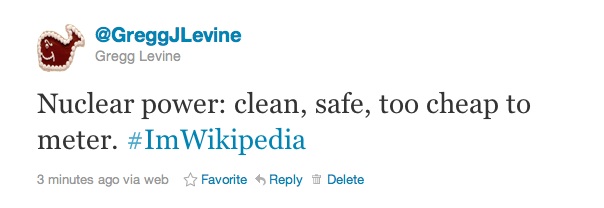
Twitter has refused to join today’s strike (though their CEO says he opposes SOPA), but maybe that’s for the best–because without Wikipedia, we all need somewhere to get our information. And so was born the hashtag #ImWikipedia.

Of course, Twitter does not have a virtual army of fact-checking editors to vet all their “facts,” but, hey, desperate times call for desperate measures!

If you want to learn more about today’s strike, try the Stopsopa Standard. If you want to tell Congress to reject a pair of bills experts say will do little to stop piracy but could do much to chill free speech, then call the Capitol at (212) 224-3121.

Too Cheap to Meter, Too Expensive to Compete

“Clean, safe, and too cheap to meter.” This sunny tagline from the early days of atomic energy has more recently become the quickest way to sum up how dark and dismal its prospects are today–as in, nuclear power has proven itself to be unclean, unsafe, and prohibitively expensive. “Clean, safe and too cheap to meter” now sounds less like boastful marketing, and more like a schoolyard taunt.

The numbers of ways nuclear power plants have betrayed their Madison Avenue mantra has pretty much been the backbeat of this column for nearly ten months now, and 2012 keeps up the cadence.

Exelon Corporation, the nation’s largest owner of nuclear facilities, has already hit a sour note. . . or two.

First, Exelon and Constellation Energy, another major nuclear operator that Exelon agreed to buy last April, have just seen Citigroup downgrade their stock from “buy” to “neutral.” The reason this time, it seems, is not due to the shaky future of nuclear holdings, but instead due to the falling price of natural gas. Gas prices have hit a two-year low thanks to the glut of gas from a nation gone frack-happy.

But why should a Citigroup not worry about the value of nuclear stocks when current problems have required costly shutdowns and repairs, and future improvements that might (might) be required post-Fukushima will necessitate more capital outflow? One need look no further than the same Exelon portfolio, as reflected in a separate story out just one week later:

The U.S. Nuclear Regulatory Commission wants Exelon Corporation to detail its plan regarding a decommissioning fund shortfall for the Limerick Unit 1 nuclear power plant in Pottstown.

“Once we receive the (request for additional information) response, we will make a determination regarding reasonable assurance of adequate decommissioning funding for the plant,” said Neil Sheehan, NRC Public Affairs, via email on Wednesday.

Sheehan said Exelon planned to request rate relief from the Pennsylvania Public Utilities Commission later this year to address the deficit.

“The relief, if approved, would take effect at the beginning of 2013,” Sheehan said.

In other words, a nuclear facility isn’t only ridiculously expensive while it is up and running, generating some power–and so, in theory, some revenue–a nuclear plant is a massive liability for years (decades, really) after it is shut down.

Decommissioning a plant is a process that the Nuclear Regulatory Commission requires operators to finish within 60 years. Yes, it can take that long to safely dismantle a facility, store its moderately radioactive parts and entomb its massively radioactive reactor shell. The cost, as estimated by the NRC itself, is “$300 million or more.”

Indeed, the emphasis should be on “more.” The NRC’s lowball figure not only assumes everything goes smoothly and there are no nasty discoveries, like, say, radioactive contamination of surrounding ground or water, it assumes a constant dollar value over the life (death?) of the decommission. Take note, for instance, that the fund for the decommissioning of one Limerick reactor is at present required to be over $628 million.

But again, why would that not more seriously affect the rating of a company like Exelon, with its vast stable of aged, faulty reactors? Because Exelon, as is the case for all its nuclear brethren, doesn’t expect to have shoulder the costs by themselves–if at all.

Feeling a little light in the decommissioning fund? Do not fear! As pointed out in the story above, Exelon expects rate relief. In other words, Pennsylvania power consumers will pick up the tab in the form of increased electric bills.

Worried the rate hike won’t quite cover it? No problem! As the NRC hints at here and has proven elsewhere, when push comes to dangerous, radioactive shove, the federal government will cover any shortfalls. After all, the alternative–a halfway or half-assed shutdown–is not an acceptable policy option.

Concerned that even with a rate hike and a government bailout something still might go wrong, resulting in pricey lawsuits? Hush, now! Thanks to the Price-Anderson Act, the liability of the nuclear plant operator is remarkably limited.

This is all part-and-parcel of the standard obfuscation procedure and pass-the-buck accounting that allows the nuclear industry to pretend to compete in the energy marketplace. Exelon executives no doubt love to praise the free market, but they are possibly the only ones that get away for anything close to free. Their taxes are discounted, their infrastructure is subsidized, their loans are guaranteed, and their accidents are indemnified, all by state and federal governments, which means all by taxpayers–taxpayers already paying up front for higher energy bills.

Lest this story be misinterpreted, the answer is not, of course, to permit more fracking to continue to drive down the price of natural gas–that option is as rife with dangers as it is ridiculously shortsighted. No, the answer is to take into account all of the money that really goes into nuclear power generation when costing out energy options. Take just a fraction of what the US government expends to backstop atomic energy and invest it instead in improved efficiency, conservation programs, and truly renewable alternatives, and then see what power source can really claim the mantle of clean, safe, and too cheap to meter.

Nuclear Regulator Adds Heat to 2012 Congressional Race

Congratulations go out this first week of the new year to the Nuclear Regulatory Commission for giving Democrats in Ohio’s 9th congressional district a reason to come out and vote in their March 6 primary. . . and for giving residents from Toledo to Cleveland, not to mention those in a large swath of southern Michigan, something to keep them up at night.

As previously reported, the NRC waited till very late on a December Friday to announce a restart of the Davis-Besse nuclear facility, located near Oak Harbor, Ohio, on the banks of Lake Erie. Davis-Besse, of course, has a rap sheet as long and as disturbing as any power plant in the country:

. . . a fire at Ohio’s crippled Davis-Besse facility cut ventilation to the reactor control room. A faulty valve in a pipe sending water to the reactor core leaked on an electrical switchbox, triggering an electrical arc, which started the fire. This could have been a potentially catastrophic emergency. . . had the reactor not been shut down seven weeks earlier to replace an already once previously replaced, corroded, 82-ton reactor lid. This “transplant operation” revealed a 30-foot crack in the concrete shield building that will require a separate repair program. . . which will in no way be completed before the end of the year.

This was all on top of dangerous acid leaks discovered years earlier that caused what was called the worst corrosion ever seen at a US reactor. For their lack of attention to this little detail, Davis-Besse operator FirstEnergy was fined $5.45 million by regulators, and the company agreed to pay another $28 million in civil penalties.

All of this was public information before the NRC signed off on the December restart. But then:

[O]n December 7, one day after the reactor restart, FirstEnergy, Davis-Besse’s operator, admitted that they had withheld news of new cracks on a different part of the structure, which were discovered in November.

But, hey, FirstEnergy said that they only had withheld this information from the public, and that they indeed did report it to the NRC–which, as was observed at the time, raises some serious questions about the honesty, independence and competency of that body.

Well, one month after the commission gave its latest blessing to Davis-Besse, the NRC arranged a public meeting to explain its decision.

Wait–that’s not quite right. Representatives of the Nuclear Regulatory Commission and FirstEnergy were at a public meeting December January 5 at the request Rep. Dennis Kucinich (D), who currently represents Ohio’s 10th congressional district, which lies to the east of Davis-Besse.

And there’s the rub. A victim of a population shift and a gerrymander by state Republicans, Kucinich’s district is disappearing in the next Congress. After much consideration, Rep. Kucinich recently announced that he would try to win back a seat in Congress representing Ohio’s 9th district, thus setting up a primary against House veteran Marcy Kaptur, the Democrat who has represented OH-9 for 29 years.

It should be noted that Kucinich has been on the Davis-Besse case for a very long time, and had called for the public meeting before the new district lines were drawn. But, as fate would have it, both Representatives Kucinich and Kaptur appeared at Thursday’s event.

Kucinich stated that his fight this January night was with the NRC and FirstEnergy, and not with Kaptur, but the contrast was there all the same:

“The cracking is not architectural, it’s structural,” Kucinich said. “FirstEnergy finally admitted this tonight. It’s an issue of public trust. FirstEnergy did not give the public, media or us a true picture of what really happened at the start.”

Rep. Kucinich has repeatedly stated that the Davis-Besse reactor should not have been allowed to restart until plant operators and regulators could explain why the reactor building was cracking and prove that the problem had been arrested. To date, neither of those criteria has been met.

Despite this uncertainty, Rep. Kaptur, whose district includes the troubled nuclear plant, supports the course currently set by the NRC and FirstEnergy–at least that seems to be what she’s saying:

“I came to assure the people that I am a proponent of public safety, I am convinced the NRC did its job this time, and I also want to see advanced energy production that’s affordable and see the plant increase employment,” Kaptur said. “We have to live in the 21st century . . . not the 20th . . . which is what Davis-Besse is providing. I know what [Kucinich] believes, but I’m in my 30th year as a public servant and I think I’ve learned something in that time.”

The Davis-Besse plant is said to account for about 800 jobs–though, since none of the players is proposing the decommissioning of the reactor, it is not clear how delaying restart until safety issues are addressed would change the employment picture. As for living in the 21st Century instead of the 20th, perhaps Kaptur has forgotten that Davis-Besse broke ground in 1970, and came on line in 1978. Its light water reactor design is older still.

As for believing in public safety, beyond the recent fire, the two reactor head replacements and the numerous unexplained cracks, Kaptur probably should be reminded that the plant in her district is the site of two of the five most dangerous US nuclear events since 1979.

As for “energy production that’s affordable,” even a casual reader is by now aware that nuclear power–with its construction costs, costs of operation, costs of fuel mining and refining, costs of spent fuel storage, accident clean-ups, tax breaks, rate subsidies and federal loan guarantees–is one of the most phenomenally uneconomical ways of producing electricity ever conceived.

And, as for the NRC doing its job–“there is a high level of assurance that the reactor building is safe,” said Cynthia Pederson, a regional director with the NRC responsible for the Midwest. But Pederson also confirmed that their investigation into the cracks is ongoing, and most notably, that the NRC is relying on FirstEnergy to sort it all out:

The commission signed off on restarting the plant following several tests and after its owner, FirstEnergy Corp., assured it that the cracks don’t pose a threat.

The commission has given Akron-based FirstEnergy until the end of February to find out what caused the cracks.

Until the cause is known, there’s no reason to order closer inspections at other plants with similar concrete shields, Pederson said.

It’s possible that the cracks have been around for a while, she said. “Concrete has a tendency to crack,” she said.

“Concrete has a tendency to crack”–how is that an acceptable “finding” from a representative of the regulatory agency responsible for guaranteeing the safety of nuclear reactors? Pederson, in her statements Thursday, has made it quite clear that her agency has no idea why the Davis-Besse containment structure is cracking, or whether it has stopped cracking, and that the NRC has relied on the operator’s assurance that the cracks “don’t pose a threat.”

Remember, this is the same operator that previously had to pay out over $33 million in penalties for a previous lapse in judgment, and has just been caught concealing knowledge of additional cracks.

And beyond those structural cracks, Davis-Besse has, time and again, revealed the troubling cracks in the system. Looking at the history of this Ohio reactor–let alone the history of atomic power across the country–the federal agency responsible for policing the nuclear industry has instead proven itself the patsy. FirstEnergy has proven itself untrustworthy, yet the NRC has said that it trusts them, and that the public should trust them, too.

And now, by coming down on the side of FirstEnergy, Marcy Kaptur has volunteered her constituents as participants in this trust exercise, as well. Rep. Kucinich chooses to trust evidence over faith–and that evidence says Davis-Besse is not just an accident waiting to happen, it is a series of accidents, some still in waiting, some now evolving. With the terrifying results of Japan’s Fukushima nuclear accident still very much developing, it seems naïve if not criminal to give the nuclear industry the benefit of the doubt.

So, this first week of 2012, the Kaptur-Kucinich race already has a clear issue. Residents of Ohio’s 9th, you have a clear choice.

The Party Line – December 30, 2011: The Party Line, Nuclear Style

As we close out 2011, readers of this space will likely not be surprised to hear the following:

  • The crisis at Japan’s Fukushima Daiichi nuclear facility continues and continues to poison the planet;
  • Accidents and events at nuclear reactors across the United States continue at a headshaking pace (something goes wrong somewhere pretty much weekly);
  • The nuclear industry continues its full-court press against any new safety rules that might spring from lessons learned from Fukushima or the domestic events;
  • Industry-friendly regulators continue to help slow-walk new rules while also working with allies in Congress to oust the slightly more safety-minded Nuclear Regulatory Commission chair, Gregory Jaczko;
  • Chairman Jaczko continues to hope his faith in a moderate path and a captured regulatory agency will guarantee a safe nuclear future and help save his job; and
  • All of this has happened before.

Last point first: Ryan Grim has a great follow-up on this month’s attempted coup at the NRC–where four commissioners, in coordination with members of congress and nuclear industry lobbyists, have gone public with complaints about the NRC chairman, Greg Jaczko. While the commissioners have stopped short of calling for Jaczko to step down, several GOP congressmen are pressing for just that result.

As Grim reports in the Huffington Post, the effort to oust Jaczko not only continues in the wake of two congressional hearings on the matter, the whole ugly putsch closely resembles moves in the 1990s to discredit another regulation-minded nuclear regulator. And the stories even include some of the same players.

Like with the current “scandal,” the plot is not a simple one to summarize (so please read Grim’s detailed story), but the highlights include a former National Resources Defense Council scientist, Terry Lash, who was appointed by the Clinton administration to run the Department of Energy’s Office of Nuclear Energy, his deputy, one William Magwood, and a staffer for the very nuke-industry-financed Sen. Pete Domenici (R-NM) named Alex Flint.

Thanks to an exploited possible gaffe in protocol and the coordinated work of Domenici, Magwood and Flint, Terry Lash was eventually pushed aside. And Magwood would take over the nuclear division at DOE, first as acting director, and then, under George W. Bush, as the office’s permanent head.

And yes, you’ve read two of those names here before. Bill Magwood is a commissioner at the NRC, a former consultant to the nuclear industry, and one of the most vocal critics of Chairman Jaczko. Alex Flint has run through the classic DC regulatory revolving door, moving between Senate staffer, nuclear industry lobbyist and back, most recently settling in as the top lobbyist for the Nuclear Energy Institute (NEI), the industry’s largest trade association.

The story is as troubling as it is tired. A government agency manipulated by the industry it is supposed to regulate. An industry, protected by bought politicians, avoids accountability while profiting from government largess. Some of that profit is then turned around to lobby and buy another administration’s worth of officials.

And an agency chief who is maybe too slow to realize that the industry and its surrogates will work relentlessly to undermine him and the regulatory body he tries to command.

The lessons here seem obvious and familiar. . . and yet they seem to be lost on so many.

It has been all-too-rare to see broad coverage of the US nuclear industry in the establishment press, yet, during the first week of December, nearly every news organ was Johnny-on-the-spot, repeating the industry storyline. Gregory Jaczko, it seems, was a temperamental leader, so difficult to work with that the NRC’s mission had been compromised.

Beyond the unremarked upon humor inherent in seeing Republican Senators and Representatives suddenly so concerned with nuclear safety, Jaczko himself provided under-reported frame-relief by proving so difficult to work with that he was able to secure the NRC’s unanimous approval of the new Westinghouse AP1000 reactor (despite some very serious concerns about that design and no financial support for construction without billions in federal loan guarantees). And the rest of the commission was able to out-vote Jaczko, four to one, to fast-track the construction and licensing of the new reactors, slated for plants in Georgia and South Carolina.

But perhaps most remarkable is that despite the industry push-back and power-politics, Jaczko still seems to think and act as if nuclear power can be regulated to a safe and prosperous future. The viciousness of the industry attacks and the seriousness of the events of nuclear’s annus horribilis should really disabuse him of that notion.

And the horrible year is not yet over. The last two weeks have seen the first of the debris from the Japanese tsunami hitting US shores, Pacific seals being tested after showing up in Alaska with skin lesions and other symptoms consistent with radiation poisoning, and a report from the International Journal of Health Services linking some 14,000 excess deaths in the US to the fallout from the Fukushima reactors.

Then there is the Japanese interim report on their nuclear disaster describing a regulatory agency unable and unwilling to take control of the crisis. There is the Tokyo Electric Power Company (TEPCO) contention that they are not legally responsible for fallout once it lands on someone else’s property. And here in the United States, there was a valve leak at Mass Pilgrim, a condenser leak at New York’s Fitzpatrick plant, and an event at Vermont Yankee where both of the cooling system’s backup power generators were offline at the same time.

Still, the nuclear industry pushes the notion of an impending nuclear renaissance. It wasn’t true before Fukushima, and it certainly isn’t true after, but with even their supposed nemesis on the NRC helping them build new reactors and relicense old ones, why not keep working the system?

As noted here (but few other places), the December hearing before the Senate Environment and Public Works Committee that was so dominated by the Jaczko cause célèbre was originally scheduled months earlier to track the progress of recommendations from the Fukushima taskforce. An August admonition from Sen. Barbara Boxer (D-CA) seemed to move the commissioners to put some of the recommendations on what passes for a fast track at the NRC, but even that has now been reversed by a majority of commissioners who voted themselves the ability to reject the very rules they previously ordered up. But all the attention in oversight hearings has been focused on Jaczko and his management style–learning the lessons of Fukushima and how that might improve US nuclear safety has been less than a footnote.

So, though Jaczko continues in his job with the public support of the White House, the nation’s regulatory agenda has already been altered. The nuclear industry may not yet have their head, but they’ve demonstrated they own the body.

And now a new year is upon us. The flip of the calendar will not wrap up the Fukushima disaster any more than it will end the parade of lesser events at American nuclear facilities. The nuclear industry will not decide to embrace safety upgrades and stricter regulation any more than the financial community will embrace nuclear power as a good risk. And no matter how many moves Gregory Jaczko makes in the direction of Bill Magwood or his industry masters, neither will ever like him. . . or consider calling off their well-practiced campaign to oust him.

Happy New Year.

It’s My Blogaversary!

(photo: Leo Reynolds)

This is where it all began, December 30, 2005. . . and a few days later, “capitoilette” was birthed as a longer-form sister site. Today, all roads lead (or is it flow from?) here.

If you are really into the oldies-but-goodies, you can check out the links on the “about” page. Thanks to all who have kept up (and gotten down) with me through the years.

Here’s to lucky seven!

You Could Even Say It Glows: NRC Votes to Fast-Track a More Dangerous Nuclear Future

To paraphrase the United States Nuclear Regulatory Commission, Merry Effin’ Christmas.

In a news dump that came a day early (because who really wants to dump on Christmas-Eve Eve?), the Nuclear Regulatory Commission made a pair of moves Thursday that could have significant consequences for America’s nuclear industry–and all the people who have to live with it.

First, the Westinghouse AP1000 reactor design got the big thumbs up:

The Nuclear Regulatory Commission unanimously approved a radical new reactor design on Thursday, clearing away a major obstacle for two utilities to begin construction on projects in South Carolina and Georgia.

Whoa–let’s stop it there for a sec. . . . A “radical new reactor design?” Somebody’s being a good little scribe this Christmas. As previously discussed, there is nothing radical about the AP1000–it’s a tweak on the generations-old pressurized water reactor design that theoretically would allow the core to avoid a meltdown in the event of a total loss of AC power. . . .

Well, for 72 hours, anyway.

After that, the manufacturer–in reality the Japanese owner of Westinghouse, Toshiba–says something about it taking only “minimal operator effort” to avert disaster.

Keep in mind that the AP1000 was designed well before the Japanese earthquake and tsunami that started the ongoing Fukushima disaster, but this approval, of course, comes well after.

Designers of the AP1000 assert that gravity and convection will serve to keep reactor cooling functioning even if systems are disabled as they were at Fukushima. That assertion is predicated on the storyline that the Daiichi plant’s safety systems survived the massive quake, and only ran into trouble when the tsunami flooded and disabled the diesel backup generators that powered cooling systems for the reactors and the spent fuel pools.

That is a capricious assertion for two very disturbing reasons:

First, it is by no means established fact that Fukushima’s cooling systems survived the earthquake undamaged. Reports from the Japanese government and TEPCO, Fukushima Daiichi’s owner-operator, have gone back and forth on this matter. It would be naturally beneficial to nuclear advocates to go with the story that the quake did nothing to the reactor and its safety systems. But given the visible damage to the plant and the surrounding area, and given the profound leaking of cooling water that has continued seemingly unabated from the earliest days of the disaster, it is hard to believe all pipes, tubes, couplings, fittings, vents and valves–not to mention the containment vessels and tanks themselves–remained watertight after the massive temblor.

Second, the earthquake worthiness of the AP1000, itself, has been officially questioned by senior NRC officials and Rep. Ed Markey (D-MA), the Ranking Member of the House committee charged with overseeing nuclear regulation:

Just days before the earthquake in Japan, Rep. Markey wrote a letter to the NRC urging the Commission not to approve the Westinghouse AP1000 design until serious safety concerns were addressed. One of NRC’s longest-serving staff, Dr. John Ma, had warned in NRC documents that the reactor’s containment could shatter “like a glass cup” due to flaws in the design of the shield building if impacted by an earthquake or commercial aircraft. The shield building has the critical safety function of preventing damage to the reactor that could cause fuel meltdowns and radiation releases.

Note, Dr. Ma has been with the NRC since its inception, and this was the first non-concurrence dissent of his career. The NRC acknowledged this concern and asked Westinghouse for a response. . . and the response was, essentially, “nah-ah.” A response that has now proven good enough for the agency tasked with assuring the safety of America’s nuclear reactors.

So, it theoretically would be great if the AP1000 were able to survive without melting down through three days without electrical power–though it should be noted that three days wouldn’t have really saved Fukushima’s bacon (even if it had remained intact) given the devastation to the region’s infrastructure. But that semi-sunny selling point on the AP1000 assumes that there would still be a reactor containment building to cool.

It is the kind of “what could possibly go wrong” assumption that has tripped up nuclear power generation in large and small ways throughout its history–and it is stunning that, especially in the wake of the Japanese crisis, this cavalier attitude continues.

But perhaps it is not so surprising when we consider just why the AP1000 has such a novel/brittle containment building: it is supposedly cheaper to build.

The AP1000 is slated to have a smaller footprint with fewer components, but still use off-the-shelf, previous-generation parts. Most notably, the design uses under a fifth the amount of concrete and rebar, compared with existing PWRs.

Not convinced that economics is the real driving force behind this “innovation?” Take a look at the other action the NRC announced Thursday:

In an unusual step, the commission waived the usual 30-day waiting period before its approval becomes official, so its decision will be effective in about a week. That moves the utilities closer to the point where they can start pouring concrete for safety-related parts of the plant.

The decision also moves the industry toward the first test of a streamlined procedure in which the commission will issue a combined construction and operating license. Up to now reactors had to obtain a construction license and then undergo a long wait for an operating license, resulting in expensive delays in starting up reactors that had essentially been completed.

The approval of a shaky design is disturbing, but the approval of a process that will allow that design to move to completion and operation with far fewer pauses to test safety is unconscionable. (And the fact that this happening because of bottom-line concerns is criminal.) As the distinguished gentleman from Massachusetts put it:

“Today, the NRC has presented its holiday gifts to the nuclear industry,” said Rep. Markey, top Democrat on the House Natural Resources Committee and a senior member of the House Energy and Commerce Committee. “Instead of doing all they should to protect nuclear reactors against seismically-induced ground acceleration, these Commissioners voted to approve the acceleration of reactor construction. While they continue to slow walk the implementation of recommendations of the NRC professional staff’s Near-Term Task Force on Fukushima, they have fast-tracked construction of a reactor whose shield building could ‘shatter like a glass cup’ if impacted by an earthquake or other natural or man-made impact.”

And it is important to mention that the approval of this accelerated process came over the objections of NRC Chairman Gregory Jaczko–who just last week faced both House and Senate panels questioning his leadership style–but the certification of the AP1000 design did not. In fact, at the same time news of the Jaczko witch hunt was blocking out the sun, the NRC chair was actually working with other commissioners–the ones who sent a letter to the White House saying Jaczko was impossible to work with–to secure the unanimous OK for the new reactor.

It is not the first time those wary of a nuclear renaissance had been presented with the dilemma of both praising and cursing Jaczko. In fact, just last week, on December 15, Jaczko was the only vote in support of a move to make all recommendations of the post-Fukushima Near-Term Task Force report mandatory for the “adequate protection” of nuclear power plants. The four other NRC commissioners asserted that it was “premature” to make such a rule–and so Fukushima’s lessons continue to go unlearned, over Jaczko’s protestations and lonely protest vote.

But it is just this sort of nightmare-inducing nuclear mollycoddling that should convince Jaczko that the process he has often praised is deeply flawed. He cannot advocate for new safety rules one week and then grant license to the industry that works so hard against those rules the next. Not if he really wants change; not if he really cares about public safety.

Regulatory Meltdown Goes Nuclear: Will Attacks on NRC’s Jaczko Kill Post-Fukushima Upgrades?

NRC Chmn. Jaczko testified Wednesday before the House Committee on Oversight and Government Reform.

If you like politics as blood sport, this is great stuff. On the other hand, if you worry about people, their lives, their health, how their money is spent and how their government protects their lives, their health and how their money is spent, well, then, this sucks.

If you had been waiting for the three-month follow-up to the Senate Environment and Public Works committee hearing on the Fukushima Near-Term Task Force recommendations–the one Sen. Barbara Boxer (D-CA) promised in August at the last hearing on this issue of vital importance to US nuclear safety–well, that hearing was yesterday, Thursday, December 15. . . and whether you watched them or not, you are still waiting.

Though this hearing was, indeed, scheduled months ago, and was introduced Thursday by Boxer with the insistence that the committee should focus on the progress of post-Fukushima lessons learned, the Senators instead behaved much like some of their House brethren had the day before, spending over two-and-a-half hours debating whether Nuclear Regulatory Commission chairman Gregory Jaczko was either a bad chairman. . . or the worst chairman ever.

As has been detailed so many places, the four other NRC commissioners sent a super-complainy letter to the White House essentially accusing Jaczko of making decisions they disagreed with. . . oh, and yelling, banging his gavel, and causing three unnamed female NRC employees to cry. Not to belittle any real problems with real bullying, harassing, martinet bosses, but given the context–seeing this letter “leaked” by House Oversight and Government Reform Chairman Darrell Issa (R-CA) just before the scheduled release of a report (PDF) from Rep. Ed Markey (D-MA) accusing members of the NRC (most notably industry loyalist and Obama appointee Bill Magwood) of conspiring to slow-walk and/or submarine safety upgrades that Jaczko wanted to see adopted after the Fukushima disaster–it is hard to see this dustup as anything but a distraction and a witch hunt.

And it is hard to see the Representatives and Senators (all of them Republican) who spent the last two days berating Jaczko as anything but clumsy puppets of a nuclear industry hell-bent on seeing that nothing more is required them, memorable nuclear nightmare or no.

Look no further than Rep. Issa’s introductory statement at his Wednesday hearing, in which he so badly butchered the names of four of the five NRC commissioners seated in front of him. Issa did OK with “Magwood,” but the verbal Play-Doh that he substituted for “Jaczko,” “Svinicki,” “Apostolakis” and “Ostendorff” demonstrated either a purposeful slight of those “fereign” soundin’ names, or a complete and total ignorance of the matter at hand.

Now, I will cop to having botched the pronunciation of Chairman Jaczko’s name (I now have it on good authority that it is pronounced YAHTZ-ko), but in my defense, I was just going by what I heard on radio and television. Issa, on the other hand, should, in his role as a House member tasked with oversight of the NRC, and as a man who has pushed this apparent scandal as the single most important thing confronting nuclear regulation right now, have a familiarity if not a close working relationship with these people. His demonstration that he did not seemed to say that rather than have any deep knowledge of the matter at hand, Issa was likely just reading what had been placed in front of him by folks who had paid for the right to put words in the mouth of a US Congressman.

Now, as has been mentioned before, it is hard to find the energy to go to the mat for Chairman Jaczko, who may be the most liberal commissioner at the NRC, but is still not seizing this Fukushima moment and truly rethinking US nuclear policy. Perhaps Kevin Kamps of Beyond Nuclear put it best: “He’s not ‘our guy’ by any means, he has voted to re-license plants that should probably be shut down. But he does care about safety, in ways that the others do not.” It is hard not to wish that Jaczko were the worst commissioner at the NRC instead of the best. But it is easy to be outraged by what has happened to Jaczko, and more importantly, what has happened to the fight to improve the safety of America’s nuclear facilities.

And it was hard, while watching the House and Senate hearings within the boundaries of a TV screen, not to think you were seeing some colorized clip from the McCarthy era. The innuendo, character assassination and countless hours of self-righteous grandstanding from Republicans that all-of-the-sudden were oh-so-concerned about supportive work environments and reactor safety went beyond politics-as-usual–it was business as usual, and politics as business. A naked power play by an entrenched, privileged, presumptuous and protected industry.

But now what? This round goes to the nuclear industry–hats off–they made a week that should have been about following up on Fukushima taskforce recommendations, and made it instead about the regulator that dared to regulate. Big nuclear put reformers on their heels at a time when the literal and political fallout from Fukushima should have nuclear apologists running for the hills.

But this is far from over. Darrell Issa, Sen. James Inhofe (R-OK), commissioners Magwood, Svinicki, Ostendorff and Apostolakis, and the nuclear lobby that buttresses all of them will not stop here. The two days of hearings may have ended with a plea for a bunch of smart and dedicated public servants to “work it out,” but watching the events of the last week (and reading the emails included in Markey’s report) make it clear this is not just a war on Jaczko, this is a war on regulation. It may look on the surface like so much bread and circuses, but big nuclear’s henchmen are prepared to feed Christians to the lions all day long. Pro-nuclear forces will accept nothing short of an unobstructed path to privatized profits with socialized risks.

So, the ball’s in your court, Chairman Jaczko. Will you try to give the industry some of what it wants–go ahead with approval of the new AP1000 reactors, the restart of derelict facilities like Davis-Besse and Crystal River, and the relicensing of aged, Fukushima-class plants–in the hopes that somehow this will make the masters of the nuclear universe like you more? Or will you stand fast, indeed, stand faster–pause the relicensing, stop new construction, accelerate post-Fukushima safety upgrades–and stare down the lobbyists and wholly owned elected officials?

If they want to pose as Joe McCarthy, then you, Chairman Jaczko, channel your inner Joseph Welch: “Have you no sense of decency, sir, at long last? Have you left no sense of decency?”

Thanks to a rare alignment of personal interests and election-year politics, it appears the White House has the NRC chairman’s back (at least for now)–Jaczko should use the opportunity to look forward.

The War on Gregory Jaczko: Attempt at NRC Coup Evidence of Bigger Problems

NRC, nuclear

NRC Chair Gregory Jaczko (photo: Gabrielle Pffaflin/TalkMediaNews)

Readers of this space know that the pace of safety reforms for America’s nuclear facilities, especially in the aftermath of Japan’s Fukushima disaster, has been alarmingly slow. The recalcitrance–if not active hostility–exhibited by the nuclear operators and their government handmaidens borders on the criminal. So, it might sound more than a little bit shocking to hear that the chairman of the Nuclear Regulatory Commission, Gregory Jaczko, is now under attack. . . for trying to implement new safety standards too quickly.

That’s not how House Oversight and Government Reform Committee Chairman Darrell Issa (R-CA) is putting it, of course. In doublespeak that would make Orwell proud, Issa has written to the White House, issued a report, and fallen just shy of calling for Jaczko’s head:

“The current Chairman, through his blatant disregard for the Commission and its core beliefs, is testing this resolve,” the report says. “The NRC has survived thus far but the cracks are forming and all symptoms point to catastrophe.”

The report comes several days after Issa released a mid-October letter from the NRC commissioners to the White House that alleges that Jaczko is causing “serious damage” to the agency that could harm the body’s ability to protect health and safety.

The reality, of course, is that Issa–who has summoned Jaczko and fellow commissioners to appear at hearings this very day–has a vested interest in obstructing new health and safety rules, and the hubbub and hearings he is now orchestrating do not in any way focus on post-Fukushima lessons learned, unless that lesson is that the nuclear industry must engage a full-court press to preserve their privilege and profits in light of a new global awareness of the true cost and real dangers of nuclear power.

Since taking the gavel at Oversight, Issa has used his authority to disrupt government’s regulatory roll in the service of his corporate benefactors. In the case of the nuclear industry, Issa’s district includes the San Onofre Nuclear Generating Station (SONGS), and Edison International, which owns nearly 80 percent of SONGS through its subsidiary, Southern California Edison, is Issa’s third largest source of career campaign contributions:

[Edison’s] political action committee has given Issa’s campaigns $46,000 over the years, including $5,500 during the last cycle. The PAC has also given $10,000 to Issa’s own PACs.

A company–in this case a nominally public utility–paying the piper and calling the tune is, sadly, not necessarily breaking news in 21st Century American politics, but when it comes to the nuclear sector, the level of influence and the nakedness of the quid pro quo should offend everyone.

And the ties don’t stop at the electoral level. Many regulators today come with strong connections to the industries they are supposed to regulate, but few demonstrate a closer relationship or a more unsettling affinity for their private-sector counterparts than NRC commissioner William Magwood, IV.

As reported in October, Bill Magwood, an Obama appointee, spent many years in the Bush administration’s Department of Energy as director of the Office of Nuclear Energy. During that time, Magwood was alleged to have had regular private meetings with Marvin Fertel, then-Senior Vice President and now President and CEO of the Nuclear Energy Institute (NEI), the lobbying arm of the nuclear power industry. (Not, coincidently, Fertel is quoted in several of this week’s stories hostile to Greg Jaczko.) FOIA requests were filed for records of those meetings, but Magwood’s email correspondence and calendars were destroyed just one month after he left the DOE in 2005.

After leaving the Bush administration, Magwood formed a consulting firm, Advanced Energy Strategies, which had as clients many of the nuclear power companies he dealt with at the Department of Energy and is now tasked with regulating as a commissioner at the NRC. One of those clients, as was uncovered this week by The Huffington Post’s Ryan Grim, was TEPCO, the Japanese power consortium that officially still owns and operates the damaged Fukushima Daiichi nuclear facility. And that’s not all:

Magwood’s recent client list makes up a who’s who of Japanese power and nuclear companies, and included CLSA Japan Equities Division, the Federation of Electrical Power Companies in Japan (FEPC), IBT Corporation, Marubeni Corporation, Mitsubishi Heavy Industries, RW Beck, Sumitomo Corporation and the Japan Atomic Energy Agency, which was roundly criticized for its response to the crisis.

It is Jaczko’s use of his authority to push for new rules based on the post-Fukushima Near-Term Task Force (NTTF) recommendations that reportedly triggered the discord that motivated Issa’s current attack. But the controversy is deeper and more complicated.

First, Magwood and other NRC commissioners were vocally differing with Chairman Jaczko before the Fukushima nightmare started. Most notably, some of the commissioners and much of the nuclear industry were upset when Jaczko removed the unfinished Yucca Mountain nuclear waste facility from the NRC budget after President Obama announced an end to the troubled Nevada dumpsite. Magwood was a strong proponent of Yucca Mountain during his years at the DOE and after, when he worked in the private sector. US nuclear facilities face a spent-fuel disposal crisis, and desperately need the federal government to take the hazardous waste off their hands.

Second, though the commissioners’ complaint was written and delivered to the White House in October, it was only made public by Rep. Issa last Friday. A slot usually reserved for news dumps seems like bad timing if Issa and his allies wanted to create a splash, unless you consider that Rep. Ed Markey (D-MA) had planned to release a report on Monday showing how NRC commissioners had coordinated with pro-nuclear legislators to slow or stop post-Fukushima safety reforms. Markey’s report (PDF) includes emails revealing commissioner Magwood and staffers for pro-nuclear Sen. James Inhofe (R-OK) worked together to discredit Jaczko for taking the lead on the US regulatory response to Fukushima.

Magwood, it should be noted, is thought to be next in line for NRC chief, if attempts to unseat Jaczko are successful.

Still, as internecine as all this sounds, this story would be easier to grasp if it were a simple tale of strong regulators vs. industry shills. Alas, as has often been the subject of these columns, the Jaczko-led NRC is far from the zealous industry antagonist depicted in pro-nuclear critiques. While Greg Jaczko might be the most regulation-friendly member of the current commission, his positions and policies are hardly progressive.

Those post-Fukushima recommendations, while all positive moves, are still weak tea when compared with the crisis that motivated the report. The speed at which they will be adopted–if they are ever adopted–can only be described as glacial. Despite Jaczko’s expressed wish that post-Fukushima realities be considered in the design, licensing and re-licensing of US reactors, the approvals of new construction and the renewals of operating licenses for aged reactors continue without any additional, Fukushima-influenced requirements. Further, disturbing domestic nuclear power events have not been met with the level of scrutiny they deserve.

November alone saw the approval of new reactors in South Texas, the refusal to consider the Fukushima report in the proposed relicensing of Seabrook, and reactor restarts of the quake-damaged North Anna facility and of the troubled Davis-Besse plant, even after its owner was forced to admit the presence of new cracks in its reactor building.

In October interviews, Jaczko expressed an interest in increased safety, but he also hid behind a regulatory process that quite plainly was not accomplishing his stated goals. The chairman also made assertions about the lifespan of reactors and the long-term safety of on-site spent-fuel storage that seemed cavalier and contrary to both existing evidence and current science.

While Jaczko might wish to see the Fukushima taskforce recommendations become rules, his pronouncements on the need for progress were weaker than the demands made by Sen. Barbara Boxer (D-CA) before her Environment and Public Works Committee (one of the committees charged with oversight of the NRC) during August hearings on the NTTF report:

The California Democrat said that if the industry wanted to operate and expand, it had to demonstrate that it could do so safely. Boxer stressed that it was important that citizens saw regulators as their defenders, able to act quickly in response to a crisis and honestly assure the safety of nuclear facilities. It takes a trusted regulatory regime for an industry to prosper.

. . . .

Boxer, to her credit, vowed to hold hearings every 90 days to push for action on the task force report.

The decision to stop construction on the Yucca Mountain waste facility, while the right one, was as much a victory for NIMBY politics as it was for progressive values. Indeed, Nevada Sen. Harry Reid (D), long an opponent of putting a nuclear dump in his state, was once Jaczko’s boss. The end of Yucca Mountain and Jaczko’s NRC job likely owe much to Reid’s early support of Obama in 2008.

Now Reid and Obama (through his Chief of Staff, Bill Daley) have come out for Jaczko again. But is this enough to counter the nuclear industry’s attempt at a coup?

While it would not be a surprise to see “no drama” Obama–who has benefitted greatly from nuclear industry campaign contributions–abandon his NRC chief, especially in the run-up to the 2012 election, it would be more difficult if anyone outside the Beltway felt moved to fight on Jaczko’s behalf.

It’s been the same story for Democrats for years now–Jaczko’s fight is just the latest example. Democrats from the president on down have repeatedly leaned right, disheartening and alienating their activist base, while gaining no measurable concessions from Republican opponents. Nothing Jaczko has done to appease the nuclear industry (or their government surrogates) has made them like him any more–to them, any regulator is a bad regulator. The nuclear lobby wants their loan guarantees, their tax breaks, and their Price-Anderson indemnity without any strings attached.

While it is very possible that any chair that replaces Jaczko will be even friendlier to the nuclear industry, there still exists little pro-Jaczko excitement on the left. Fukushima is a signal moment (well, in actuality, it is a never-ending series of signal moments), one that demands a much broader rethink of US nuclear policy than the regulatory tweaks in the taskforce report. If Jaczko and his elected allies want to energize America’s very-energize-able anti-nuclear community, then they need to seize the Fukushima moment with more than a proposal that better backup power systems be in place at some nuclear plants by 2016.

In the wake of the Japanese earthquake, the nuclear industry mobilized to secure their bottom line. Before there were recommendations to oppose, the industry had a plan in place to oppose them. If Jaczko and his backers want to see a mobilized response to this industry putsch, then they have to give people something to fight for. They can’t just make a few ripples and hope pro-nuclear forces will let it go; Jaczko, and Markey, and Boxer–and any others in government that grasp the meaning of nuclear’s “annus horribilis“–have to make waves.

Gregory Jaczko Has a Cold

NRC Chairman Gregory Jaczko (photo: pennstatelive)

In April 1966, Esquire Magazine published a story by Gay Talese that is still considered one of the greatest magazine articles of all time; the article, the cover story, was titled “Frank Sinatra Has a Cold.”

The piece, still very much worth the read, says much about celebrity, journalism, and, of course, celebrity journalism, but germane here is a point Talese makes early on: for most people, having a cold is a trivial matter–after all, it’s called the “common” cold–but when a man, a cultural icon, a giant of stage and screen like Sinatra (remember, this is 1966) has a cold, well. . . .

Frank Sinatra with a cold is a big deal. It affects him, his mood, his ability to perform, and so it affects his friends, his entourage, his personal staff of 75, his audience, and perhaps a part of the greater popular culture. In other words, as Talese wants you to understand, in this case, a cold is anything but trivial.

Gregory Jaczko, the chairman of the United States Nuclear Regulatory Commission, made some comments to the press earlier this week. Jaczko, it seems, is worried. He believes, as noted in an Associated Press story, that “U.S. nuclear plant operators have become complacent, just nine months after the nuclear disaster in Japan.” The NRC head thinks that a slew of events at over a dozen domestic nuclear facilities reveal the safety of America’s reactors to be something less than optimal.

To be clear, safety concerns at any kind of plant, be it a soda bottler or a microchip manufacturer, are probably not trivial, but when the safe and secure operation of a nuclear facility comes into question–as the aftermath of Chernobyl or the ongoing crisis in Japan will tell you–it ratchets up concern to a whole different level. So, when the man who more or less serves as the chief safety officer for the entirety of the nation’s nuclear infrastructure says he’s worried, many, many other people should be worried, too.

To put it another way, Greg Jaczko has a cold.

But that’s not the scariest part.

When Frank Sinatra had a cold, he knew he had a cold–pretty much everyone knew he had a cold. It was unpleasant for all of them, but forewarned is forearmed. Jaczko, though, doesn’t know–or won’t acknowledge–he’s sick. As relayed by the AP:

Jaczko said he was not ready to declare a decline in safety performance at U.S. plants, but said problems were serious enough to indicate a “precursor” to a performance decline.

Pardon my acronym, but WTF does “‘precursor’ to a performance decline” mean?

It sounds like a way to talk about erectile dysfunction, but perhaps a more accurate analogy is to say that Greg Jaczko has just told us that, yes, actually, you can be a little bit pregnant.

Of course, that is not true. Either safety–with regards to protocols, equipment and people–is up to snuff, or it is not. As Jaczko observes–and the many “unusual events” he has had to deal with this year make clear–the safety of America’s nuclear reactors is not where it needs to be:

Mr. Jaczko said the NRC has noticed an increase in “possible declines in performance” at some U.S. nuclear facilities, including instances of human error that almost exposed workers to high levels of radiation. He said a number of nuclear plants have experienced safety challenges in recent months, and that two of the plants were having significant issues.

The chairman’s classic understatement here is magnified by the Wall Street Journal. Beyond the fact that “possible declines in performance” means flat-out “declines in performance,” the human error referred to here didn’t “almost” expose workers to high levels of radiation–the accidents at Cooper Nuclear Station in Nebraska and the Perry Nuclear Power Plant in Ohio most definitively exposed workers to high (and possibly dangerously high) levels of radiation.

And the two plants having significant issues–which would those be? Would they be Crystal River in Florida, where news of a third major crack in the containment building recently came to light, and Nebraska’s Fort Calhoun, which is still shut down after flooding earlier this year? Or might they be New Hampshire’s Seabrook, where crumbling concrete was discovered in November, a month after the plant had to shut down because of low water levels, and Vermont Yankee, where radioactive tritium continues to leak into the Connecticut River?

Or maybe Jaczko was referencing North Anna, which of course scrammed when the Mineral Springs, VA, earthquake shook the reactors well in excess of their designed tolerances. Or maybe he’s including Calvert Cliffs in Maryland, where a piece of siding blown off by Hurricane Irene shorted a transformer, and the resulting loss of power to safety systems caused its reactor to scram. And who can forget Michigan’s Palisades nuclear power plant, which had to vent radioactive steam when it scrammed after worker error triggered a series of electrical issues?

Is it possible the NRC head was thinking of the constantly troubled Davis-Besse plant near Toledo, Ohio? Probably not–since the Commission just (as in 4:40 PM on Friday, December 2) okayed a restart there, despite serious concerns about numerous cracks in its shield building. But perhaps Jaczko should think again–on December 7, one day after the reactor restart, FirstEnergy, Davis-Besse’s operator, admitted that they had withheld news of new cracks on a different part of the structure, which were discovered in November. (FirstEnergy says that they only withheld the information from the public, and that they did report it to regulators–which raises grave questions about the honesty, independence and competency of the NRC and how it could approve a restart.)

Representative Dennis Kucinich, by the way, is thinking of Davis-Besse. The Ohio Democrat had called for public hearings in advance of the restart, and is now criticizing both FirstEnergy and the NRC for their lack of candor about the new cracking.

Kucinich appears to understand something that Jaczko does not: when it comes to oversight of the nuclear industry, there is no room for even the germ of a doubt.

To extend the illness-as-metaphor metaphor a little further, there is a construction often used to imply the broadly felt repercussions of a single action or a major actor: When “x” sneezes, “y” catches a cold. The phrase is believed to have started during the worldwide depression that spread after the U.S. stock market crash of 1929–as in, “When America sneezes, the whole world catches cold.” The cliché has come back into vogue during the last three years of global economic tumult, but it could easily be adapted to the ongoing perils of nuclear power.

On November 26, the Asahi Shimbun gave the world another measure of just how big a disaster the ongoing crisis at the Fukushima Daiichi nuclear facility has become:

Radioactive substances from the crippled Fukushima No. 1 nuclear power plant have now been confirmed in all prefectures, including Uruma, Okinawa Prefecture, about 1,700 kilometers from the plant, according to the science ministry.

The ministry said it concluded the radioactive substances came from the stricken nuclear plant because, in all cases, they contained cesium-134, which has short half-life of two years.

Before the March 11 Great East Japan Earthquake, radioactive substance were barely detectable in most areas.

Or, it could be said, when Fukushima sneezed, all of Japan caught a cold.

And not just Japan, of course. Fallout from Fukushima has drifted halfway around the world. Radioactive isotopes directly linked to Japan’s crippled reactors have been detected in milk and vegetables across the U.S. and Canada. And the Pacific Ocean, too, has been contaminated–and continues to be more so. December brings news of new leaks sending more radioactive runoff from the Japanese reactors into the sea. Tens of thousands of tons of overspill have already flowed into the waters around Japan’s northeastern coast–bringing levels of radioactivity to thousands of times what is considered acceptable–and TEPCO, still nominally the Fukushima’s operator, just had to scrap plans to dump untold tons more after protests from Japanese, Chinese, and Korean fishing concerns. (The contaminated water, still collecting at the plant at a rate of 200 to 500 tons a day, will exceed the facility’s 155,000-ton storage capacity by March.)

The effects of bioaccumulation–as dangerous isotopes move with global tides, and contaminated fish (and their contaminated predators) migrate–presents scientists with a long-term research project where much of the world’s population will serve as unwilling subjects.

And, as has been noted here many times, the crisis is far from over. Even TEPCO’s own conservative (or is that “dishonest?”) models now confirm a core melt-through in reactor 1. TEPCO officials insist that somehow they will cool the surrounding steel or concrete enough to stop the molten corium from going further, but the architect of Fukushima Daiichi Reactor 3, Uehara Haruo, sees things very differently. As relayed by Kevin Kamps of Beyond Nuclear, Haruo says:

It is only a matter of time before the molten core, at least of Unit 1–if not Units 2 and 3–does reach ground water, and if it hits it right. . . you’re going to have a powerful steam explosion.

And, as Kamps explains, that steam explosion will again send massive amounts of radiation into the atmosphere. As longtime nuclear activists Paul Gunter recently put it, “It’s pins and needles time,” implying that while much is unknown about what is going on inside the destroyed reactors, nothing indicates TEPCO is gaining the upper hand on this dire situation.

Yet, with all this–with the spreading fallout, the continuing radioactive water leaks, and the real threat of what so many refer to as a “China Syndrome” event–NRC Chair Jaczko worries that the U.S. nuclear industry has become complacent about the safety gaps highlighted by the Fukushima disaster. Given the evidence–and given that the NRC itself spent all summer studying the crisis and drafting recommendations based on “lessons learned”–it is hard to believe complacency is really the problem. It is probably even too generous to say that the industry suffers from willful ignorance. No, when considering the contagion spreading from Japan and the coughs and hiccups that are practically weekly here in the United States, it is probably more accurate to say that the profit-driven, government-protected nuclear sector is actively callous.

The risks, after all, of the nuclear business model are not borne by power companies. In the U.S., federal loan guarantees, state tax breaks and utility rate hikes insulate nuclear operators from the costs of slipshod construction, poor training, and malign management. Even without that, perhaps the only lesson the domestic nuclear industry will choose to learn from Fukushima is that when a catastrophe like this happens, the government is given no choice but to step in. (Beyond the price of the cleanup, and the healthcare and relocation of those in severely contaminated regions, note how TEPCO’s stock price fell all week after word leaked that the Japanese Government would buy $13 billion worth of new shares.)

So, what’s a chief regulator to do? Given the overwhelming evidence of industry arrogance in the face of real danger, Jaczko could have an “I am Hamlet, Prince of Denmark” moment, seize his birthright, as it were, and actually demand compliance from the industry he has been tasked to oversee–but, judging from his tone in many interviews, and the continuing approvals of new and renewed operating licenses, it seems more like the NRC chief will remain the Hamlet of the first four acts of the play.

WWSD–What Would Sinatra Do? Read through the Esquire piece and see how, despite his froggy throat and foul mood, Sinatra takes control of his world. In the end, as Sinatra drives his Karmann Ghia down a sunny LA street, a pedestrian sees him through the windshield and stares, wondering, “Could it be? Is it?” Sinatra, knowing he has done what needed to be done–and done it well–stares back, as if to confidently say, “Yes, it is.”

Gregory Jaczko would do well to read (or maybe re-read–who knows?) “Frank Sinatra Has a Cold.” Even if his nuclear rat pack won’t learn the lessons of Fukushima, the NRC chairman could learn a thing or two from the Chairman of the Board. Let’s hope Jaczko does so before his cold gets worse–because the possibility of another Fukushima, here in the United States, is nothing to sneeze at.

Greenpeace Activists Enter French Nuclear Plant, Hang Banner to Highlight Lax Security

EDF's nuclear plant at Nogent-sur-Seine, France (photo: Aramis1955)

You Just Can’t Find Good Help These Days.

Not only were members of Greenpeace able to get past the security guarding at least one, and possibly three, nuclear facilities in France, they were able to plan and execute this operation less than a month after the plant operator, French energy giant EDF, was fined 1.5 million Euros ($2 million) for hacking into Greenpeace computers.

So, how bad is security at France’s 58 nuclear power plants? You be the judge:

Activists from environmental group Greenpeace managed to sneak into a nuclear power plant near Paris Monday in a move they said highlighted the dangers posed by France’s reliance on atomic energy.

. . . .

In a statement, Greenpeace said some members had entered the nuclear site at Nogent-sur-Seine, 95 kilometers southeast of Paris, to “spread the message that there is no such thing as safe nuclear power.”

“A group of militants managed to climb on to the dome of one of the reactors, where they unfurled a banner saying ‘Safe Nuclear Power Doesn’t Exist,’” said Greenpeace spokesman Axel Renaudin.

“The aim is to show the vulnerability of French nuclear installations, and how easy it is to get to the heart of a reactor,” said Sophia Majnoni, a Greenpeace nuclear expert.

Greenpeace activists also hung banners at two other EDF plants (EDF–or Electricite de France SA–runs all of France’s nuclear power stations), but as of this writing it is not yet clear whether those banners were unfurled in- or outside of security gates.

The government of Nicolas Sarkozy has demonstrated a full-throated commitment to nuclear energy–despite popular calls in the wake of the Fukushima crisis for a reexamination of the dominant role nuclear plays in generating France’s electricity. Just last month, thousands of French protestors delayed a convoy of nuclear waste from being transported to Germany (the hazardous waste has since made it across the border). Germany’s Prime Minister Angela Merkel has signaled her country will phase out nuclear power in the next ten years.