The Party Line – October 28, 2011: NRC Moves to Adopt Fukushima Recommendations “Without Delay”

The US Nuclear Regulatory Commission voted last week to implement recommendations from the Near-Term Task Force Review of Insights from the Fukushima Daiichi Accident (PDF), and to do so “without delay.” Coming over seven months after the earthquake and tsunami that started the crisis in Japan, and over four months after the Near-Term Task Force (NTTF) issued its report, the move highlights what might be accomplished when attention is paid, but also illustrates systemic flaws in the US nuclear regulatory regime.

The NRC identified a set of top-tier recommendations that focus on:

  • Re-evaluation of seismic and flood hazards;
  • Inspections after earthquakes and floods;
  • New regulations for “station blackouts” (the loss of all AC power at a reactor);
  • Reliability of vents on Mark I and Mark II containments; and
  • Better instrumentation for monitoring spent fuel pools.

This list does not represent the entirety of NTTF recommendations, just the ones the NRC wishes to see fast tracked (you know, “without delay”)–which, when it comes to nuclear regulation in the United States, means years. The NRC said its staff “should strive to complete and implement” these changes by 2016 (though Commission Chairman Gregory Jaczko said he thinks the station blackout rule can be adopted by April 2014 (PDF), so fasten your seatbelts).

Now, these recommendations (as opposed to actual rules, which still have to be drafted) do address some of the specific weaknesses exposed by the Japanese disaster–multiple external threats, power interruptions, hydrogen buildup, failing spent fuel storage systems–and that’s a positive step because these problems are quite real and quite possible at many of America’s nuclear power plants. But these fast-tracked proposals make up only seven of the 12 or 13 recommendations in the NTTF report–which, itself, is several points short of a truly comprehensive response to the threats Fukushima brought to the fore–and the process (much beloved by Chairman Jaczko) relies heavily on the cooperation of other government agencies, the good faith of the nuclear industry, and a seemingly magical belief that manmade or geologic events on a level with the March earthquake and tsunami will not happen here until after everything is brought up to code.

So, yes, there is a process for identifying problems (at least after they happen) and proposing some fixes with something approximating alacrity–which raises the question of why the system has not been more responsive over the last 50 years–but history and experience make it clear that process does not equate with performance.

During an interview earlier this month, NRC Chair Greg Jaczko was asked about one of his biggest efforts before the Fukushima crisis (PDF & Flash)–improving fire safety at nuclear facilities. Jaczko reflected on it this way:

[A]fter the Browns Ferry fire, we came up with a new set of regulations. Those regulations ultimately I think were very, very challenging to implement, so we’ve been struggling really for several decades to really implement those in an efficient and effective way. That’s not to say we don’t have strong fire protection programs, but we don’t have the most effective way to do it.

The Browns Ferry Fire happened in 1975. Jaczko has been an NRC commissioner since 2005; he has been chairman since 2009. And yet, here, now, in October 2011, 36 years after a guy checking for air leaks with a candle started a fire considered to be the second most frightening accident at a US nuclear plant (next to Three Mile Island), six years after Jaczko joined the NRC, Jaczko says that fire safety–a cause he has championed–is a “struggle,” “challenging to implement” and still not at its “most effective.”

In the same discussions, Jaczko also referenced safety upgrades suggested in response to the terrorist attacks of September 11, 2001, and how those are not yet fully implemented. Indeed, a recent story on security at the Indian Point power station underscored just how far the industry still has to go:

[W]hile the NRC came out with new security guidelines in 2003, these were largely voluntary in keeping with the Bush administration’s anti-regulatory policy. They were made mandatory in 2009, but Indian Point, New Jersey’s Salem, Hope Creek and Oyster Creek plants, and about 60 others around the country were granted waivers so they did not have to incur immediate expenses.

If a major domestic accident or a terrorist attack that, frankly, has colored practically every government action over the last decade cannot motivate full and fast compliance with NRC rules, why should the 65% of Americans who live within 50 miles of a nuclear plant believe that the Fukushima recommendations will be handled any better?

Already, events say that they shouldn’t. Within a day of the NRC voting to fast track some NTTF recommendations, the Atomic Safety and Licensing Board, the body responsible for renewing or extending the operating licenses of existing facilities, declared that it would not consider the proposed post-Fukushima requirements when evaluating an extension for the Seabrook Station nuclear plant, nor would it delay consideration of the license till new rules were in place. This is despite NRC Chair Jaczko’s stated preference to the contrary:

I would like to see some type of license condition that provides a commitment or a requirement for implementation of those [Fukushima] lessons before the plants would operate.

It should also be noted that even with Jaczko’s predilection on record, his term as chairman is set to expire in 2013–over a year before he expects any of the NTTF recommendations to be implemented. Jaczko’s desire to serve another term not withstanding, the question of whether he will be asked–even if President Obama is re-elected–or whether he can get reconfirmed is an open one. Despite originally being appointed by George W. Bush, Jaczko has come under fire from other NRC commissioners and from Republicans on the Hill. And it should be pointed out that Obama’s own appointee to the NRC, William Magwood, IV, is a veteran of the Bush administration’s Department of Energy and has been roundly criticized for his cozy relations with the nuclear industry.

And, of course, the planet also seems to have little regard for Jaczko’s inclinations. As repeatedly noted here, numerous US nuclear reactors have had to scram this year, courtesy of Mother Nature’s tornadoes, floods, earthquakes and hurricanes. (Again, that was all this year.)

So, what’s a country to do? Cross some fingers and hope for the best from a deep-pocketed industry and its weak, captured regulators? Or hit “pause” on license renewals and new plant construction–and even some restarts of sub-standard facilities–until the lessons of nuclear power’s most recent catastrophes are truly learned, and instead spend the time, money and effort on energy sources that don’t require such elaborate safety regimes?

In time, the Rockies may crumble, Gibraltar may tumble. . . but so many of the problems and byproducts of nuclear power are here to stay. Instead of accepting this eternal and fatalist frame for learning lessons and making changes, perhaps this latest case study in regulation should teach a broader lesson: transition to cleaner, safer, and more sustainable energy sources. . . without delay.

NRC Chair Jaczko: Events Like Fukushima Too Rare to Require Immediate Changes

NRC, nuclear

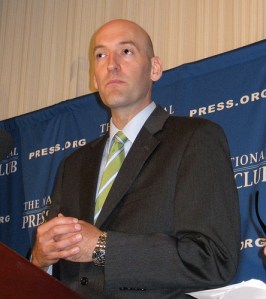
NRC Chair Gregory Jaczko (photo: Gabrielle Pffaflin/TalkMediaNews)

For those that think nothing has changed in United States regulation since the Japanese earthquake and tsunami started the ongoing crisis at the Fukushima Daiichi nuclear facility, think again. The pre-disaster mentality of “What could possibly go wrong?” has been replaced with reassurances that “Stuff like that hardly ever happens!”

At least that is the impression conveyed by the current chairman of the US Nuclear Regulatory Commission, Gregory Jaczko, in a pair of early October interviews. During two NRC-sponsored events, Jaczko fielded questions first from nuclear industry professionals and those considered friendly to the expansion of nuclear power, and then, in a separate session two days later, responded to representatives from public interest groups and other individuals generally seen as opposed to nuclear energy.

While the tone of the questions differed somewhat predictably in the two sessions, Chairman Jaczko’s attitude did not. Jaczko took several opportunities to praise the NRC staff and the processes and protocols used by the commission, repeating in both panels that the primary duty of his agency is ensuring the safety of nuclear facilities in the United States.

Beyond his broad assurances and patient, capable demeanor, however, many of the chairman’s assertions about both the NRC process and the progress being made toward his stated safety goals highlighted notable contradictions and troubling biases inherent in America’s nuclear regulatory regime.

To be fair, the pre-Fukushima outlook was not exactly “What could possibly go wrong?” In terms of the types of accidents and the repercussions of contamination, containment breaches, radioactive releases, meltdowns, melt-throughs, and a host of other undesirable situations, regulators and industry insiders alike were probably quite aware of what could go wrong. But as US nuclear proponents and profiteers strove to convey the impression of an informed industry, they also moved to downplay the threats to public safety and made sure to stress that, when it came to disaster scenarios, they had it covered.

If the disaster in Japan has proven one thing, though, it is that plant operators and nuclear regulators didn’t have it covered. Events (or combinations of events) that were either not foreseen or not acknowledged leave Japan scrambling to this day to understand and mitigate an ever-evolving catastrophe that has contaminated land and sea, and exposed yet-untallied thousands of Japanese to dangerous levels of radiation. “As we saw in Fukushima,” said Jaczko, “accidents still do happen in this industry. If we are thinking that they can’t, we are in a dangerous place.”

But for US nuclear regulators, there needn’t be any sense of urgency–or so believes the NRC chair. When asked why the agency doesn’t hold up plant relicensing until new standards that include lessons learned from the Japanese disaster are in place, Jaczko expressed confidence in the current system:

Bottom line is that changes get made at a plant. . . some changes will be made quickly, some may take years. It doesn’t matter where a plant is [in the process]–what is the licensing phase–but that changes get made. These are low frequency events, so we have some leeway.

It is a posture Jaczko took again and again in what totaled over two-and-a-half hours of Q&A–accidents are very, very rare. Given the history of nuclear power, especially the very recent history, his attitude is as surprising as it is disturbing. Beyond the depressingly obvious major disasters in nuclear’s short history, unusual events and external challenges now manifest almost weekly in America’s ageing nuclear infrastructure. The tornado that scrammed Browns Ferry, the flooding at Fort Calhoun, the earthquake that scrammed the reactors and moved storage casks at North Anna and posed problems for ten other facilities, and Hurricane Irene, which required a number of plants to take precautions and scrammed Calvert Cliffs when a transformer blew due to flying debris–all are external hazards that affected US facilities in 2011. Add to that two leaks and an electrical accident at Palisades, stuck valves at Diablo Canyon, and failures in the reactor head at oft-troubled Davis Besse, and the notion that dangerous events at nuclear facilities are few and far between doesn’t pass the laugh test.

That these “lesser” events have not resulted in any meltdowns or dirty explosions does nothing to minimize the potential harm of a more serious accident, as has been all too vividly demonstrated in Japan. The frequency or infrequency of “Level 7” disasters (the most severe event rating–so far given to both Chernobyl and Fukushima) cannot be used to paper-over inadequate safeguards when the repercussions of these catastrophes are so great and last for generations.

Storage concerns don’t concern

Chairman Jaczko’s seeming ease with passing current problems on to future generations was also in evidence as he discussed mid- and long-term storage of spent nuclear fuel. Though previously a proponent of an accelerated transfer of spent fuel from pools to dry casks, Jaczko now says, post-Fukushima, he has “no scientific evidence that one method is safer than the other.” The chairman made a point of noting that some dry casks at Virginia’s North Anna plant moved during the August earthquake, but said that it will be well over a year before we can evaluate what happened to wet and dry storage systems at Fukushima.

While it is true a full understanding will have to wait until after Daiichi is stabilized and decontaminated, it is already apparent that the spent fuel pools, which require a power source to actively circulate water and keep the stored fuel cool, posed dangers that in some ways rivaled the problems with the reactors. (So far, no Japanese plants have reported any problems with their dry casks.) So obvious was this shortcoming, that the NRC’s own staff review actually added a proposal to the Fukushima taskforce report, recommending that US plants take more fuel out of wet storage and move it to dry.

Jaczko’s newfound indifference is also odd in light of his own comments about dry casks as an alternative to a central nuclear waste repository. Asked in both sessions about the closing of Yucca Mountain (the proposed US site for spent nuclear fuel), the chairman buoyantly championed the possibility of using on-site dry casks for hundreds of years:

The commission is taking the appropriate action to address the storage of spent fuel. We have come to the conclusion that, over the short- and medium-term, safe storage is possible. We are taking a look at what is the finite limit on current [dry] storage. . . 200, 300, 400 years. Is there a time we have to move the fuel? . . . Nothing tells us we shouldn’t generate the [radioactive] material. We don’t see a safety concern out 100 years, or anything that says at 101 years, everything changes.

Chairman Jaczko then added that while the nuclear industry is generating waste that will require “long, long term storage or isolation,” it is not unprecedented to assume this problem can be taken care of by “future generations.”

It is good that Jaczko has such faith in the future, because his depiction of the present is not actually that impressive. While the NRC chief repeatedly touted their “process” for evaluating risks, problems, and proposals, he also painted a picture of a bureaucracy that has so far failed to fully act on the initiatives he has considered most important. Neither the fire-safety improvements Jaczko has championed since he came to the commission in 2005, nor the security enhancements required after 9/11/2001 have as yet been fully implemented.

Process is everything

Time and again, whether he was directly challenged by a question or simply asked for clarification, Gregory Jaczko referred to the NRC’s “process.” “We have a relicensing process,” “there is an existing process [for evaluating seismic risk],” there is a process for determining evacuation zones, there is a process for incorporating lessons learned from Fukushima, and there is a process for evaluating new reactor designs. Process, of course, is not a bad thing–in fact, it is good to have codified protocols for evaluating safety and compliance–but stating that there is a process is not the same thing as addressing the result. Too often, what might have sounded like a reasonable answer from the chairman was, in reality, a deflection. “The process knows all; trust in the process. I cannot say what will happen, and what I want to happen does not matter–there is a process.” (This, of course, is a dramatization, not a direct quote.) Form over functionary.

But Jaczko had barely started his second session when his reliance on process suffered an “unusual event,” as it were.

Asked about why the NRC seemed to be moving full-speed ahead with relicensing, rather than pausing to wait for Fukushima taskforce recommendations to be formalized, the agency chief first said, “There is an existing program, there are processes.” But within a breath, Jaczko then said, when it comes to lessons learned from Fukushima being some sort of prerequisite for final license approval, “We are going to look on a case-by-case basis.”

Is deciding whether to apply new requirements on a “case-by-case basis” actually a process? Many would say it pretty much defines the opposite.

The counter-intuitive also took a star turn when it came time to consider new externalities and pending environmental impact surveys. Shouldn’t the Fukushima taskforce findings be considered as part of a series of new environmental impact studies? Well. . . “It is clearly new information, but does it affect the environmental impact survey? Because they are very, very low likelihood events, it is not part of the environmental impact survey.” Jaczko here seems to be saying that unless you know in advance of the new study that the new information will alter the findings, you do not need to consider new information.

Shocked, shocked

With such confidence in the commission and its process, would it be safe to assume that Greg Jaczko is comfortable with the current state of nuclear safety in the United States? Perhaps surprisingly, and to his credit, the NRC head seems to say “no.”

As previously discussed, Jaczko expected faster action on fire safety and security upgrades. He also defended his going public with complaints about design problems with the AP1000 reactors proposed for Plant Vogtle:

We had been going back and forth with [AP1000 designer] Westinghouse for two years. I felt [a lack of] openness; felt if you aired the issues, they get addressed. Now, I feel it was. . . addressed. It ultimately forced these issues to get resolved.

Chairman Jaczko was also asked what tech issues keep him up at night:

Those components that are not replaceable, not easily inspectable. Those subjected to repeated exposure to high radiation, stresses that cause high degradation.

Jaczko said he felt the commission had a handle on what radiation does to the concrete in the containment vessel, but he was less sure about the effect of “shock,” which he defined as “repeated power trips” or scrams. Jaczko acknowledged that this increases stress on the containment vessels, and added, “Some places will not have 20 years [left] on pressure vessels. We get into an unknown piece of regulation on pressure vessel repair.”

That is a pretty stark revelation from a man so passionate about his agency’s ability to, uh, process new data, but it highlights another facet of Jaczko’s approach to regulation.

Noting that New Jersey’s Oyster Creek reactor was granted a renewed operating license for 20 years, but its operator later negotiated with the state to shut it down in 10 years, Jaczko said, “Extension is an authorization to operate, not a requirement to operate.” Relicensing, he said, might come with requirements for modifications or orders that they “monitor aging.”

Jaczko also said that states or facilities might decide it is not economically viable to keep a plant running for the full length of its license, “Like if you have a car and the clutch goes and you make a decision not to replace it.”

How to regulate, even without the Regulatory Commission

Yes, another deeply flawed automobile analogy, but note that Jaczko allows for, and maybe even expects, limits to a plant’s life that are not regulated by the NRC. And in detailing such, the chief regulator of the US nuclear industry shows where citizens might exercise leverage when his NRC fails.

First, there is that issue of economic viability. As previously discussed, the market has already rendered its verdict on nuclear power. In fact, it would be absolutely impossible to build or operate a nuclear plant without loan guarantees, tax breaks, and subsidies from the federal government. The new construction at Vogtle is projected to cost nearly $15 billion (and these plants always go way over budget), and the Obama administration has had to pledge $8.33 billion in loan guarantees to get the ball rolling. Without that federal backstop, there would be no licensing battle because there wouldn’t be the possibility of the reactors getting built.

In fact, in this time of questionable nuclear safety, deficit peacockery and phony Solyndra outrage, it is illustrative to note:

. . . in FY2010 alone, $2.82 billion went to natural gas and petroleum interests (through direct expenditures, tax expenditures, research and development funds, and loan guarantees), $2.49 billion to nuclear energy interests and $1.13 billion to solar interests.

Would any of the relicensing and new construction applications be before Jaczko’s NRC if the energy-sector playing field were leveled?

Second, at many points in the interview, federal regulator Jaczko referenced the power of the states. Early in the “pro” nuclear session, an anxious question expressed worry that states such as Vermont could play a role in the relicensing of reactors. While stating it was yet to be determined whether Vermont’s authority overlapped with the NRC, its chairman stated plainly that states do play a role. “States decide what kind of generating sources they use,” Jaczko said, “especially if the state has a public utility.”

When asked in the second panel if the NRC considers whether new rules or licensing delays will cause rate hikes for consumers, Jaczko said the final determination on rates was the purview of a state’s public utilities commission:

If the PUC denies charges, then they won’t get our approval to go forward–but if the PUC denies a rate change, they [the plant operators] still have to make the improvement required.

And when discussing how the NRC draws evacuation zones, Chairman Jaczko said that in the end, it was the responsibility of the state and local governments, acting on data from the utilities and advice from the NRC, to determine where, when and how to evacuate in case of a nuclear accident.

And, yes, that does sound again like some of the buck-passing that marked too much of these interviews, but it is also a roadmap for a possible detour around a recalcitrant or captured federal agency. If activists feel shut out of the regulatory process, they can attack the funding. If federal elected officials are not responsive (because they, too, have been captured by a deep-pocketed nuclear industry), concerned citizens can hit closer to home. As Jaczko says, states can choose their power sources, and states can define evacuation protocols that either better insure public safety or reveal continued operation of nuclear facilities to be untenable.

Such action would not be easy–state and local officials have their own interests and conflicts–but it might prove easier than a broad federal play. Recent successes by those seeking to close aging coal-fired generators show that action at the individual plant level is possible.

Open to openness

For anything to happen, of course, it is important that a dedicated and passionate citizenry organize around a tactic, or, if they prefer, a process. But it will also require a level of openness on the part of government. Sometimes that openness is offered, sometimes it is hard won, but without transparency, progress is hard to make and hard to measure.

Gregory Jaczko repeatedly stated that he is a big advocate of openness, and he offered these interviews in that spirit. These two events obviously didn’t go all the way in that direction–not even close–but the sessions had merit. Chairman Jaczko, despite all the problems detailed above, can still be admired for exhibiting something rather rare in today’s political climate, a regulator that actually believes in regulation. He, in fact, conveys a passion for it. That some of that regulation is based on flawed assumptions, and that much of it is weak or never enforced, cannot be ignored, but if the head of the Nuclear Regulatory Commission advocates for the regulatory process (even when hiding behind it), then there is at least a process to improve.

* * *

A version of this story was previously posted on Truthout.

The Party Line – September 30, 2011: No Will, No Way: Nuclear Problems Persist, But US Fails to Seize Fukushima Moment

As September drew to a close, residents of southwest Michigan found themselves taking in a little extra tritium, thanks to their daily habit of breathing (h/t emptywheel). The tritium was courtesy of the 40-year-old Palisades Nuclear Generating Station in Covert Township, which suffered its third “event” (as they are politely called) in less than two months, and was forced to vent an indeterminate amount of radioactive steam.

The reactor at Palisades was forced to scram after an accident caused an electrical arc in a transformer in the DC system that powers “indications and controls“–also known as monitoring devices, meters and safety valves. (Transformer arcs seem to be “in” this season–it was a transformer arc that caused the Calvert Cliffs plant in Maryland to scram during Hurricane Irene.)

While it is nice to see rectors shut themselves down when a vital system goes offline, remember that “turning off” a fission reactor is not like flicking a light switch. Shutting down a reactor is a process, and the faster it is done, the more strain it puts on the reactor and its safety and cooling systems. And even after fission is mitigated, a reactor core generates heat that requires a fully functional cooling system.

Which is kind of an interesting point when considering that Palisades had just been restarted after completing repairs to a breach in the cooling system that was reported to be leaking more than 10 gallons per minute. Prior to that, a “special inspection” was ordered August 9 after a pipe coupling in the plant’s cooling system failed.

(By the way, have no fear, Michiganders, a public affairs representative for the Nuclear Regulatory Commission reassured the public that the concentration of tritium was “far below regulatory releases,” and that “as soon as it goes out, it gets diluted further.” You know, in the air. . . that you breathe.)

News of the Palisades tritium burp came at roughly the same time as a breathless (if a press release can be breathless) announcement from Dominion Resources, the folks responsible for the North Anna nuclear plant, the facility that scrammed after being shaken beyond design specifications by the earthquake centered in nearby Mineral, Virginia:

Our investigation showed the units tripped before the loss of off-site power when multiple reactor sensors detected a slight power reduction in the reactors. . . .

The root cause team determined that this occurred as result of vibration in the reactor or the monitoring devices in the reactors, or both.

Again, good that the reactors scrammed when something registered the quake, but noteworthy again because it was previously believed that the automatic shutdown started as a result of a loss of power–power required to operate the cooling systems, not only for the reactors, but for the spent fuel pools, as well.

While North Anna remains offline as the NRC continues its inspection (and tries to decide what would constitute passing that inspection), and Palisades is also down pending an (another) investigation, both serve as only the latest in a long string of examples in what could be called The Light Water Paradox: In order to safely generate a steady stream of electricity, a light water reactor needs a steady stream of electricity.

This is not just a perpetual motion machine laugh line. This inherent flaw in the design of LWRs is at the root of two other prominent tales of nuclear safety (or lack thereof).

The first, of course, is the ongoing, ever-metastasizing disaster in Japan, where failures in the cooling systems at Fukushima Daiichi following a massive earthquake and tsunami resulted in hydrogen explosions, core meltdowns, and, likely, melt-throughs that contaminated and continue to poison sizable portions of the country and surrounding sea.

The second story concerns the proposal for the construction of two new reactors at Plant Vogtle, a nuclear power facility near Augusta, Georgia.

The Vogtle reactors would be the first to be built in the US in a generation, and they have come under some additional scrutiny in part because they would be the first of a new-design LWR called the AP1000. A riff on previous Toshiba/Westinghouse pressurized water reactors, the AP1000’s most noticeable “innovations” are meant to address the active cooling paradox. First, it has emergency “dump tanks,” reservoirs of water situated above the reactor that could, in an emergency, empty into the reactor via gravity, providing up to 72 hours of “passive” cooling. Second, rather than housing the core in a reinforced concrete shell with a metal liner, the AP1000 would have an all-steel containment vessel which would, in theory, be able to expel heat through convection.

While these two design features both highlight and attempt to address a dangerous flaw that is a part of every other nuclear facility in the United States–that water has to be actively cycled through a reactor core to keep it from melting–the design still predates the Fukushima quake, and fails to truly incorporate the lessons of that disaster.

The massive March 11 earthquake shutdown power to the Fukushima Daiichi plant, and thus the cooling systems, and the tsunami that followed flooded the diesel-powered backup generators, but that was only part of the problem. Investigations now show that even if Fukushima had in some way managed to maintain power, the cooling system would still likely have failed for at least some (and likely all) of the reactors, and (and this is important) for the spent fuel pools, as well. That is because the quake not only caused a loss of power, it also caused numerous breaches in the cooling system. Cracks in the containment vessel, broken pipes, and dislodged couplings would have likely resulted in a calamitous drop in water levels, even with full power. Less than successful attempts to restore the cooling systems with new, external power sources, and the large amounts of contaminated water that continue to pour from the plant, have demonstrated just how severely the physical infrastructure was damaged.

There are additional concerns about the design of the AP1000 (possible corrosion of the all-metal containment vessel and less than rigorous computer modeling of seismic tolerances, for instance), but, in a post-Fukushima world, simply addressing the active/passive cooling problem (and only doing so for the reactor and not the spent fuel pools) does not promise a safe nuclear facility.

And there is, perhaps, a hint that at least one of the members of the NRC understands this:

The chairman of the U.S. Nuclear Regulatory Commission says the agency may need to incorporate its findings about a nuclear disaster in Japan into a license to build a new nuclear plant in Georgia.

NRC Chairman Gregory Jaczko said Wednesday [September 28] he believes the license to build two more reactors at Plant Vogtle near Augusta should include conditions that reflect the findings of a review of this year’s disaster at the Fukushima Dai-ichi plant.

While it is true that “may” and “should” are not “will” and “must,” and it is also the case that the Fukushima taskforce recommendations themselves do not fully address the problem outlined here, Chairman Jaczko’s comments do make the point that there are indeed lessons to be learned from the Japanese crisis, and right now, in the US, that education has not taken place.

The chairman and his fellow commissioners have wrestled all summer with the pace of post-Fukushima reform. Jaczko has argued for what in NRC terms is considered a speedy consideration of the new safety regime, but a majority of the panel has managed to slow the process down to a point where no new regulations will likely be in place by the time the NRC is required to rule on the Vogtle permits.

But, because the Vogtle hearings have revealed the Chairman’s understanding of at least some of the problems, it also reveals an obvious path for Jaczko and those (such as Senator Barbara Boxer (D-CA)) who would also want any new construction or operating permits to only be approved under guidelines drafted in response to the Fukushima disaster. If the industry–and the commissioners most friendly to it–wants to move quickly ahead on new construction and the relicensing of 40-year-old plants, then it should be required that they move quickly on adopting the Fukushima taskforce recommendations. No new safety rules, no new permits–the political calculus should be that simple.

And, if the NRC won’t do the political math, then it should be up to elected government to run the financial numbers.

Building the new Vogtle reactors is projected to cost $14.8 billion. That’s projected–the existing Vogtle plant went over budget by a factor of 14. But even if the new reactors stay on budget, there is still no way they would get built without help from the Federal Government. To that end, the Obama administration okayed an $8.33 billion loan guarantee for The Southern Company, owners of Plant Vogtle, contingent on the NRC’s approval of the plans. (By way of comparison, that is 16 times the size of the loan given to the now-defunct solar technology company Solyndra.) While there are a myriad of reasons why that and other such guarantees should never be proffered, at minimum, the federal government should now freeze the financial backing for new construction until the NRC passes–and industry adopts–an enhanced safety regime.

This wouldn’t be a one-shot power play. Hot on the heals of Vogtle, the V.C. Summer nuclear facility in South Carolina is also looking to add two new AP1000 reactors, and its permit process is also underway. And financial markets understand what a bad bet that project is, too. Summer is also owned by Southern, but it is operated by SCANA. Moody’s, the bond-rating agency, just downgraded SCANA’s debt to one notch above “junk” status, citing the cost of the proposed new reactors.

Meanwhile, the Commonwealth of Virginia has handed over $7 million in precious state funds to North Carolina’s Babcock & Wilcox to open a prototype of a small modular reactor (SMR) in the town of Forest, near Lynchburg. The SMR is small, indeed–160 megawatts (in contrast to the 1,800 megawatt capability of Virginia’s North Anna plant)–and it’s built entirely underground, supposedly enhancing its safety when faced with a potential terrorist attack. How it will provide greater protection from an earthquake or flood seems (at best) less obvious.

Yet, with all of this action, all of these new designs, all of this lobbying, and all of this (as “serious” people repeatedly caution) scarce government money, still no one is addressing another part of the nuclear equation: spent fuel. With Yucca Mountain now (supposedly) abandoned, the United States has no long-term plan for handling the already large and ever-growing problem of dangerous spent nuclear fuel. Right now, each nuclear facility stores its used fuel in either pools, dry casks, or both. The spent fuel pools require an active cooling system, which faces most of the same problems inherent in reactor cooling. Dry casks–used for fuel that is cool enough to remove from the pools–are considered safer, but they are far from “safe.” They are above ground, emit some radiation, and are theoretically vulnerable to terrorist attack (and the casks at North Anna moved and sustained “cosmetic” cracks in the August earthquake). In many US plants, both pools and casks are already filled to capacity. Expanding the number of nuclear reactors only accelerates the storage crisis.

And it must be reiterated, all of this activity comes a mere six months after the start of the Fukushima disaster. The latest announcement from the Japanese government–that they will relax the evacuation order for more than 100,000 residents even though their towns have not yet been decontaminated–says nothing about an easing of the emergency, and everything about a government that frankly just doesn’t know what else to do. The United States, though obviously larger, has reactors near enough to densely populated areas that a nuclear accident would make Japan’s evacuation problem seem like a rush hour fender bender. And the US government’s plan to deal with a nuclear disaster is no more impressive than Japan’s.

The saddest part, of course, is that it needn’t be that way. Beyond the political and financial tools proposed above, the NRC actually already has the power to demand the nuclear industry own up to the new seismic reality. When Westinghouse Electric came before the commission in May, it was ordered to fix its seismic calculations. Though Westinghouse grumbled, it did not question the NRC’s authority to rule on seismic concerns.

David Lochbaum, director of the Nuclear Safety Project at the Union of Concerned Scientists, agrees that the NRC has all the authority it needs:

Nuclear regulators already have “sufficient information and knowledge” to deal with earthquake risks at existing U.S. reactors and don’t need to wait for a broader review, a safety advocate said.

The Nuclear Regulatory Commission developed seismic rules for new plants in 1996 and has since approved preliminary construction for proposed nuclear units at a Southern Co. plant in Georgia and certified an early reactor design by Toshiba Corp.’s Westinghouse Electric unit, according to comments filed with the agency today by David Lochbaum. . . .

“If the NRC truly lacks sufficient information about seismic hazards and how safety at nuclear power reactors is affected, then the agency cannot responsibly have issued early site permits and certified new reactor designs,” he said.

Of course, having the authority and exercising it are not the same thing, but just as the NRC is not truly handcuffed by the fight over the Fukushima taskforce recommendations, the entire country need not be shackled to such a flawed, dangerous and expensive energy source as nuclear. The US government has demonstrated that it has the authority to make decisions on energy sources, and it has shown that it actually has the money to invest–big money. Of course, be it the NRC, Congress or President Obama, when it comes to moving beyond nuclear to demonstrably safer and truly renewable sources, what the US has not shown is the will.

– – –

Correction: Last week’s post included the wrong location for the Seabrook nuclear plant; Seabrook is in New Hampshire. Apologies and thanks to the readers that spotted the error.

The Party Line – September 9, 2011: Shaken, But Still Not Stirred

Sunday, September 11, will of course be the tenth anniversary of a tragedy that fundamentally changed America in ways we are still trying to understand. But this 9/11 is also a day for other anniversaries, ones that will likely get little, if any, recognition in the US.

In 1985, for instance, September 11 saw a Keystone Kops-like collection of miscues during a test of the remote shutdown protocols at the Limerick Generating Station, a boiling water nuclear reactor outside of Philadelphia. During the shutdown, a valve on a cooling system failed to open, and attempts to manually open the valve were met by a locked door, and a call for a key, which, after a 15-minute wait, turned out to be the wrong key. Once the proper key was found and the door was opened, the operators found the valve’s hand wheel chained and padlocked to prevent accidental opening. Those keys were in the abandoned control room. Bolt cutters had to be used before the operators could finally open the valve.

All that time, the reactor core’s temperature was increasing. Fortunately, the test was done during startup, when decay heat is relatively low, so control rods were able to slow the reaction enough to provide time to overcome the multiple barriers to opening the valve. Had the plant been operating at full power when this series of problems occurred, the outcome would likely have not been so rosy.

September 11 will also mark six months since the massive earthquake and tsunami that struck northern Japan triggered a series of cataclysmic failures at the Fukushima Daiichi nuclear complex. That accident provides no amusing anecdotes or happy endings, but those horrible events should provide a loud wakeup call and numerous object lessons for nuclear power programs across the globe.

As previously noted, the Japanese nightmare and domestic political realities have spurred German Prime Minister Angela Merkel to announce a rather rapid phase out of her country’s nuclear plants. The Japanese government, too, has spoken of turning away from nuclear power and toward renewable alternatives.

But here in the United States, six months on from Japan’s quake, there are no such proclamations or pledges–if anything, quite the contrary–and almost no movement on even the most incremental of recommendations.

In the face of lessons still not learned, a trio of nuclear experts gathered in Washington, DC on September 8 to highlight key concerns that still have not been addressed six months after the start of the world’s worst nuclear accident. Included on the list are several issues discussed in this space since the Fukushima quake (this is a partial and edited list–please use the link for more concerns and more explanation):

The U.S. regulatory response since Fukushima has been inadequate. “Six months after Fukushima, it seems clear that the U.S. is not going to undertake the type of fundamental, no-holds-barred look at its nuclear regulatory practices that followed the much less serious accident at Three Mile Island some 30 years ago.”

America should avoid post-9/11 mistakes in tightening reactor safety standards. “In responding to Fukushima by issuing orders, the NRC should not make the same mistakes as it did following 9/11, when industry stonewalling delayed implementation of critical security measures for many years. Even today, some post 9/11 security upgrades have not been completed at numerous plants. . . . The U.S. must respond to Fukushima in a much more comprehensive way or it may soon face an accident even worse than Fukushima.”

The U.S. was warned of Fukushima-style problems but failed to act … and is still failing to do so. “U.S. reactors have some of the shortcomings of the Fukushima plants. Furthermore, citizen groups and scientists had tried to call one of these – spent fuel pool vulnerability — to Nuclear Regulatory Commission attention during the last decade. The NRC dismissed these efforts. . . . Without a root cause analysis of its own failure to heed the now validated warnings about spent fuel pools, the NRC may patch the technical problems revealed by Fukushima, but it won’t fix the underlying shortcomings that allow defects to persist until catastrophic events rather than regulatory vigilance force the nuclear industry and the public to face up to them.”

Emergency planning zones in the U.S. must be expanded. “In contrast to the [NRC] Task Force conclusions, we believe that emergency planning zones should be expanded, certain hydrogen control measures should be immediately enforced and spent fuel transfer to dry casks should be accelerated. Also, the safety margins of new reactors need to be reassessed.”

The recent East Coast earthquake should spur more NRC safety analysis. “The earthquake near the North Anna nuclear plant, which reportedly exceeded the plant’s seismic design basis, reinforces the urgency of the NRC Fukushima task force’s recommendation that all plants immediately be reviewed for their vulnerability to seismic and flooding hazards based on the best available information today.”

To that last point, as noted before, the earthquake that struck Mineral, VA in late August should have moved US nuclear regulators to quickly adopt the recommendations of the Fukushima task force. Well, the quake doesn’t seem to have moved the NRC much, but it did move some things, like most of the 117-ton dry storage casks at the North Anna facility. . . and, as we now have learned, pretty much everything else there:

Last month’s record earthquake in the eastern United States may have shaken a Virginia nuclear plant twice as hard as it was designed to withstand, a spokesman for the nuclear safety regulator said on Thursday.

Dominion Resources told the regulator that the ground under the plant exceeded its “design basis” — the first time an operating U.S. plant has experienced such a milestone. . . .

That a facility experienced such a milestone is now known because, over two weeks after the fact, data from the so-called “shake plates” has finally been released (almost a week after it was expected):

“We are currently thinking that at the higher frequencies, the peak acceleration was around 0.26” g, which is a unit of gravity that measures the impact of shaking on buildings, said Scott Burnell, an NRC spokesman.

The plant was designed to withstand 0.12 g of horizontal ground force for parts that sit on rock, and 0.18 g for parts that sit on soil, Burnell said.

Dominion’s sensors recorded average horizontal ground force of 0.13 g in an east-west direction and 0.175 g in a north-south direction, officials said.

The apparent discrepancy seems to stem from the distance between instruments used by the US Geological Survey and those cited by North Anna’s operator, Dominion, but even taking the smaller numbers, the design limits of the plant were exceeded.

Dominion officials have been quick to point out that even though some things have moved and some structures show cracks, those changes are merely cosmetic and in no way dangerous. But nuclear engineer John H. Bickel says that vessels and pipes are not the first things to go in a quake:

[A]n analysis of plants hit by earthquakes had shown that the most vulnerable components were ceramic insulators on high-voltage lines that supply the plants with power and electrical relays, which resemble industrial-strength circuit-breakers and switches.

Even if the relays are not damaged, they might be shaken so that they change positions, cutting off the flow of electricity or allowing it to flow without any command from an operator.

As previously noted (with more than a hint of irony), in order to safely generate electrical power, nuclear plants need an uninterrupted supply of electrical power. Without electricity, cooling systems and important monitors in both the reactors and spent fuel storage pools cannot function. Without effective cooling, nuclear facilities are looking at a series of disasters like the ones encountered at Fukushima Daiichi. That the most quake-vulnerable components directly affect a nuclear plant’s power supply is yet another data point underscoring the urgent need to review and enhance seismic safety at US facilities.

But even before that nation-wide examination can take place, the damage to the shaken North Anna plant needs to be surveyed and analyzed so that Dominion might restart its reactors. What does Dominion need to show in order to get the thumbs up, what criteria need to be met, what repairs or retrofits should be required? To paraphrase the head of the NRC: Who knows?

In an interview last week, NRC Chairman Gregory Jaczko told Reuters it was unclear what the plant would need to show to resume operations because it is the first time an operating plant has sustained a beyond-design-basis quake.

As Hurricane Irene revealed the lack of national guidelines for what to do in the face of an approaching storm, the Virginia earthquake has shown that the United States has no regulatory regime for learning, analyzing, or acting on data from events that exceed the often-negotiated-down design parameters of its nuclear facilities.

In fact, the NRC does not even have a post-quake inspection protocol. Inspections of North Anna are being done according to procedural guidelines drawn up by the Electric Power Research Institute, “a nonprofit utility consortium that has inspected dozens of industrial plants hit by earthquakes around the world.”

Yes, the nuclear industry has written its own post-event checklist, and, in the absence of any other standard, is left alone to use it.

That sort of self-policing leads to some noteworthy analysis, like this from a nuclear industry attorney: “You shake something really hard, and it’s not designed to be shaken that hard — it doesn’t mean that it’s broken.”

But there is something even more disturbing, if that is possible, propagated by the weak regulations and weak-willed regulators. It leaves space for arguments like this one from that same industry lawyer:

The incident helps make the case for new-generation nuclear plants, which have additional safety features. . . . “If you can have a car from 2011 vs. a car from 1978, what are you going to put your toddler in?”

Beyond the fact that no one is actually suggesting the 1978 plants get traded in for newer models (just augmented with them), cars have to compete for consumer dollars in a way that nuclear plants do not. Nuclear plants could not be built, fueled, operated or maintained without massive subsidies, loan guarantees, and infrastructure commitments from the federal government.

Also of note, a 2011 automobile is safer and more efficient than a 1978 model because of government regulation. The auto industry has fought improvements like mandatory airbags, three-point restraints, and CAFE standards, but a strong government imposed those requirements anyway. And your toddler is safer in that car because the Consumer Product Safety Commission reviews the design of child car seats, and laws mandate their use.

Where the comparison does work, however, is that both represent a false choice. Just as a car is not the only way to transport a toddler, nuclear plants are not the only means by which to generate power. And in 2011, there are many more choices, and many safer choices, than there were in 1978.

Which recalls the important contrast between a country such as Germany–which, faced with a restive electorate and lessons to be learned from Japan’s misfortune, has made a commitment to not just trade in nuclear but trade up to renewable alternatives–and the US, where corporate influence and politics as usual have left the government with seemingly few options beyond willful ignorance and calcification.

Even without recognition of the Japan quake’s semi-anniversary, September 11 will probably be a tense day for most Americans, especially those with personal connections to the events of ten years ago. But while remembrance will be hard, it will mostly be so because of an event now relegated to history.

Residents of Japan, still living with an ongoing and ever-evolving threat, cannot so neatly define their anguish. And if there is a message to be found in this coincidental concurrence of dates, it perhaps springs from there. While Americans can debate what could have been done to prevent the attacks of 9/11/2001, it is a debate held in hindsight. For the Japanese dealing with the aftermath of their disaster, hindsight still seems like a luxury to be enjoyed very far in the future.

But, for the United States, a debate about what can be done to prevent a Fukushima-like disaster here is theoretically blessed, both because it is a debate that can be had before the next crisis, and because it is a debate that can be informed by events. And experience, science, economics and common sense are all pretty clear on what needs to be done.

The Party Line – August 5, 2011: Japan Worries About More Radiation, US Officials Worry About Red Tape

News this week out of Japan that workers at the crippled Fukushima Daiichi nuclear plant have detected extremely high levels of radiation in and around reactor 1. The first incident, on August 1, pinned the Geiger counter at 10 sieverts (1000 rem)—yes, that’s as high as the device could measure, so that number is a minimum—and was taken at the base of a ventilation stack. The second reading, the following day, clocked in at five sieverts per hour inside the reactor building.

I have yet to read an explanation for the discovery of the second reading, but the initial, sky-high measurement on Monday has me and many others scratching heads. A thousand rem is not some little ho-hum number. A half-hour of exposure at that level is fatal in a matter of days, I am told. Where did that radiation come from? When did contamination occur? How is it that such a dangerous level could go unreported for what is now over 140 days?

Officials from the Japanese power company, TEPCO, who have been repeatedly criticized for withholding critical information, insist that contamination likely happened in the first few days of the disaster when workers tried to vent hydrogen from the reactor building in a futile attempt to prevent an explosion. Somehow, though, this part of the facility (which, it should be noted, has been extensively mapped for radioactive hotspots over the last several months) was not measured till August.

Others, such as Arnie Gundersen, chief engineer at Fairwinds Associates, believes levels this high would not have gone undetected this long, and that these new readings represent a recent accumulation. Because the measurement was taken at the base of a ventilation stack that has continued to vent undisclosed amounts from the damaged reactors, Gundersen believes that condensation and radioactive cesium trickled down to the base of the stack—which means that some amount of radioactive isotopes continues to be vented into the atmosphere. And it seems, some not inconsequential amount.

Back in April, TEPCO was ordered to give an accounting of the amounts of radiation released during the crisis, and TEPCO promised to do so by August. It is now August, but there is no sign yet of this report or an indication of when it will be released.

And, just to wrap up newish news from Japan, the government has announced plans to build a wall around Daiichi reaching 60 feet below ground to try to stop contaminated groundwater from reaching the sea. Beef contaminated with radioactive cesium from the plant has turned up in more markets across Japan, and the government has banned the sale of most beef from the north.

Japanese Prime Minister Naoto Kan has fired three government officials with ties to the crisis, including the leader of the Nuclear and Industrial Safety Agency, which would be roughly the Japanese equivalent of the US NRC. Officially, the reason is because the agency did a lousy job of preparing for a tsunami and its disastrous effects, but it also recently came to light that this official had planted pro-nuclear-industry shills at town hall meetings in an attempt to steer public opinion.

Back in the United States, one can only imagine what that kind of accountability would look like—but why imagine, when we have the videotape!

On August 2, when most eyes (like, you know, everyone’s) were on the floor of the Senate, a few of us (probably a very few, it wasn’t even on CSPAN-3) were watching the Senate Committee on Environment and Public Works full committee and subcommittee on Clean Air and Nuclear Safety joint hearing entitled “Review of the NRC’s Near-Term Task Force Recommendations for Enhancing Reactor Safety in the 21st Century.” (Sounds so much more important when you spell it all out.)

This was the hearing on the report I discussed three weeks ago, and besides the obvious observation that there’s 150 minutes of life I’ll never get back, there were a few points worth mentioning.

First, it was clear from the opening statements that no Senator (perhaps with the exception of Bernie Sanders. . . perhaps) was going to come close to making a call for a shift away from nuclear power in the US the way leaders in Germany and Japan have in the wake of the Fukushima disaster. In fact, the tone was very much about moving forward with some version of a flourishing nuclear industry.

For Republicans on the panel, the response was predictable. The only thing that is keeping us from rushing headlong into a glorious future with upwards of 100 fabulous, new nuclear plants is excessive government regulation. In fact, Senators Lamar Alexander and Jeff Sessions seemed stunned that the Nuclear Regulatory Commission had the primary responsibility of protecting the health and safety of the public rather than helping to foster an environment favorable to the expansion of the nuclear industry. (A funny protest, really, considering that the NRC has long been criticized for acting as a booster club for the industry it is supposed to regulate—and especially risible in light of this summer’s AP exposé on the cozy relationship between power companies and regulators.) The GOP contingent chastised NRC members for thinking of themselves as guardians of public safety without regard to what it would cost what they always euphemistically referred to as “stakeholders” (as did the more overtly pro-industry commissioners).

This, in turn, earned the senators a chastisement of their own from EPW chair, Sen. Barbara Boxer, who literally threw the book at them. . . ok, she didn’t throw the book, she just read from the law that empowers the NRC.

Indeed, Boxer had a more refreshing take on government regulation. The California Democrat said that if the industry wanted to operate and expand, it had to demonstrate that it could do so safely. Boxer stressed that it was important that citizens saw regulators as their defenders, able to act quickly in response to a crisis and honestly assure the safety of nuclear facilities. It takes a trusted regulatory regime for an industry to prosper.

That is a fair point, and one that applies to a much broader discourse about government regulation. Alas, in this case, it papers over a slow, lax regulatory history and a nuclear industry that has done a solid job of dumping campaign cash into the coffers of most of the politicians responsible for oversight.

On the always amusing “did he just say that?” front, there was Sen. Alexander saying that we didn’t have to worry about anything like what happened in Japan because we had a different system, blithely adding that no one had ever been killed by an accident at a US nuclear plant or on a US nuclear submarine. This will be news to the families of the four workers killed in two separate accidents at Surry 2 in Virginia, or to the crews of the USS Thresher and USS Scorpion. Or to the one man killed in the 1959 Navy reactor explosion. (Nitpickers will argue, of course. Lucky for them, the four dead at Surry 2 died from steam burns before they had to worry about radiation, and the two subs imploded after plummeting below their crush depth, and so cannot be classified with surety as “nuclear” accidents. The 1959 USS Triton accident happened on a prototype at a Navy training center, so I guess that won’t count, either.)

And, of course, Alexander has no room in his worldview for the 430 infants (PDF) (the most conservative estimate) that died from radiation released during the Three Mile Island disaster.

Jeff Sessions is a circus sideshow all by himself (an imperious, ignorant sideshow). He used most of his time to criticize Gregory Jaczko, Chair of the Nuclear Regulatory Commission, for assuming emergency powers in the days after the earthquake and tsunami that crippled Fukushima Daiichi. In essence, Sessions was upset that Jaczko empanelled the task force quickly, rather than allow the process to be sabotaged by commissioners more friendly with those aforementioned stakeholders.

Sessions also used the story of how the Japanese are pulling together to conserve energy now that so many of its nuclear power plants are offline to negatively paint the dystopian hellscape that awaits the US if we were to shift away from nuclear power. Conservation, including the royal family using flashlights in their garden, lord save us! (This New Yorker had to laugh when Sessions told of the horrors of Japanese subway platforms that now went un-air-conditioned for three hours a day.)

The senator also tossed out that nuclear was a clean, safe and cheap domestic source of energy. None of those things are true, of course. Mining and refining the fissile materials for the reactors is polluting and comes with a large carbon footprint. We still have no clear plan to deal with “spent” fuel. Fukushima, TMI, Chernobyl, and dozens of less famous disasters belie the “safe” assumption. As far as “cheap,” when you add in the government subsidies, loan guarantees, tax breaks, security costs, and the need for a fuel -disposal infrastructure, nuclear power is not just not “cheap,” it is one of the most expensive options out there. And, as for “domestic,” as I have detailed before, we import most of our uranium—and not always from the nicest people.

Alas, no one had the inclination in this Senate session to respond with any of that to Sen. Sessions. The real problems facing our nuclear future were not really on the table this week.

What the two-and-a-half hour hearing really boiled down to, really hinged on, was that NRC Chair Jaczko believes that 90 days is plenty of time for disposal of the recommendations (that’s how he put it—we are not talking implementation here, just the decision that the task force recommendations should be turned into rules. . . which would then take about five years to enact), but three of the five-member NRC do not. Those commissioners and their Republican brethren on the committee steadfastly refused to commit to any timeframe on anything, insisting that they needed first to hear from “stakeholders” (yes, that word again).

Democrats for the most part tried to buttress Jaczko, asking for commissioners to at least admit that some of the recommendations could be disposed in 90 days. The results of that request were inconclusive. Boxer, to her credit, vowed to hold hearings every 90 days to push for action on the task force report. (Will any more people be paying attention in November. . . right before Thanksgiving. . . when the SuperCommittee is supposed to deliver its budget-cutting plan? No breaths were held in the crafting of this question.)

But I feel funny rallying around this flag. As I mentioned when the Near-Term Task Force report came out, there is nothing I can see particularly wrong with any of the recommendations, as far as they go, but they fail to address any of the bigger issues, from used fuel disposal to the decommissioning of old, poorly designed, geographically vulnerable facilities. Yes, the NRC should prove that it can act—authoritatively and quickly—in the wake of a disaster. And, the federal government should prove it can rise above campaign considerations to exercise real oversight. But until people like the Senators on the EPW committee, or members of the House Energy and Commerce Committee, or the president, face up to the dangers of nuclear power revealed (again) by the Japanese disaster, or confront the myths of an energy source once called “clean, safe, too cheap to meter,” then hearings like this will feel more like redecorating than real policy.

(A version of this post also appears at Firedoglake.)

The Party Line – July 22, 2011: Fixing a Hole

Focusing on broad, long-term goals while ignoring obvious, near-term problems is order of the day, be it in the Fukushima reactors or deficit-obsessed DC.

I feel like I am saying this every week, but tear yourself away for a minute, if you can, from the daily deficit follies—I promise we’ll get back to them.

As I detailed last week, a study called the Near-Term Task Force Review listed a set of suggestions for ways the US nuclear power industry could improve safety in the wake of the meltdowns and continuing crisis in Japan’s Fukushima reactors. The recommendations were a mixed bag of mostly regulatory tweaks–nothing particularly bad, as far as they go–but obviously missing from the report was any program that would effectively improve the way spent fuel rods are stored.

Earlier this week, the task force officially presented its report to the Nuclear Regulatory Commission, and NRC chair Gregory Jaczko said the full commission should move to accept or reject the recommendations within 90 days, and implement any new rules within five years.

That sounds glacial, especially given the ongoing Japanese crisis and many US plants of similar design facing the possibility of similar problems, but even this cautious approach to some cautious recommendations was more-or-less opposed by three of the five commissioners.

The commissioners reacted much like the Republican leadership on the House Energy and Commerce Committee did a day earlier, asking for a “full and deliberate process of review”—a rather naked demand that the NRC slow-walk these recommendations with an eye toward weakening or killing them. The ECC has yet to schedule any hearings on the task force report.

On the Senate side, I am told that the Committee on Environment and Public Works will hold hearings in August, but nothing as yet is listed on the committee website. (EPW is chaired by Barbara Boxer; if you want, give her a call and express your interest in a timely hearing.)

Sadly, it seems like the US takeaway from the triple meltdown and massive environmental disaster in Japan is that we need to stick up for our domestic nuclear industry. In fact, just yesterday, the NRC approved a 20-year operating license extension for Hope Creek in New Jersey. Hope Creek is a boiling water reactor, just like Fukushima Daiichi 1, and stores spent fuel in above-ground pools, just as was done in the now-crippled Japanese plants.

Conveniently, practically no one in the US has any time to devote to nuclear concerns—after all, we are facing a debt-pocalypse!

I write that with a healthy degree of sarcasm, but it seems to me more than a happy accident that absolutely nothing else can get done in Washington because of the never-healing, self-inflicted wound that has tied our governing in knots and threatens to cripple the entire government. Forgive the cheap allusion, but it is a meltdown of accountability.

An easy turn of phrase, but I have been feeling like there is some deeper connection—or, if not connection, parallel—between the ongoing crisis in Fukushima and the never-ending “crisis” in Washington.

Earlier in the week, TEPCO (the power company that owns Fukushima Daiichi) and the Japanese government updated their plans for cleanup and containment of the disaster area. They announced that their goal is a cold shutdown of the crippled reactors in three to six months, and with that, they hope to reduce the radiation level around the plant to one millisievert per year by mid-January. That would be substantial. Officials even talk of allowing some to return to the quarantine area if that goal is met.

But for that goal to be met—for any of the goals to be met, really—the crews at Fukushima will have to do something else first. Namely, emergency workers must find and fix the cracks and holes in the containment vessels of the damaged reactors that continue to allow contaminated, radioactive water to leak into the reactor buildings, the surrounding tunnels and neighboring facilities, and onto the ground, possibly into the ground water, and, almost certainly, into the sea. Yet, the problem of fixing the holes, a goal that was part of the previous plan of action, a goal that has not been met, is not in the latest Japanese report.

When asked about the omission, officials said that they expect progress to be made on the leaks. They did not say how. They did not say when. But, you know, obviously, that will be addressed. The main thing is, though, focus on the big, happy, longer-term goals.

Is this starting to sound at all familiar?

In the current context, I can certainly find fault with many of the details, but let’s say, OK, long-term deficit reduction is not a bad goal, in and of itself. It would, in theory, be good to spend less on interest, and more, say on education or infrastructure. . . .

But that is not how I hear President Obama addressing this. Instead, I hear him mimicking self-interested deficit hawks, blurring the difference between debt and deficit, allowing the Tea-OP to frame budget cuts as linked to the debt ceiling, and purposely dragging entitlements into the mix when they don’t have a bearing on the matter at hand. And, worst of all, the president and practically every other leader in DC has made deficit reduction the stand-in for the warm, fuzzy goal of rebuilding the economy—which is, at best, putting the cart before the horse, but is more likely a damaging and dangerous lie.

Before we get to jump in to the magic happy balanced-budget pool, perhaps there are a few holes and cracks the administration might want to spackle. And the cracks are legion, aren’t they?

Of course, there is the war. . . the wars. . . the three, three-and-a-half, or four wars, sucking trillions out of the economy.

And, of course, there are the very-much-still-here-even-though-they-should-have-already-expired Bush-era tax cuts for the wealthiest of the wealthy. And there is the hedge-fund-manager’s loophole and any number of other breaks for the rich that deprive the supposedly going-up-in-flames system of a cooling river of cash.

But I want to talk about an even more obvious, immediate, gaping hole, a hole that should be goal one in any discussion of the economy, and yet is embarrassingly absent from the beltway back-and-forth:

Jobs.

Before we spend another breath of air or drop of ink on the goal of deficit reduction, the federal government should be focusing on the goal of decreasing unemployment—focusing on the goal of creating jobs. It is, in fact, the obvious first step, the obvious hole you plug on the way to broader economic health. With more and better-paying jobs, you pump more money into the marketplace, increase demand, and spur expansion. And you also create a more robust revenue stream for the government. Almost every new job is a new taxable income.

And right now, when interest rates are so extremely low, when money is cheap for the government, now is an excellent time to invest in the country by spending. You know what would make this a less-good time for borrowing? Defaulting on our debt.

If the jerk circus in Washington fails to raise the debt ceiling, sends a message that it is some degree less than a sure thing that America will honor its obligations, then the cost of borrowing could go up, and then maybe we have a real problem.

Now, if you were president, what frame would you rather be forced to defend?

Why not take advantage of this situation—which has the added advantage of being the truth—and demand a clean vote, and only a clean vote, on the debt ceiling? Why not tell the American people that if we do this, and keep the money supply cheap and fluid, then government can do what it is supposed to do—what it can do: care for its people, create jobs in a time of need, repair aging infrastructure, research and develop new, greener energy sources (hint, hint—which will not only wean us off of expensive oil and nuclear power, but it could help build the economic engine that could power the US economy for the next decade), and provide a better life for every level of society?

Then, when we are back on terra firma, when we have plugged the gaping hole, we can re-examine the big rosy budget goals. But then we can do so from a place of strength, do so from a place where we are not trying to bail out a sinking ship with a perforated bucket, do so without running from crisis to crisis like terrified citizens in some Japanese horror film.

Let’s at least try to learn one thing from the Fukushima crisis: Make our goal to fix the hole.


(A version of this post also appeared at Firedoglake.)