Regulators said Edison “failed to develop procedures to monitor electronic devices related to security,” but the NRC has withheld most of the details of the violation.
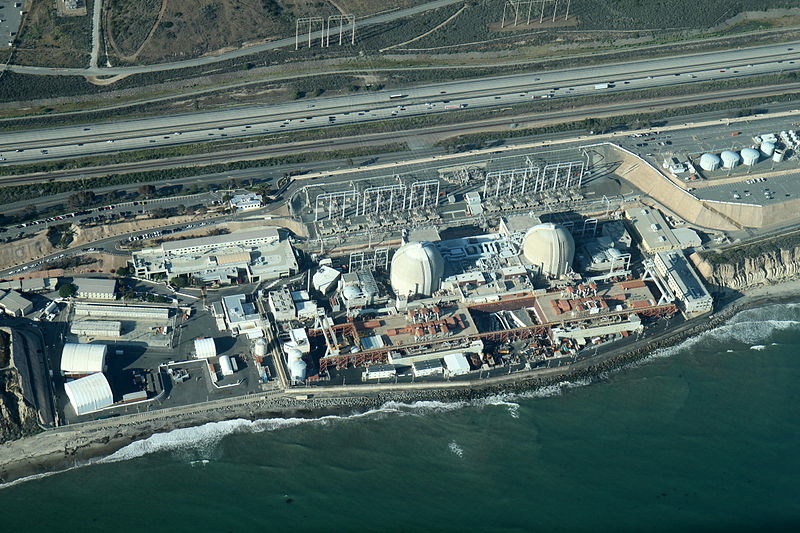
San Onofre has a long list of safety and security problems dating back long before the latest tube debacle. In January, around the same time as the radioactive leaks, a SONGS worker accidentally fell into one of the facility’s spent fuel storage pools while trying to retrieve a dropped flashlight. And just two weeks ago, an investigation uncovered a staggering number of fire safety violations that continue to go uncorrected, despite previous NRC warnings.
Joseph P. Como, head of the PUC’s Division of Ratepayer Advocates, sent a letter to the commissioners this week stating they should “remove [San Onofre] from Southern California Edison’s … and San Diego Gas & Electric’s… rate base now instead of waiting several more months and allowing hundreds of millions of dollars in needless costs to be borne by customers.”
Edison, the plant’s operator, is charging ratepayers about $54 million per month for a nonproducing plant, the letter said. Edison holds 78 percent of the plant’s ownership, SDG&E owns 20 percent, and Riverside 1.8 percent, the CPUC said.
While the PUC has a provision to investigate rate cuts when plants are down for over nine months (which would be November and December for the two SONGS reactors), Como noted that San Onofre is almost certain not to restart before then, if it is ever to restart at all. The full commission has twice postponed votes on an earlier investigation.
In moving for earlier action, Como referenced a 1982 decision that upheld rules requiring that power plants actually function to be included in the rate base. The California Supreme Court agreed, saying a facility must be “used and useful.”
“It seems very obviously that a fundamental prerequisite for a power generator to be considered “used and useful” is that it actually be generating power,” Como writes. “SONGS does not meet this test.”
Southern California Edison released a letter stating that it looks forward to working with the commission through the normal, long, dragged-out process.
As for the security violation, all the utility would say was that the problem had been addressed.
Edison may think it has addressed its problems, and the NRC might think its process addresses the problems of the country’s nuclear fleet as a whole, but the regular drumbeat of security and safety violations coupled with the perpetual fleecing of the public till calls for a paraphrase of a famous line from the movie The Princess Bride: Address. You keep using that word. I do not think it means what you think it means.
Though incomplete, the footage from a concrete bunker at the plant confirms what many had long suspected: that the Tokyo Electric Power Company, the plant’s operator, knew from the early hours of the crisis that multiple meltdowns were likely despite its repeated attempts in the weeks that followed to deny such a probability.
It also suggests that the government, during one of the bleakest moments, ordered the company not to share information with the public, or even local officials trying to decide if more people should evacuate.
Above all, the videos depict mayhem at the plant, a lack of preparedness so profound that too few buses were on hand to carry workers away in the event of an evacuation. They also paint a close-up portrait of the man at the center of the crisis, Mr. Yoshida, who galvanizes his team of engineers as they defy explosions and fires — and sometimes battle their own superiors.
That summary is from New York Times Tokyo-based reporter Hiroko Tabuchi. The story she tells is compelling and terrifying, and focuses on the apparent heroism of Masao Yoshida, Fukushima’s chief manager when the crisis began, along with the far less estimable behavior of TEPCO and Japanese government officials. It is worth a couple of your monthly quota of clicks to read all the way through.
The story is but one take on the video, and I point this out not because I question Tabuchi’s reporting on its content, much of which is consistent with what is already known about the unholy alliance between the nuclear industry and the Japanese government, and about what those parties did to serve their own interests at the expense of the Japanese people (and many others across the northern hemisphere). Instead, I bring this up because I do not myself speak Japanese, and I am only allowed to view a 90-minute “highlight reel” and not the entire 150 hours of video, and so I am dependent on other reporters’ interpretations. And because neither TEPCO nor the Japanese government (which now essentially owns TEPCO) has yet proven to be completely open or honest on matters nuclear, the subtle differences in those interpretations matter.
Tabuchi took to Twitter to say how much she wanted to tell the story as “a tribute to Fukushima Daiichi chief Yoshida and the brave men on the ground who tried to save us.” But in a separate tweet, Tabuchi said she was “heartbroken” to discover her article was cut in half.
Editing is, of course, part of journalism. Trimming happens to many stories in many papers. But I had to raise an eyebrow when I saw a note at the bottom of Tabuchi’s piece that said Matthew Wald “contributed reporting from Washington.” I have previously been critical of Wald–a Times veteran, contributor to their Green blog, and often their go-to reporter on nuclear power–for stories that sometimes read like brochures from the Nuclear Energy Institute. Wald tends to perpetuate myths in line with the old “clean, safe, and too cheap to meter” saw, while reserving a much, uh, healthier (?) skepticism for nuclear power critics and renewable energy advocates.
There is, of course, no way to know what Wald’s contributions (or redactions) were in this case, and it is doubtful any of the parties involved would tell us, but what particularly stokes my curiosity is this paragraph:
Despite the close-up view of the disaster, the videos — which also capture teleconferences with executives in Tokyo — leave many questions unresolved, in good part because only 50 of 150 hours include audio. The company blamed technical problems for the lack of audio.
TEPCO might blame technical problems, but reports from other news services seem to leave little doubt that the general belief is that the audio has been withheld–or in some cases most obviously obscured–by TEPCO. The BBC’s Mariko Oi saw it this way:
Tepco has bowed to pressure to release 150 hours of teleconferencing footage but the tape was heavily edited and mostly muted to “protect employees’ privacy”.
. . . .
Tepco is again under criticism for not releasing the full recordings and has been asked if it was removing more than employees’ names and phone numbers.
Japan’s former prime minister criticized the tsunami-hit nuclear plant’s operator Wednesday for heavily editing the limited video coverage it released of the disaster, including a portion in which his emotional speech to utility executives and workers was silenced.
Naoto Kan called for Tokyo Electric Power Co. to release all of its video coverage, beyond the first five days. Two-thirds of the 150 hours of videos it released Monday are without sound, including one segment showing Kan’s visit to the utility’s headquarters on March 15 last year, four days after a tsunami critically damaged three reactors at the Fukushima Dai-ichi power plant.
Many people’s faces, except for the plant chief and top executives in Tokyo, are obscured in the videos and frequent beeps mask voices and other sound.
The AP story also points out that the released video arbitrarily ends at midnight on March 15–and though it is not known how much more tape exists, it appears clear that TEPCO has held some substantial portion back. After five days, the Fukushima crisis was far from over, after all (as it is still far from over), and the recordings end amidst some of the disaster’s most critical events.
But the New York Times omits all of this, leaving TEPCO’s Rose Mary Woods-like excuse to stand as the innocent truth.
That’s a shame, because the way you read this story changes when you look at some of the horrific revelations keeping in mind that this is only the part TEPCO decided it could let you see. Here are just a few highlights. . . or lowlights:
Plant managers and TEPCO officials were aware from the earliest hours of the crisis that they were likely facing multiple meltdowns.
Japanese government officials withheld information–and ordered TEPCO to withhold information–on radiation levels that could have helped untold numbers of civilians reduce their exposure.
Despite warnings years prior that such natural disasters were possible in the region, Fukushima operators had no plan to deal with the damage and loss of power caused by the quake and tsunami.
TEPCO did not even have the infrastructure or procedures in place to evacuate its own employees from an imperiled facility.
Plant officials were–from the earliest days–as worried about the spent fuel pools as they were about the reactors. Those on the scene feared that most of the pools at Daiichi, not just the one at reactor four, were facing loss of coolant and the fires and massive radiation leaks that would follow, though publicly they said none of the pools were a danger at the time.
And there is more about the dire conditions for plant workers, the lack of food or water, the high levels of radiation exposure, and even a point where employees had to pool their cash to buy water and gasoline. And, as noted above, that’s just the part TEPCO has deemed acceptable for release.
Above all, though–beyond the discrepancies in reporting, beyond the moral failings of TEPCO and government officials, beyond the heroism of those at the crippled facility–what the new Fukushima tapes reveal is what those who watch the nuclear industry have mostly known all along. Nuclear power is dangerous–the radiation, the complexity of the system, the waste, the reliance on everything going right, and the corrupt conspiracy between industry and government saddle this form of energy production with unacceptable risks. The video now available might shed some light on how things at Fukushima went horribly wrong, but the entire world already knows plenty of who, what, where and when. We all know that things at Fukushima did go horribly wrong, and so many know that they must suffer because of it.
Prior to the court’s ruling, the Commission had evaluated licensing and relicensing with the assumption that spent fuel–currently stored on site at nuclear power plants in pools and dry casks–would soon be moved to a central long-term waste repository. As previously noted, that option was once thought to be Yucca Mountain, but after years of preliminary work and tens of millions of dollars wasted, Yucca was found to be a poor choice, and the Obama Department of Energy and the NRC ended the project. The confirmation of new NRC Chair Allison Macfarlane–considered a nuclear waste expert and on record as a Yucca Mountain critic–focused even more attention on the country’s lack of realistic plans for safe, permanent waste storage.
Waste confidence undergirds certain agency licensing decisions, in particular new reactor licensing and reactor license renewal.
Because of the recent court ruling striking down our current waste confidence provisions, we are now considering all available options for resolving the waste confidence issue, which could include generic or site-specific NRC actions, or some combination of both. We have not yet determined a course of action.
In recognition of our duties under the law, we will not issue licenses dependent upon the Waste Confidence Decision or the Temporary Storage Rule until the court’s remand is appropriately addressed.
What this means in real terms remains to be seen. No licenses or renewals were thought imminent. Next up were likely a decision on extending the life of Indian Point, a short drive north of New York City, and a Construction and Operation License for Florida’s Levy County project, but neither was expected before sometime next year. Officially, 19 final reactor decisions are now on hold, though the NRC stressed that “all licensing reviews and proceedings should continue to move forward.”
Still, this should be read as a victory for the originators of the suit that resulted in the June ruling–the Attorneys General of Connecticut, New Jersey, New York and Vermont in coordination with the Prairie Island Indian Community of Minnesota and environmental groups represented by the National Resources Defense Council–and most certainly for the millions of Americans that live close to nuclear plants and their large, overstuffed, under-regulated pools of dangerous nuclear waste. Complainants not only won the freeze on licensing, the NRC guaranteed that any new generic waste rule would be open to public comment and environmental assessment or environmental impact studies, and that site-specific cases would be subject to a minimum 60-day consideration period.
While there is still plenty of gray area in that guarantee, the NRC has (under pressure) made the process more transparent than most similar dealings at the agency. The commission has also, at least for the moment, formally acknowledged that the nation’s nuclear reactor fleet faces a very pressing problem.
The US has 72,000 tons of radioactive waste and generates an additional 2,000 tons every year. Spent fuel pools at individual sites are already so full they pose numerous threats, some eerily similar to the ongoing disaster at Fukushima. Dry cask storage poses other problems and much additional expense. And regional interim waste storage facilities, an idea possibly favored by Macfarlane, is problematic for many reasons, not the least of which is that no sites have yet been designated or built.
But nuclear plant operators, already burdened by the spiraling costs of a poorly maintained and aging inventory, are desperate to have the federal government take the waste problem off their backs–and off their books. Whether that is even technically feasible, let alone politically of fiscally possible, remains to be seen. But the NRC has at least recognized–or at least been forced to recognize–that the nuclear industry should not be allowed to create waste indefinitely without a plan to safely secure what is already on hand.
You know that expression, “Hotter than July?” Well, this July, July was hotter than July. Depending on what part of the country you live in, it was upwards of three degrees hotter this July than the 20th Century average. Chicago, Denver, Detroit, Indianapolis and St. Louis are each “on a pace to shatter their all-time monthly heat records.” And “when the thermometer goes way up and the weather is sizzling hot,” as the Cole Porter song goes, demand for electricity goes way up, too.
During this peak period, wouldn’t it be great to know that you can depend on the expensive infrastructure your government and, frankly, you as ratepayers and taxpayers have been backstopping all these years? Yeah, that would be great. . . so would an energy source that was truly clean, safe, and too cheap to meter. Alas, to the surprise of no one (at least no one who watches this space), nuclear power, the origin of that catchy if not quite Porter-esque tripartite promise, cannot.
It was so hot last week, a twin-unit nuclear plant in northeastern Illinois had to get special permission to continue operating after the temperature of the water in its cooling pond rose to 102 degrees.
It was the second such request from the plant, Braidwood, which opened 26 years ago. When it was new, the plant had permission to run as long as the temperature of its cooling water pond, a 2,500-acre lake in a former strip mine, remained below 98 degrees; in 2000 it got permission to raise the limit to 100 degrees.
The problem, said Craig Nesbit, a spokesman for Exelon, which owns the plant, is not only the hot days, but the hot nights. In normal weather, the water in the lake heats up during the day but cools down at night; lately, nighttime temperatures have been in the 90s, so the water does not cool.
But simply getting permission to suck in hotter water does not make the problem go away. When any thermoelectric plant (that includes nuclear, coal and some gas) has to use water warmer than design parameters, the cooling is less effective, and that loss of cooling potential means that plants need to dial down their output to keep from overheating and damaging core components. Exelon said it needed special dispensation to keep Braidwood running because of the increased demand for electricity during heat waves such as the one seen this July, but missing from the statement is that the very design of Braidwood means that it will run less efficiently and supply less power during hot weather.
Also missing from Exelon’s rationale is that they failed to meet one of the basic criteria for their exception:
At the Union of Concerned Scientists, a group that is generally critical of nuclear power safety, David Lochbaum, a nuclear engineer, said the commission was supposed to grant exemptions from its rules if there was no increase or only a minor increase in risk, and if the situation could not have been foreseen.
The safety argument “is likely solid and justified,’’ he wrote in an e-mail, but “it is tough to argue (rationally) that warming water conditions are unforeseen.’’ That is a predictable consequence of global warming, he said.
Quite. Lochbaum cites two instances from the hot summer of 2010–New Jersey’s Hope Creek nuclear station and Limerick in Pennsylvania each had to reduce output due to intake water that was too warm. In fact, cooling water problems at US thermoelectric generators were widespread along the Mississippi River during the hot, dry summer of 1988.
Higher water temperatures and reduced river flows in Europe and the United States in recent years have resulted in reduced production, or temporary shutdown, of several thermoelectric power plants, resulting in increased electricity prices and raising concerns about future energy security in a changing climate.
. . . .
[The Nature Climate Change study] projects further disruption to supply, with a likely decrease in thermoelectric power generating capacity of between 6-19% in Europe and 4-16% in the United States for the period 2031-2060, due to lack of cooling-water. The likelihood of extreme (>90%) reductions in thermoelectric power generation will, on average, increase by a factor of three.
Compared to other water use sectors (e.g. industry, agriculture, domestic use), the thermoelectric power sector is one of the largest water users in the US (at 40%) and in Europe (43% of total surface water withdrawals). While much of this water is ‘recycled’ the power plants rely on consistent volumes of water, at a particular temperature, to prevent overheating of power plants. Reduced water availability and higher water temperatures – caused by increasing ambient air temperatures associated with climate change – are therefore significant issues for electricity supply.
That study is of course considering all thermoelectric sources, not just nuclear, but the decrease in efficiency applies across the board. And, when it comes to nuclear power, as global temperatures continue to rise and water levels in rivers and lakes continue to drop, an even more disconcerting threat emerges.
When a coal plant is forced to shut down because of a lack of cool intake water, it can, in short order, basically get turned off. With no coal burning, the cooling needs of the facility quickly downgrade to zero.
A nuclear reactor, however, is never really “off.”
When a boiling water reactor or pressurized water reactor (BWR and PWR respectively, the two types that make up the total of the US commercial reactor fleet) is “shutdown” (be it in an orderly fashion or an abrupt “scram”), control rods are inserted amongst the fuel rods inside the reactor. The control rods absorb free neutrons, decreasing the number of heavy atoms getting hit and split in the fuel rods. It is that split, that fission, that provides the energy that heats the water in the reactor and produces the steam that drives the electricity-generating turbines. Generally, the more collisions, the more heat generated. An increase in heat means more steam to spin a turbine; fewer reactions means less heat, less steam and less electrical output. But it doesn’t mean no heat.
The water that drives the turbines also cools the fuel rods. It needs to circulate and somehow get cooled down when it is away from the reactor core. Even with control rods inserted, there are still reactions generating heat, and that heat needs to be extracted from the reactor or all kinds of trouble ensues–from too-high pressure breaching containment to melting the cladding on fuel rods, fires, and hydrogen explosions. This is why the term LOCA–a loss of coolant accident–is a scary one to nuclear watchdogs (and, theoretically, to nuclear regulators, too).
So, even when they are not producing electricity, nuclear reactors still need cooling. They still need a power source to make that cooling happen, and they still need a coolant, which, all across the United States and most of the rest of the world, means water.
Water that is increasingly growing too warm or too scarce. . . at least in the summer. . . you know, when it’s hot. . . and demand for electricity increases.
[A] spokeswoman for the Midwest Independent System Operator, which operates the regional grid, said that another plant had shut down because its water intake pipes were now above the water level of the body from which it draws its cooling water. Another is “partially curtailed.”
That spokeswoman can’t, it seems, tell us which plants she is talking about because that information “is considered competitive.” (Good to know that the Midwest Independent System Operator has its priorities straight. . . . Hey, that sounds like a hint! Anyone in the Midwest notice a nearby power plant curtailing operations?)
So, not isolated. . . and also not a surprise–not to the Nature Climate Change people this year, and not to the industry, itself. . . 17 years ago. The Electric Power Research Institute (EPRI), a non-profit group of scientists and engineers funded by the good folks who generate electricity (a group that has a noticeable overlap with the folks that own nuclear plants), released a study in 1995 that specifically warned of the threat a warming climate posed to electrical generation. The EPRI study predicted that rising levels of atmospheric carbon dioxide would make power production less efficient and more expensive, while at the same time increasing demand.
And climate predictions have only grown more dire since then.
And yet, despite a myriad of potential problems and two decades of climate warnings, it is sobering to note that none of the US reactors were built to account for any of this. . . because all American nuclear reactors predate these revelations. That is not to say nuclear operators haven’t had 20 years (give or take) to plan for these exigencies, but it is to say that, by-and-large, they haven’t. (Beyond, that is, as described above, simply lobbying for higher water temperature limits. That’s a behavior all too recognizable when it comes to nuclear operators and regulators–when nuclear plants can’t meet requirements, don’t upgrade the procedures or equipment, just “upgrade” the requirements.)
But, rather than using all this knowledge to motivate a transition away from nuclear power, rather than using the time to begin decommissioning these dinosaurs, nuclear operators have instead pushed for license extensions–an additional 20 years beyond the original 40-year design. And, to date, the Nuclear Regulatory Commission has yet to reject a single extension request.
And now the nuclear industry–with the full faith and credit of the federal government–is looking to double down on this self-imposed ignorance. The “Advanced Passive” AP1000 reactors approved earlier this year for Georgia’s Plant Vogtle (and on track for South Carolina, too) may be called “advanced,” but they are still PWRs and they still require a large reserve of cool, circulating water to keep them operating and nominally safe.
The government is offering $8.3 billion of financing for the Georgia reactors at rock-bottom rates, and with very little cash up front from the plant owners. There have already been numerous concerns about the safety of the AP1000 design and the economic viability of the venture; factor in the impact of climate change, and the new Vogtle reactors are pretty much the definition of “boondoggle”–a wasteful, pointless project that gives the appearance of value while in reality delivering none. It is practically designed to fail, leaving the government (read: taxpayers and ratepayers) holding the bag.
But as a too-darn-hot July ends, that’s the woo being pitched by the nuclear industry and its government sweethearts. Rather than invest the money in technologies that actually thrive during the long, hot days of summer, rather than invest in improved efficiency and conservation programs that would both create jobs and decrease electrical demand (and carbon emissions), rather than seizing the moment, making, as it were, hay while the sun shines, it seems the US will choose to bury its head in the sand and call it shade.
Nuclear power was already understood to be dirty, dangerous and absurdly expensive, even without the pressures of climate change. Far from being the answer to growing greenhouse gas emissions, the lifecycle of nuclear power–from mining and milling to transport and disposal–has turned out to be a significant contributor to the problem. And now, the global weirding brought on by that problem has made nuclear even more precarious–more perilous and more pricy–and so an even more pernicious bet.
According to the Kinsey Report, every average man you know would prefer to play his favorite sport when the temperature is low. But when the thermometer goes way up and the weather is sizzling hot, a gob for his squab, a marine for his beauty queen, a GI for his cutie-pie–and now it turns out–the hour for nuclear power is not.



 capitoilette
You must be logged in to post a comment.